Attributing AI Agent Visits to Named Accounts Before Any Human Salesperson Appears
Verified agent visits can be tied to named accounts for sales.
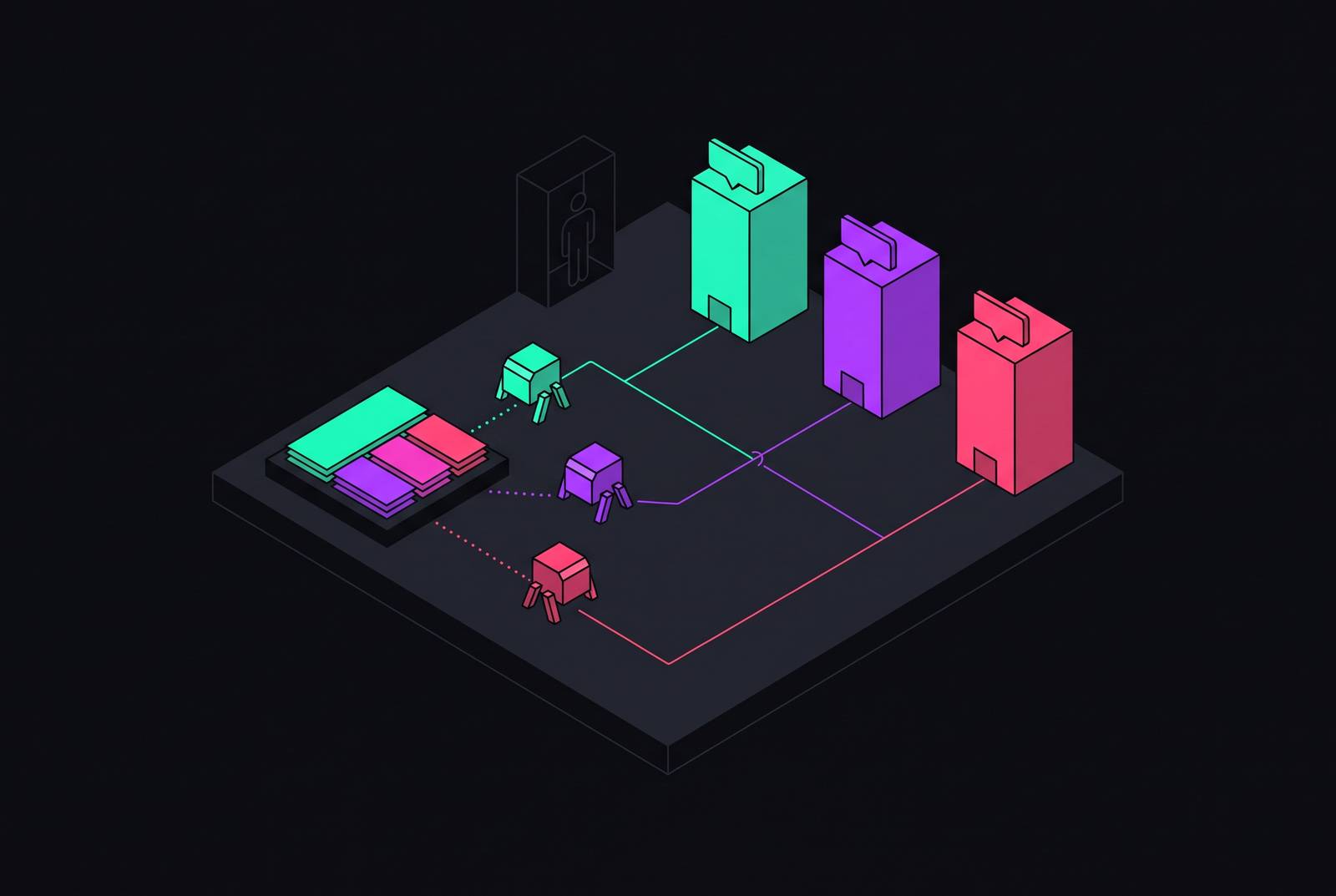
To detect AI agents on a website, examine request logs, distinguish personal agents from crawlers, and verify identity claims against published signatures, user-agent tokens and IP ranges. The requested pages show what content they accessed, but identifying the buyer requires a separate attribution layer. Connecting verified visits to named accounts and routing that evidence into sales workflows gives teams a head start that human-session tracking alone cannot provide.
Why AI agents now arrive at B2B websites before any human buyer does
A sales team usually understands a website visit as a person opening pages, comparing options and leaving engagement signals. A personal AI agent breaks that assumption. It executes a task for a specific human rather than browsing as that human or building an index for a search engine. The buyer can thus start looking into a supplier without visiting its website in person.
That distinction changes the sequence of commercial research. When a buyer delegates a task, the agent can reach pricing, comparison or demo pages before the buyer opens them. The request belongs to a real research process, even though the visitor is software. Personal agents are consequently a separate visitor class. Their defining feature is the human directive behind the visit.
Why these visits are invisible to standard session analytics and most identification tools
Standard analytics and visitor identification systems depend on signals that personal agents may never produce. Google Analytics and similar tools rely on pageview events and other engagement signals to record activity. An automated request that does not fire those events may never appear as a session. The page was accessed, but the session is absent.
Identification tools face a related classification problem. Filters built around referrer strings, engagement or corporate IP ranges can discard agent visits or fold them into unattributed traffic. Personal agents also identify themselves inconsistently, using user-agent tokens, cryptographic signatures or no declared signal at all. A single detection rule leaves substantial gaps.
These gaps distort interpretation as well as counts. GPTBot and ClaudeBot are training crawlers, while ChatGPT-User and OAI-SearchBot belong to the search and live-retrieval class. Neither class should automatically be treated as a personal assistant acting for an identifiable buyer. Combining them produces an AI traffic total with no stable commercial meaning.
How can you tell if AI agents are visiting your website?
Request logs provide the starting point because they expose requests that session analytics may miss. The requested pages establish which content an apparent agent accessed. User-agent tokens can then point to possible agents, including Muse, Grok Bot, Hark and Google-Agent. A token is only an identity claim. Reliable detection checks that claim against the operator’s published signals.
Cryptographic verification provides a stronger basis for classification. OpenAI’s cloud-browser allowlisting guide specifies Signature, Signature-Input and Signature-Agent headers for dots cloud-browser requests. Grok Bot and Hark also sign requests, with Hark using Ed25519 Web Bot Auth. Cloudflare, Akamai, HUMAN, AWS WAF and Vercel verify several agents automatically. Published IP ranges provide another check where the operator supplies them, although cloud-browser signing should not be assumed to cover sessions running on a user’s own computer.
Some agents provide no reliable identity claim. Instinct documents no user-agent token, signature or IP ranges, leaving behavioral heuristics or an explicit finding that reliable detection is not possible. Evidence from behavior should be kept separate from verified identity. For most businesses, the purpose is to let agents finish their tasks while recording trustworthy evidence. Verification establishes the agent operator and enables downstream attribution, but it does not necessarily reveal the buyer.
What an AI agent visit actually signals about buying intent
A personal agent on a high-intent page indicates that someone has formed enough interest to delegate research. That can be stronger evidence than an anonymous human session, which may reflect casual browsing. Delegation gives the visit a concrete purpose. The commercial inference comes from the task and its destination.
An agent reading pricing or comparison pages presents a different signal from one retrieving a blog post. The same page-scoring logic used for human visits applies, with less reason to assume that a task-driven visit was accidental. Meta Muse’s approval requirement for sensitive actions, including signing in or making a purchase, also distinguishes decision support from the human’s final authorization. Agent activity can show that a buyer is moving toward a decision without proving that they are about to buy.
A verified pricing-page visit can be worth a look even when it gives sales no account to contact. Attribution must bridge that gap without converting evidence of interest into an unsupported claim about identity.
Attributing a verified agent visit to a named account and an individual buyer
Account attribution requires three layers of evidence. Verified agent identity establishes the service making the request, network-level resolution identifies the infrastructure it came from, and person-level enrichment seeks the human behind the activity. These layers answer different questions about the visitor. Treating any one of them as a substitute for the others creates false certainty.
Network resolution is especially easy to misread. Agents running through dots cloud computers, Muse Secure VM or Grok Bot on hosted computers originate from the agent operator’s infrastructure. A reverse-IP lookup can therefore identify the AI company. A valid cryptographic signature authenticates the agent operator.
A prior human identification can provide an anchor. Where an attribution architecture can associate an agent’s subsequent activity with an existing identity record, a cookie, prior form fill or CRM-matched session can connect that activity to a named account. The association is the necessary link. Merely having a known contact and an agent visit in the same dataset does not establish that the contact sent the agent.
Without a prior human session, attribution is probabilistic. Target pages, timing and available account signals, including a domain, referrer chain or ad click path, can narrow the candidate account. Person-level enrichment against an identity graph can then infer a likely buyer’s identity. Company-level attribution gives sales an account to look into, while person-level attribution gives them someone they might contact without a separate cold-enrichment step. The record’s confidence should reflect which route produced it.
Why match rate accuracy matters more for AI agent attribution than for human session identification
A tool that counts an identified agent operator as an identified human visitor overstates what sales can use. Including agents and crawlers in the denominator also makes its rate incomparable with a tool that filters them first. Classification must precede any useful comparison of rates. Company-level identification and person-level identification need separate baselines because company matches are much more common in B2B traffic.
The practical test is a parallel evaluation on a pricing or demo page over a defined period. Identified sessions can be compared with an independent analytics source, followed by an audit of agent records in the identified set. Because session analytics may omit automated requests, that comparison needs the earlier request-level classification to remain interpretable.
How to route AI agent attribution into sales workflows before a rep makes first contact
An attributed visit loses its timing advantage if it waits unread in a dashboard. The operational trigger should be verified agent attribution to a named account. Webhooks or CRM events can deliver that signal to the responsible owner as it occurs. Speed alone is not enough to make it useful. The routed record must preserve the evidence that makes the account worth attention.
That record should include the account and, where available, the person’s name, title, LinkedIn profile and business email. It should also identify the agent and preserve the sequence of pages accessed. Available ad or traffic-source information connects the research to Google, Meta or LinkedIn campaigns. CRM status distinguishes prospects from existing customers and supports ownership decisions, while an ICP fit flag helps the rep prioritize.
Where tools support agent-sourced records, person.identified and person.activity events can route those records to sales. These interfaces are useful only if the underlying record distinguishes verified agent identity from inferred buyer identity.
The buyer has not necessarily appeared personally, so the rep should not refer to detected browsing or disclose agent monitoring. The recommended approach is a value-first note within the day, grounded in the company’s known interests. Browsing should not be mentioned before the buyer confirms who they are.
What the tool landscape looks like for teams trying to act on AI agent attribution today
There are fewer independent visitor identification tools to choose from in 2026. Salesforce completed its acquisition of Qualified on April 1, 2026, Warmly was acquired by HubSpot on June 30, 2026, and Koala shut down in September 2026. Those changes affect the choices available to teams seeking CRM-agnostic identification. They do not establish any product’s detection accuracy. Evaluation still needs to separate request verification, account resolution, person identification and workflow delivery.
For request verification, Cloudflare, Akamai, HUMAN, AWS WAF and Vercel are relevant because they automatically verify several agents. Their role is distinct from buyer enrichment. Lead Forensics is built for enterprise and mid-market corporate traffic, but its identification is weaker on residential, SMB and remote-worker traffic, and it has no documented personal-agent detection layer. RB2B offers US-only person-level identification and real-time Slack and Teams alerts with LinkedIn profiles, but no documented personal-agent detection. Its free tier was discontinued, with paid plans starting at $79/month.
6sense covers a wider range of enterprise account-engagement needs. Its capabilities include AI-driven intent scoring across the web and CRM and marketing automation integrations, with enterprise-contract pricing. That scope should be evaluated on its merits rather than treated as proof of personal-agent attribution. The decisive questions remain whether a candidate separates automated from human traffic, detects personal agents rather than only crawlers, and exposes attributed records through an API or webhook.
Person-level tools also warrant examination at the event level. A full journey may include page views, clicks, scroll depth, video plays and exit intent, but human engagement coverage does not establish agent detection. Explicit personal-agent classification, ad-source attribution to named individuals and usable CRM delivery are separate requirements. A 14-day test on a high-intent page can check those claims in practice. A tool must keep agent records separate from human matches for its results to be compared fairly.
Building an ongoing practice around AI agent visits as an early-warning signal
A weekly review should surface accounts where agents visited but no human session followed, particularly where no rep has engaged. The review should keep clear what is unknown about the person and which pages made the account worth a look.
Matching attributed agent visits to campaigns behind prior human sessions can reveal paid acquisition followed by delegated research. An agent visit associated with a cold CRM account can also trigger re-engagement, with the page sequence routed to its owner. Both uses depend on a defensible attribution link. Neither benefits from treating every automated request as a new lead.
As agent traffic grows, choosing which visits to flag matters more than how many alerts are sent. ICP fit, high-intent pages and a named-account match should guide which records go into sales workflows. Teams that use those filters every time can reach buyers while competitors are still waiting for human sessions they recognize. The standing practice is to review the evidence, preserve attribution confidence and route qualifying activity promptly to the account owner.