Your Analytics Call It Bot Traffic but Here Is How to Confirm It Is an AI Agent
Confirm AI agents with IP, network, browser, and behavior checks.
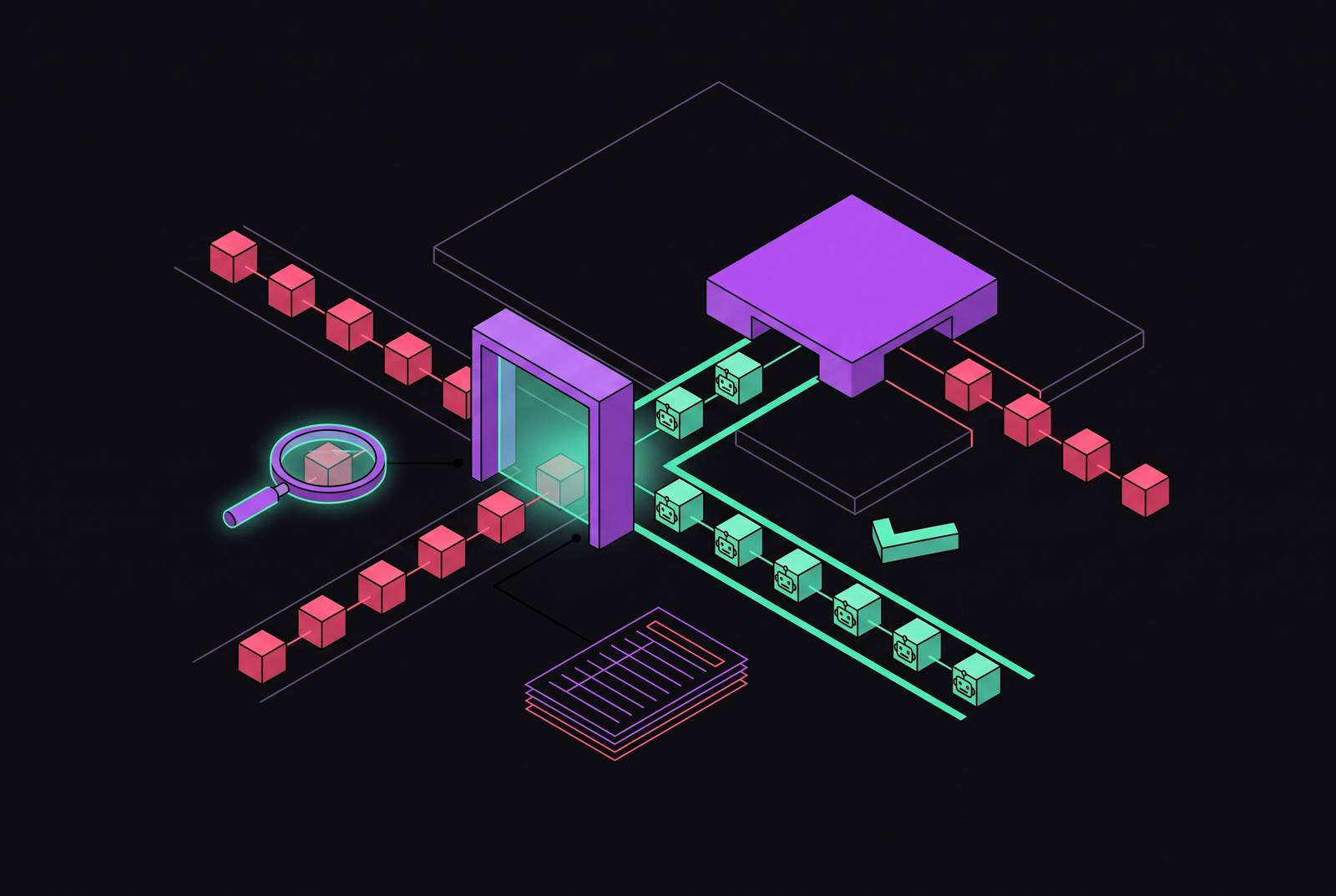
To detect AI agents on a website, use user-agent strings only to sort candidates, then confirm them through IP verification, network signals, browser artifacts, and behavioral scoring. The verification path depends on whether the traffic comes from a training crawler, search indexer, user-triggered fetcher, or agentic browser. Preserve that classification and enrich it with operator identity where possible.
Why standard analytics cannot tell you what kind of automated traffic just visited your site
Standard analytics misses AI traffic in two directions. Training crawlers such as GPTBot and ClaudeBot never execute JavaScript, so their visits never fire the analytics snippet and produce zero rows in GA4, PostHog, or Amplitude. Agentic browsers, however, run real Chromium instances and execute JavaScript fully. Their sessions can look human, so GA4 counts them as real users. The same dashboard therefore undercounts automated visits while overstating human activity.
DataDome's AI traffic report detected 52.7 billion AI agent and LLM crawler requests across its customer base between July 2025 and June 2026. The sharpest acceleration came in the final four months. Yet the number of requests alone does not explain what they are for, and a generic bot label cannot tell content collection apart from an assistant fetching a page for someone. Those purposes require different responses. The appropriate next step is a confirmation process.
The four distinct types of AI agent traffic and why each one behaves differently
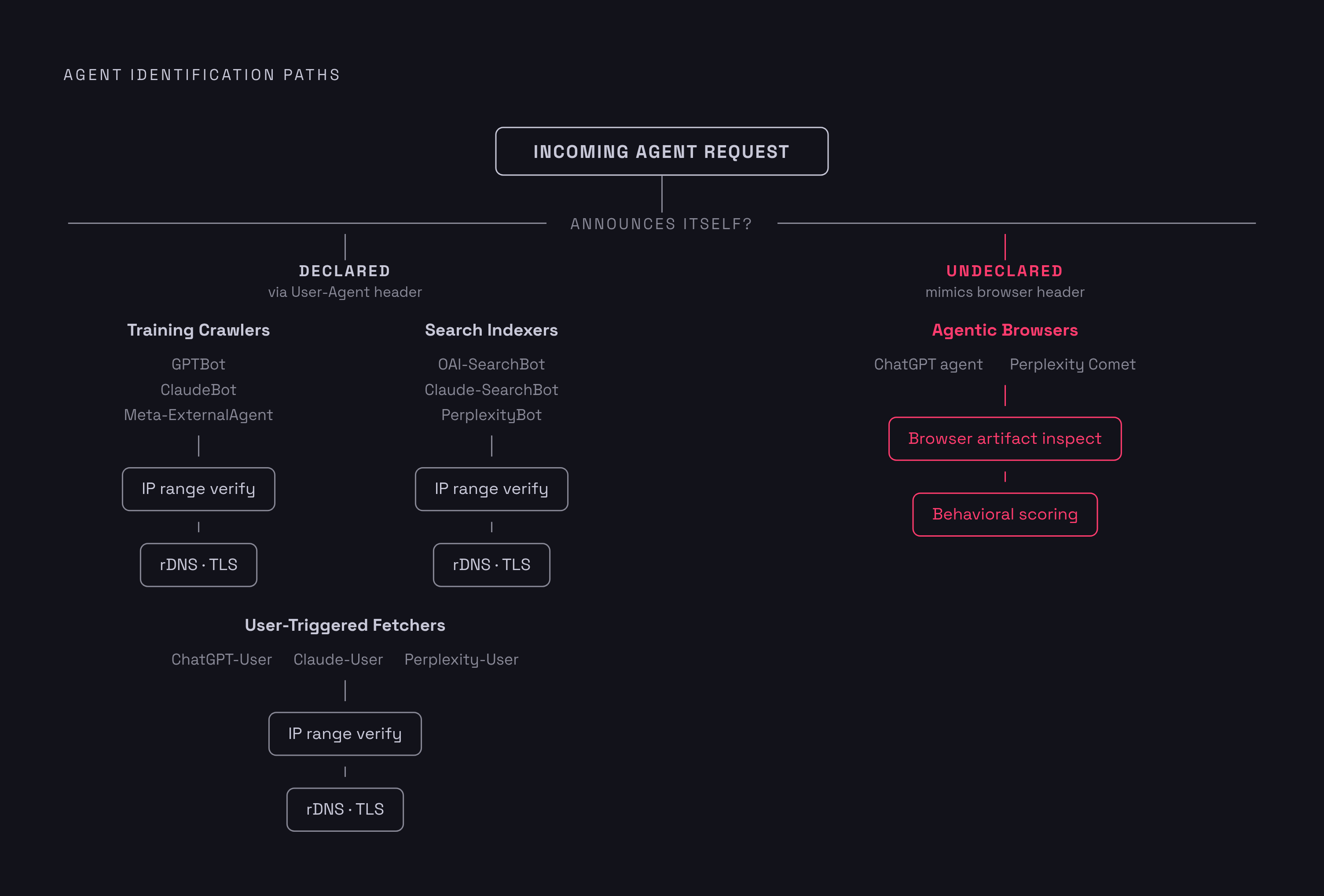
Training crawlers fetch HTML in bulk to use in model training. GPTBot from OpenAI, ClaudeBot from Anthropic, and Meta-ExternalAgent from Meta declare themselves through user-agent strings and respect robots.txt. They return almost no human traffic to the pages they visit. Search indexers serve a different purpose. OAI-SearchBot, Claude-SearchBot, and PerplexityBot build the indexes assistants search when answering questions, so blocking them removes a site from those assistants' answers.
User-triggered fetchers get pages when a person asks for them. ChatGPT-User, Claude-User, and Perplexity-User belong to this category. The initiating person changes the policy context. OpenAI and Perplexity state that robots.txt rules may not apply because a person initiated the request. These fetchers still require identity verification, but treating them as bulk training crawlers erases the distinction between background collection and live research.
Agentic browsers drive a real browser to find products, fill forms, or book something. Some run in a vendor's cloud, as ChatGPT's agent does, while Perplexity Comet runs on the user's machine. Comet uses an ordinary Chromium-based user-agent and has no documented unique identifier or IP range file. Declared crawlers, indexers, and fetchers can therefore follow an IP-verification path, while an on-device agentic browser requires evidence from its runtime and behavior.
Why user-agent strings cannot serve as proof of identity for any of these four types
A user-agent string is a claim. It is cheap to fake, which makes any allowlist based on that field alone an easy bypass. Prosopo's analysis of requests to its own site between 5 and 18 October 2026 found that more than half of requests presenting AI user-agent strings were spoofed. For xAI, Cohere, Mistral, and Google-Extended, every presenting request in that analysis came from a spoofer. Google states that Google-Extended has no user-agent of its own, so a request presenting that identity is fake by definition.
Comet can send no AI identifier and still act on someone's behalf through a real browser. A policy that rejects undeclared traffic also risks excluding legitimate agent-assisted visits. The user-agent string can help narrow what to check, but it cannot on its own show whether to grant or deny access.
Layer 1 and Layer 2 — confirming declared agents through IP ranges and network signals
Layer 1 tests a declared identity against its published network origin. The source IP must match the vendor's current range file for the claimed agent. OpenAI publishes GPTBot ranges at openai.com/gptbot.json, OAI-SearchBot ranges at openai.com/searchbot.json, and ChatGPT-User ranges at openai.com/chatgpt-user.json. Each file serves a different declared identity. A request claiming to be GPTBot from outside its current published ranges does not pass that identity check.
Anthropic publishes the ranges for ClaudeBot, Claude-SearchBot, and Claude-User at claude.com/crawling/bots.json. Perplexity publishes PerplexityBot ranges at perplexity.com/perplexitybot.json and Perplexity-User ranges at www.perplexity.ai/perplexity-user.json. DuckAssistBot uses duckduckgo.com/duckassistbot.json. These are working references that change over time. The ChatGPT-User file was regenerated on 27 October 2026, and the Perplexity-User file on 28 October 2026, which makes regular refresh part of verification.
Layer 2 adds network evidence to the identity match. For vendors supporting reverse DNS verification, the process resolves the source IP to a hostname, checks the vendor domain, and resolves that hostname back to the same IP. Google describes how to do this with domains ending in googlebot.com, google.com, or googleusercontent.com. Data-center ASNs from AWS, GCP, or Azure suggest automation, while JA3/JA4 TLS fingerprints can expose a claimed Chrome session whose handshake resembles a Python script.
Cryptographic verification is another way to check declared cloud agents. OpenAI's ChatGPT agent uses HTTP Message Signatures, with keys published at chatgpt.com/.well-known/http-message-signatures-directory. A valid signature identifies the agent independently of its current IP range, avoiding the specific weakness of stale address lists. That does not solve the on-device case. Comet declares no unique identity and uses the user's machine, so IP and network checks alone cannot distinguish it from ordinary browsing.
Layer 3 and Layer 4 — detecting agentic browsers through runtime artifacts and behavioral signals
Layer 3 examines the browser environment for automation artifacts. Playwright and Puppeteer control browsers primarily through the Chrome DevTools Protocol, while Puppeteer also supports WebDriver BiDi. Such automation can leave runtime traces, including the cdc_ prefix in window objects. Environment checks also inspect inconsistent navigator properties, absent or anomalous viewport dimensions, and unusual timing of DOM reads. The useful evidence is a cluster of inconsistencies.
Layer 4 tests whether the interactions fit human behavior. Human mouse paths are non-deterministic and follow movements a person could make, while an agent may navigate too regularly or in bursts that do not fit how people read. Form-fill speed and keystroke cadence can fall outside human ranges. Many agent sessions also omit scrolling before a content query. Behavioral scoring is therefore necessary when a browser looks ordinary but its actions do not resemble a person using it.
Account age, payment provenance, and behavioral consistency across sessions can remain useful when browser checks are spoofed. No single layer covers every agent type. The practical response is to score the available evidence across the four layers and send low-confidence sessions to a challenge. Detection requires active browser and behavioral engineering because a classified visit can reveal activity worth preserving.
How can you tell which AI bots visit your website and what content they read?
A confirmed ChatGPT-User visit means a person asked ChatGPT something that required the assistant to fetch the page, making the visit a content-consumption signal tied to that person's research. It does not, by itself, establish that person's identity or exact question. The distinction keeps enrichment grounded in what the request actually proves.
A confirmed ClaudeBot visit has a different interpretation. It identifies content collection for model training and informs robots.txt policy, while the separate search-indexer classification informs decisions about presence in assistant answers. An agentic browser visit shows that an agent is acting for someone and may use forms, follow navigation flows, or make transactions. These differences extend beyond analytics reporting. A generic exclusion bucket loses them when it removes all automated sessions from view.
Identifying the company or individual operating an agent distinguishes an enterprise agent researching a pricing page from a training crawler collecting blog content. Human visitor identification and AI agent detection work together here because knowing which software is at work differs from knowing the person or company behind its task. The requested content supplies the remaining context. Preserving identity, type, operator where available, and content consumption makes the visit usable for both access policy and go-to-market analysis.
Applying the confirmation process — a session-level decision sequence from suspicious to verified
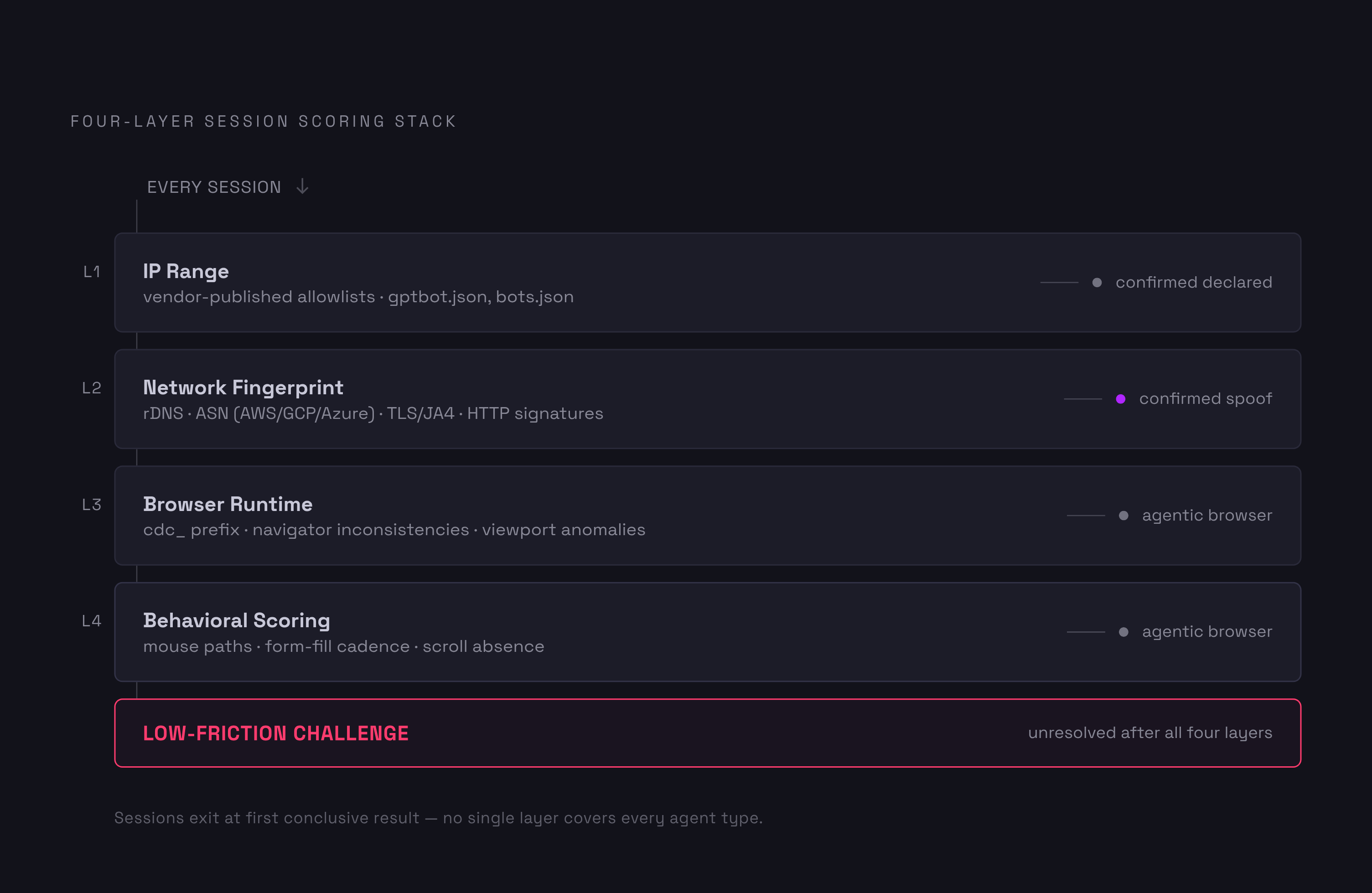
First, inspect the user-agent string for a declared AI identity. A declaration creates a verification candidate. If the string declares nothing, keep the agentic-browser path open rather than recording the session as human by default. That path needs evidence from the browser and its behavior even when the network origin looks ordinary.
For a declared candidate, compare the source IP with the current range file for that specific identity. A matching address and user-agent establish the confirmed-declared classification, subject to checking for contradictory network evidence. A mismatch flags a spoof candidate. The freshness of the file is essential to that decision, because an obsolete copy weakens the comparison. Next, use supported reverse DNS checks, ASN context, and TLS fingerprints to corroborate the origin or expose an inconsistency.
For undeclared traffic, a data-center ASN can suggest automation, but it does not identify an AI operator on its own. The next step inspects browser artifacts, navigator properties, viewport anomalies, and timing inconsistencies. Behavioral scoring then checks whether mouse paths, navigation timing, form-fill cadence, and scrolling fit how people act. Sessions that look ordinary at the browser layer but fail behavioral scoring are still strong agentic-browser candidates.
The resulting classification determines the response to the visit. A confirmed declared agent is recorded by type and operator, then handled under the relevant robots.txt or allowlist policy and routed to the appropriate team. A confirmed spoof is treated as adversarial and receives no robots.txt exemption implied by its false identity. Sufficient runtime or behavioral evidence supports an agentic-browser classification, followed by task-access policy and operator enrichment where possible. Evidence of automation alone does not establish a named vendor or operator.
For unresolved sessions, a low-friction challenge preserves a path for legitimate traffic while surfacing sessions that cannot respond. Server log analysis, a CDN bot management layer, or a dedicated AI agent detection platform can carry out these steps. A dedicated platform's value lies in automating multi-layer scoring and producing enriched records. The relevant capability is the complete confirmation process.
Applied consistently, this workflow produces a classified record of which AI systems request which content and, where enrichment succeeds, on whose behalf. That record helps guide choices about robots.txt, access control, and which tasks to allow. It also distinguishes companies sending agents to research a site from vendors collecting content in bulk. Teams can use that distinction for go-to-market action without treating every automated request as buyer intent. The practical gain is a defensible record of visits that a catch-all bot bucket would otherwise discard.