How ChatGPT Crawls B2B Websites Before Answering Buyer Questions
Three separate OpenAI crawlers now drive more traffic than Google, reshaping B2B visibility.
ChatGPT does not send out a single crawler to read the web when it answers buyer questions. It runs three separate agents, and each one has its own job, its own robots.txt directive, and its own consequence for a B2B site that gets the distinction wrong. A marketer who blocks GPTBot thinking the site is now protected from AI has done something entirely different from a marketer who blocks OAI-SearchBot: one trims a training set, the other erases the site from ChatGPT's cited answers. The rest of this piece works through what each agent does, how much of the web they now cover, and what a B2B team has to get right, structurally and technically, to show up where buyers are already building their shortlists.
How ChatGPT's crawl infrastructure works: three agents, three jobs
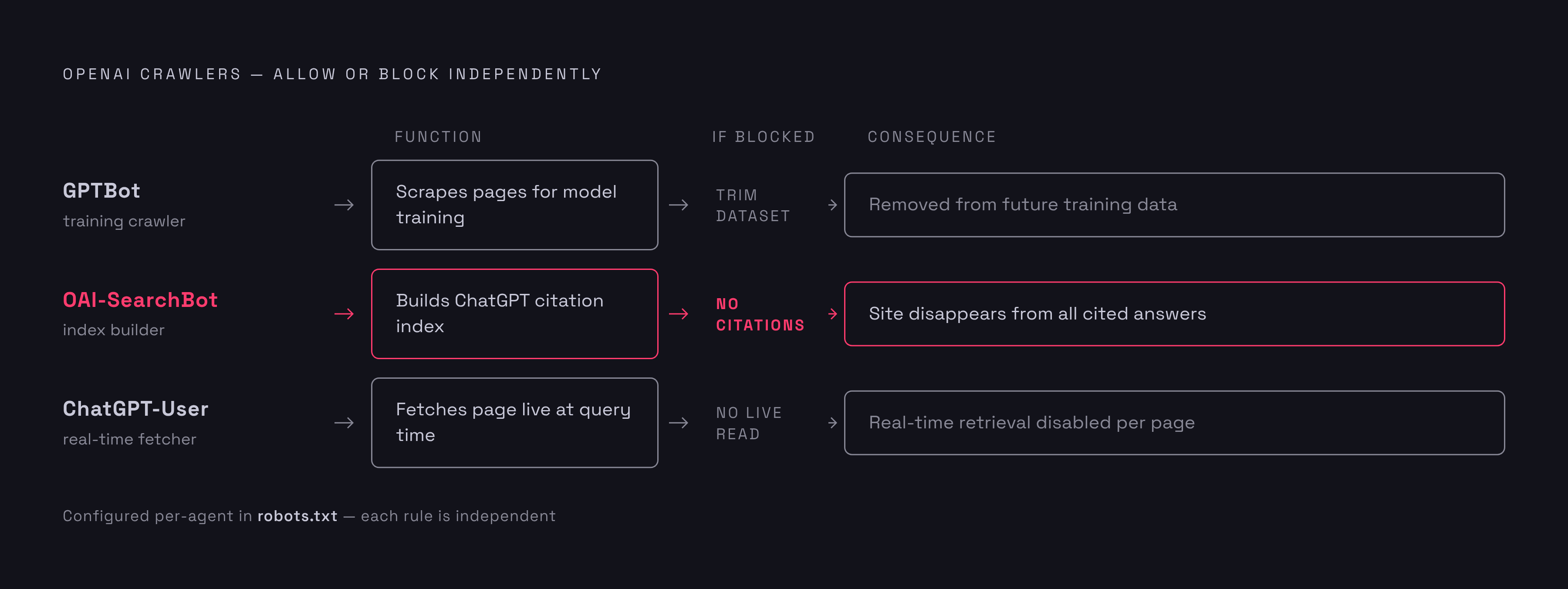
OpenAI operates three crawlers, and they do not overlap in function. GPTBot is the training crawler. OAI-SearchBot does something different: it builds the search index ChatGPT reads from when it answers a query with a cited link. Blocking OAI-SearchBot does not just trim training data. It removes a site from ChatGPT's search answers entirely, full stop on citation, not a partial degradation. ChatGPT-User is the third agent, and it works in real time: it fetches a specific page the moment a user's question needs current web information, or the moment someone pastes a URL directly into a chat.
Each of these three agents can be allowed or blocked independently in robots.txt, and most B2B teams never account for that independence. Treating these three agents as one undifferentiated threat produces exactly the opposite of what most teams think they're doing when they configure bot access.
ChatGPT-User's crawl footprint relative to traditional search bots
This three-agent system is now the largest source of automated traffic hitting most B2B servers, and AI crawler policy has become the highest-volume infrastructure decision most B2B teams have never made on purpose. An analysis of proxy requests across tens of thousands of pages on dozens of websites between January and March 2026 found that ChatGPT-User alone made several times more requests than Googlebot, and GPTBot's volume was counted entirely separately on top of that. Combine the two OpenAI crawlers and their total request volume ran well over three times Googlebot's across the same dataset.
The scale kept climbing through the second quarter of 2026. Bots generated the majority of HTML web traffic that month. None of this is a forecast. It is the current baseline load on B2B servers right now, and the practical question for any site owner is not whether to prepare for this shift but how to respond to a decision already made for them by the agents already crawling.
How the crawl becomes a buyer answer
Knowing how much crawling happens only matters once it connects to what a buyer actually sees in a chat window. ChatGPT-User fetches pages live to answer questions that need current information, and this is the agent that decides whether a site's content shows up in ChatGPT's answers with a cited link attached. GPTBot works upstream of that moment: it feeds model training and shapes the background knowledge ChatGPT draws on when it answers without doing a live fetch at all, a separate route to influencing what gets named on a shortlist.
Because training and citation run as separate pipelines, a site can get crawled heavily and never appear in a cited answer, and a site can get cited often even as the live fetch volume against it drops. Second-quarter 2026 data showed exactly that pattern: ChatGPT-User's request volume fell even as ChatGPT referral traffic grew, which points to the index doing more of the work over time, fewer live fetches producing more cited answers pulled from what's already indexed.
Most B2B teams have never diagnosed it, but JavaScript creates a blind spot in this system. The test for this is fast: disable JavaScript in a browser and reload the page. If the product catalog disappears, that page is invisible to the answer engine for the identical reason.
Even on pages that do render server-side, structure can still compound the problem. A language model cites what it can lift cleanly, a product name, a price, a spec, something it can quote with confidence. Markup with no labels, no schema, no clear fields gives the model nothing to pull from, even when the content is technically present in the HTML.
Why the crawl-to-refer ratio reveals what most B2B analytics miss entirely
A useful number for understanding what AI crawlers actually do is the crawl-to-refer ratio: pages fetched divided by referral visits sent back to the site. It exposes a real asymmetry between what these agents take and what they visibly return, and OpenAI's ratio is toward the extractive end.
The ratio traces back to product design. An additional sliver came from what Cloudflare classified as "User Action" crawls, bringing referral-capable traffic to just over a tenth of total AI crawler activity combined.
Most B2B marketing teams do not track AI crawlers as a distinct category in their analytics at all, so the single largest contributor to their server logs goes unmeasured, though that does not mean the crawling is wasted. Most of the value AI crawling generates appears in shortlist influence rather than in a line item on a referral report, and the ratio reflects a measurement gap as much as a verdict on where the value actually lands.
How AI-driven pipeline disappears inside "Direct" traffic
That measurement gap turns into a daily operational headache once you follow it into the CRM. AI chatbots do not send referrer headers, so when ChatGPT sends a buyer to a site, that visit registers as direct traffic. The result systematically understates how much pipeline AI influenced while making the source of real deals look like a mystery.
The buying journey makes the gap worse. Sales teams see pipeline arrive from a buyer who says outright that ChatGPT led them to the vendor, while the dashboard beside that conversation shows flat organic traffic for the month.
The signature of this kind of deal is familiar to anyone running demand gen: a buyer books a demo already knowing the product, already having narrowed the field, unable to say precisely where they first heard the name. The buyer's first impression of a vendor forms from the AI's summary of that vendor, not from a site visit, so the entire research window bypasses standard retargeting infrastructure.
The stakes get sharper once you account for how few brands ChatGPT actually names. Landing in the top positions of an AI-generated shortlist carries far more buyer visibility than a bare mention further down.
B2B sites accidentally blocking the agents that would put them on shortlists
A meaningful share of B2B sites are blocking at least one major AI crawler right now, usually through a CDN default or an outdated robots.txt file, and in most cases nobody made that decision on purpose. It's a holdover from 2023 and 2024, when treating any AI bot as a threat was the default security posture across the industry.
Roughly 27% of B2B sites are blocking major AI crawlers at the CDN level without anyone on the marketing or sales team aware it's happening, and a meaningful share of top websites block GPTBot.
The CDN layer sits above robots.txt in the request chain, so if a bot-management toggle gets switched on there, it makes a perfectly written robots.txt irrelevant. Rendering is a third gate that most audits never check: because the majority of AI crawlers cannot execute JavaScript, a site built with client-side rendering serves a blank shell to those crawlers with no explicit block configured anywhere.
A practical audit runs in three steps: check robots.txt for each of the three OpenAI agents by name, check the CDN's bot-management settings for a blanket "AI bots" rule, then load the site with JavaScript disabled and see what's actually present in the raw HTML. Verified bot authentication now makes this a matter of policy rather than an all-or-nothing switch: a site can let verified AI search agents into pricing pages and product specs while still keeping out unverified scrapers.
Content types and structural signals that determine whether ChatGPT quotes a B2B vendor
Access only gets a crawler through the door. What it finds once it's there decides whether a brand gets quoted, and ChatGPT's retrieval agents pull disproportionately from a narrow set of content formats. A site can be fully accessible and still functionally invisible on a shortlist if it's not structured the way these agents read.
Agent-log and crawl-budget analyses consistently show AI answers drawing from "best X" roundups, "X vs Y" comparisons, alternatives pages, integration documentation, pricing transparency pages, category definitions, and FAQ-dense pages, not generic blog posts and not brand storytelling. B2B teams need a citable fact, a product name, a price, a capability, an integration, to sit in the raw HTML returned at first byte. If it only appears after the browser runs JavaScript and paints it into the DOM, the crawler never sees it.
Schema.org markup gives a model machine-readable fields for a product or service that it can quote with confidence. An llms.txt file paired with a clean sitemap works as a machine-readable index telling AI retrieval agents where a site's authoritative content lives, functioning the way robots.txt has always worked for traditional search, except written for this new category of agent.
The gap is sharpest on B2B commerce sites. The test takes two steps. Ask ChatGPT a problem-first question in the relevant category and watch whether the brand appears in the answer. Then you disable JavaScript and check whether that same brand's core content is still there in the raw HTML. Structure is a prerequisite for citation in the same way access is a prerequisite for crawl. Both gates have to be open before a vendor shows up on a shortlist.
Identifying which AI agents visit a site and what they read
Access and structure together are the gate ChatGPT checks before it will cite a site. A separate problem compounds this: most B2B teams have no way to see any of this happening in real time, so there is nothing to optimize, prioritize, or act on from the crawl itself.
AI agents don't fire tracking scripts, don't show up in a GA4 session, and don't leave a standard referrer header, so conventional web analytics never sees them. Thousands of crawlers, including the agents operated by ChatGPT and Claude, visit B2B sites daily, and the entity behind a given agent fetch is often a real company or individual using an AI tool to research vendors on behalf of a buying committee. Detecting which pages a retrieval agent reads, a pricing page, a comparison page, integration documentation, generates a signal about buyer intent that arrives days or weeks ahead of any form fill or CRM entry.
Maverick Intelligence operates at exactly this layer: enriching every site visit, including AI agent visits, with identification at the operator level, so a team can see what content AI systems are consuming and which organizations are running them. So sales and demand-gen get a live view into the dark-funnel research that happens before a buying decision gets made. The capability works both directions at once: identifying human visitors by name, company, title, LinkedIn profile, and email, alongside identifying the AI agents researching on those same buyers' behalf, which together form a single intelligence layer turning what used to be invisible crawl activity into a pipeline signal a revenue team can act on.
Closing the loop: connecting AI-agent crawl signals to CRM records, paid media, and pipeline attribution
Once AI agent visits are identified and enriched, they stop sitting in a server log and start flowing into the CRM and ad-platform workflows revenue teams already run. So dark-funnel activity that used to be invisible becomes an attributed pipeline signal and a retargetable audience.
The CRM side of this runs through a few concrete fields: a normalized acquisition-source field, an AI-source detail field, and lifecycle-stage automation that tags any lead or account flagged as AI-discovered, across HubSpot, Salesforce, and other platforms, so pipeline reporting stops collapsing into an undifferentiated "Direct" bucket. HubSpot also launched CRM connectors for ChatGPT, Anthropic's Claude, Gemini, and Microsoft Copilot, letting customers bring CRM data directly into the AI tools they're already using, which closes the loop between the AI research phase and the records sales teams work from every day.
Retargeting is a harder problem than attribution, because the pixel never fires during the AI research phase. Paid media attribution to identified companies and individuals, rather than anonymous traffic, closes the gap between ad spend and AI-shaped pipeline: when a company's AI agent has already read a pricing page and a retargeted ad later reaches an identified buyer at that same company, the spend traces back to the account it actually influenced.
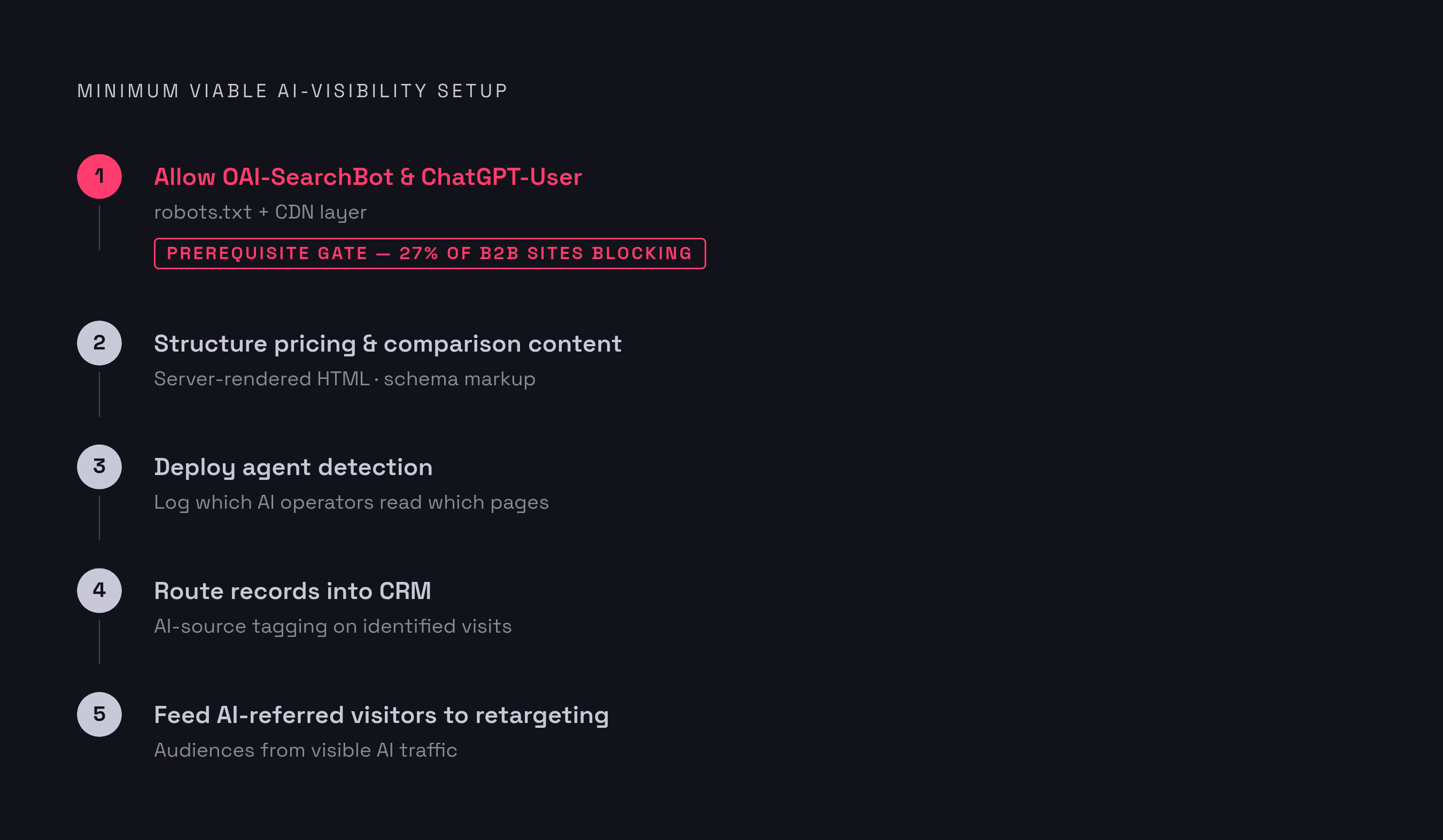
The minimum viable setup for a B2B team working through this today has five parts: allow the retrieval agents, OAI-SearchBot and ChatGPT-User, in robots.txt and at the CDN layer; structure pricing and comparison content in server-rendered HTML with schema markup; deploy agent detection to log which AI operators are reading which pages; route identified records into the CRM with AI-source tagging; and feed the visible tail of AI-referred visitors into retargeting audiences. None of this is a future capability waiting on some new platform release. The stack connects today, with the pieces named above, because the integrations are already live. The B2B teams that map this pipeline now will hold a structural advantage over the ones still measuring AI's influence through a line labeled "Direct."