Server Logs vs GA4 for Detecting AI Agents
Logs catch AI crawlers and GA4 catches clicks, so you need both.
A marketer opens GA4 and a steady stream of sessions arrives from chatgpt.com. A systems administrator opens the server access log and sees hundreds of requests from GPTBot. Both are looking at genuine AI interest in the same website. Neither is looking at the full picture. The reason is not a data-quality problem. It is architectural: each tool is measuring a different layer of reality, and the split between them determines what any team can actually know about how AI systems treat its content.
Why the same website visit looks completely different depending on where you look
The disagreement between GA4 and server logs is not a disagreement. It is a structural consequence of how each tool collects data. GA4 measures visits by executing a JavaScript tag inside a browser. AI crawlers fetch pages server to server. They never run that JavaScript. GA4 records nothing for them, not because the crawlers are hidden, but because the crawlers never enter the environment GA4 observes. The same moment of AI attention therefore produces two completely different signals depending on where one looks: a log entry that never appears in the analytics dashboard, or a referral session that a log analyst dismisses as ordinary human traffic.
The marketer sees chatgpt.com referrals in GA4 and assumes that is the whole AI picture. The systems administrator sees crawler requests in the access logs and assumes none of them sent any traffic downstream. Both are right about what their tool shows. Both are missing roughly half of the observable activity. The diagnostic question is not which tool is better. It is which layer of reality each tool is actually measuring, and what falls between them.
The two hit types that split AI agent activity into two invisible populations
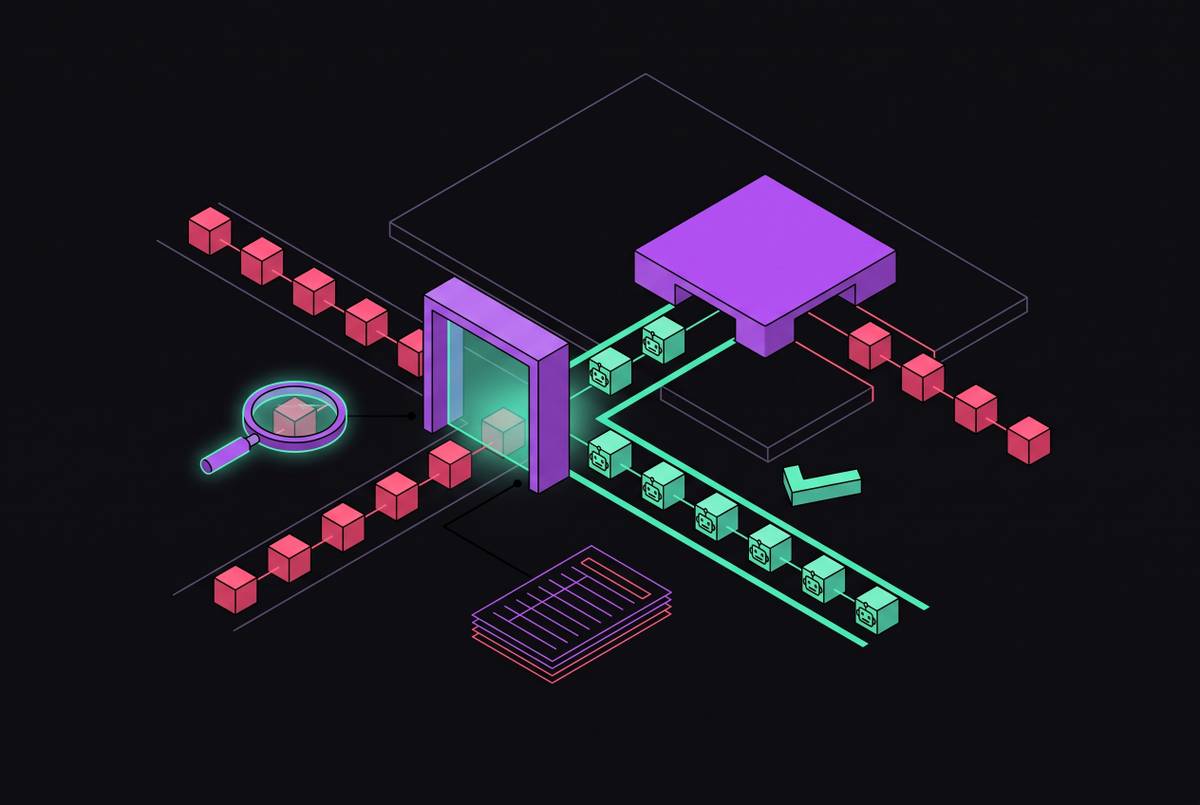
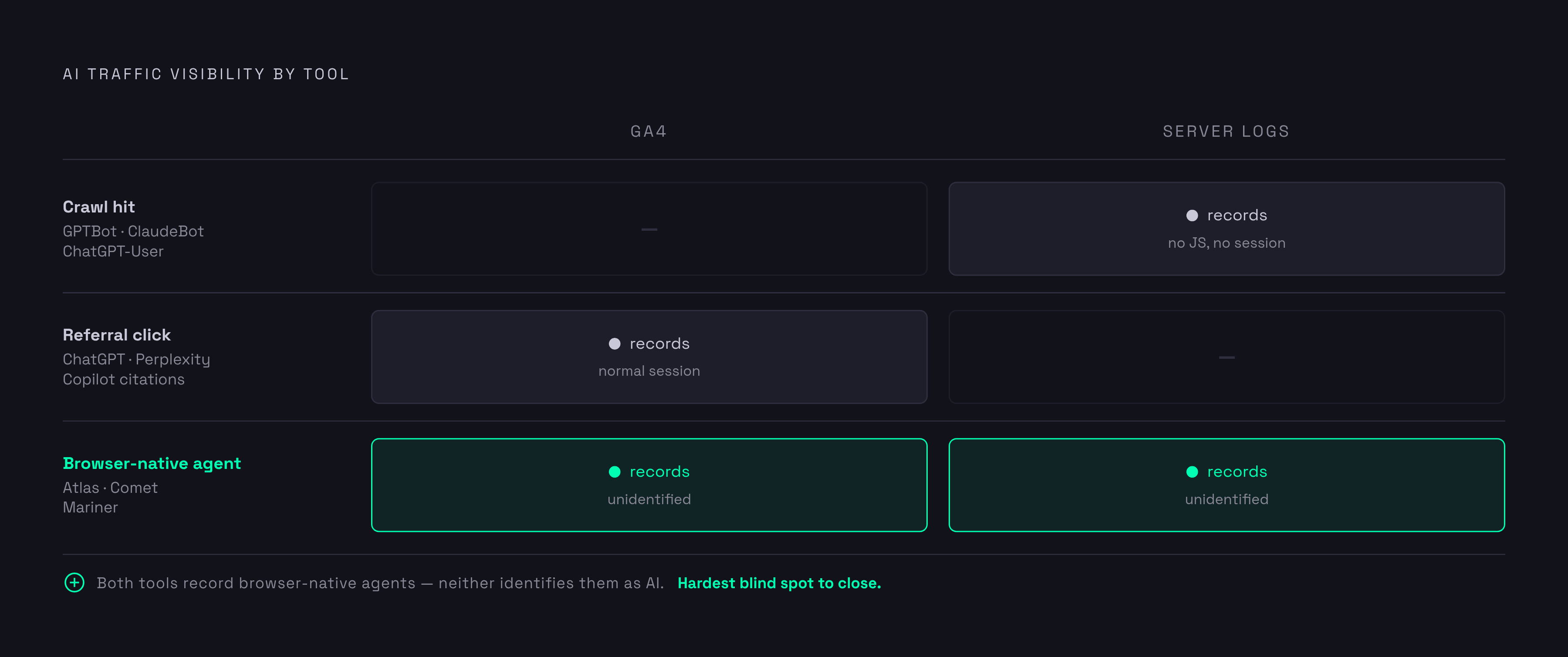
Every AI agent interaction with a website is one of two fundamentally different events, and each event is only visible to one of the two tools. The first is a crawl hit: a bot user agent with no human referrer, the model fetching raw HTML server to server to index the page or answer a question. Only server logs record these. The second is a referral hit: a human user agent with an AI-surface referrer, a person clicking a citation link inside ChatGPT, Perplexity, or Copilot. That click arrives as a normal browser session, and GA4 can see it.
Citeflow's log monitoring guide draws this distinction explicitly. Crawl hits tell you the model has seen the page. Referral hits tell you the citation converted to a click. Logs see both. GA4 sees only the second. Once that mapping is locked in, the complications that follow become comprehensible.
The partial exception that keeps GA4 relevant is worth stating plainly. When a human clicks a link inside a ChatGPT answer, that click carries a chatgpt.com referrer, and GA4 captures it. The referral domains that show up as sessions include chatgpt.com, perplexity.ai, copilot.microsoft.com, gemini.google.com, and claude.ai. This is a narrow but real signal. It means GA4 is not blind to AI-driven traffic entirely. It sees the downstream human consequence of an AI citation. It simply cannot see the upstream crawler event that earned the citation in the first place.
What server logs actually expose about AI crawler behavior, and why the distinction between training and retrieval bots matters
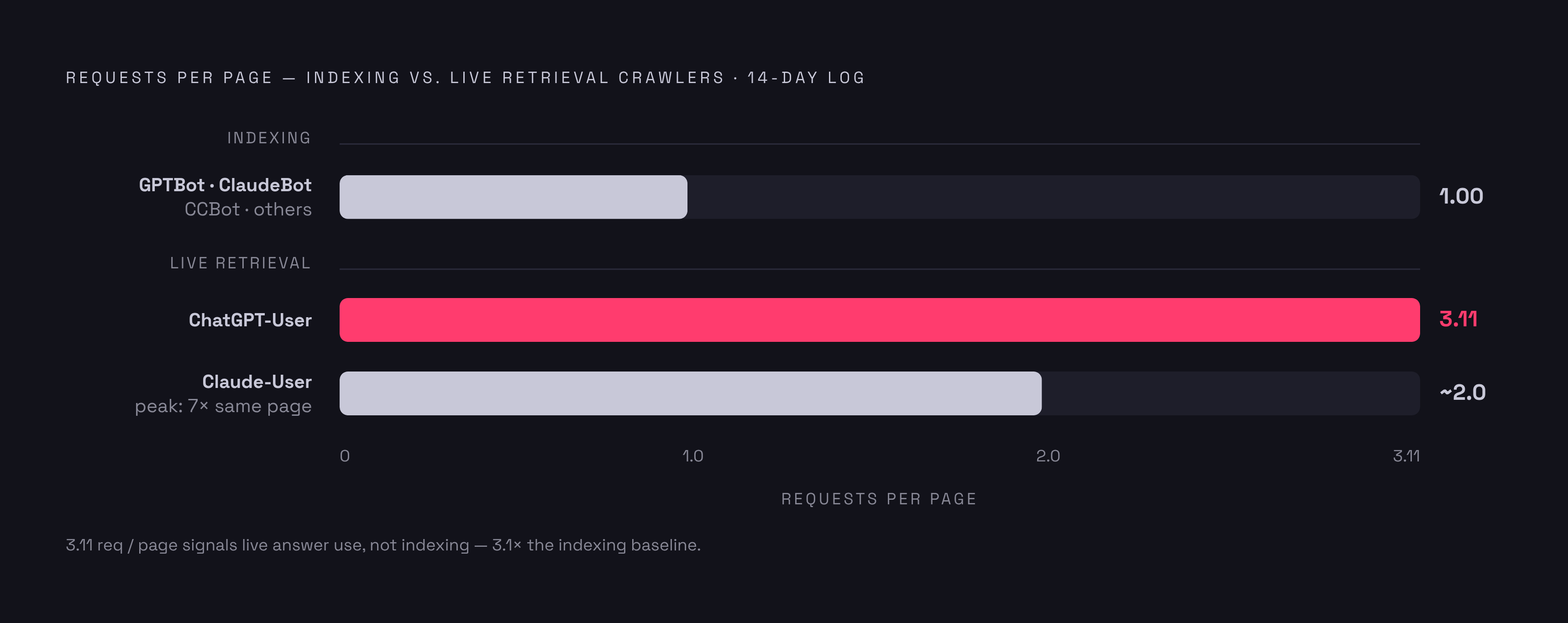
Server logs are the only source that records direct AI crawler access. But the value of that record depends entirely on distinguishing which kind of crawler left it. Training and indexing crawlers include GPTBot, ClaudeBot, CCBot, Amazonbot, PerplexityBot, and Applebot. They sweep broadly, one pass per page, and build or refresh an index. A 14-day log study found these bots hit many distinct pages at about 1.00 requests per page. That is the signature of an indexing sweep.
Live retrieval fetchers behave differently. ChatGPT-User, Claude-User, and Perplexity-User fire when a real user's prompt triggers a real-time fetch. The same 14-day study found ChatGPT-User averaged 3.11 requests per page, and Claude-User returned to the same two pages seven times. That is a demand signal, not an indexing sweep. The requests-per-page ratio in logs is the closest thing a site has to a live readout of which pages AI assistants treat as an authoritative answer to something. GA4 cannot provide this signal at any price. Maverick Intelligence detects and reports both crawl hits and referral hits from AI agents, a dual visibility that neither server logs nor GA4 alone can provide, and it separates the training crawler from the retrieval fetcher rather than collapsing them into one bot count.
Logs also expose failure modes GA4 cannot. A 403, 404, 429, or 5xx response to an AI retrieval system means that system lost access to content. Those failures are invisible inside GA4 because no browser session ever starts. Only the log record shows the difference. If a page gets many ChatGPT-User or Perplexity-User requests but few referral clicks, AI answers cite it but users don't click through. That is a direct content-optimization target, and it only becomes visible when the two streams are joined.
What GA4 actually captures about AI-driven traffic, and where its signal is genuinely useful
After the previous section's emphasis on logs, GA4 deserves its due. Referral sessions from chatgpt.com, perplexity.ai, copilot.microsoft.com, gemini.google.com, and claude.ai are visible in GA4 as ordinary sessions with identifiable sources. A GA4 session says a human clicked a citation and then did something measurable afterward.
The reframe this supports is useful. Logs show what happened before a citation was earned. GA4 also captures utm_source=chatgpt.com tracking when publishers append UTM parameters to links cited in AI answers. This gives campaign-level attribution that logs cannot, because a UTM parameter only works when a browser session begins. For the demand-generation team measuring whether AI search contributes to pipeline, GA4 is not a grudge concession. It is the conversion-measurement layer, and the only one available without building something custom.
The category of AI agent that defeats both tools simultaneously
The two-tool model covers crawl hits and referral hits. It does not cover browser-native agents, which behave like neither. A browser-based AI agent runs in a real Chromium engine, so it executes JavaScript normally. Its user agent often looks like Chrome on Linux, which makes it invisible in log-based bot filters at the same time. Both tools record it. Neither recognizes it as an agent.
As of July 2026, the active field of browser agents includes ChatGPT Atlas, OpenAI's native Chromium-powered browser for macOS launched in fall 2025, with agent mode available to paid tiers. The crawl-hit and referral-hit vocabulary does not cover this category. It is a third population, and it sits directly in the blind spot where both tools overlap.
Why user-agent strings alone cannot verify that a crawler is what it claims to be
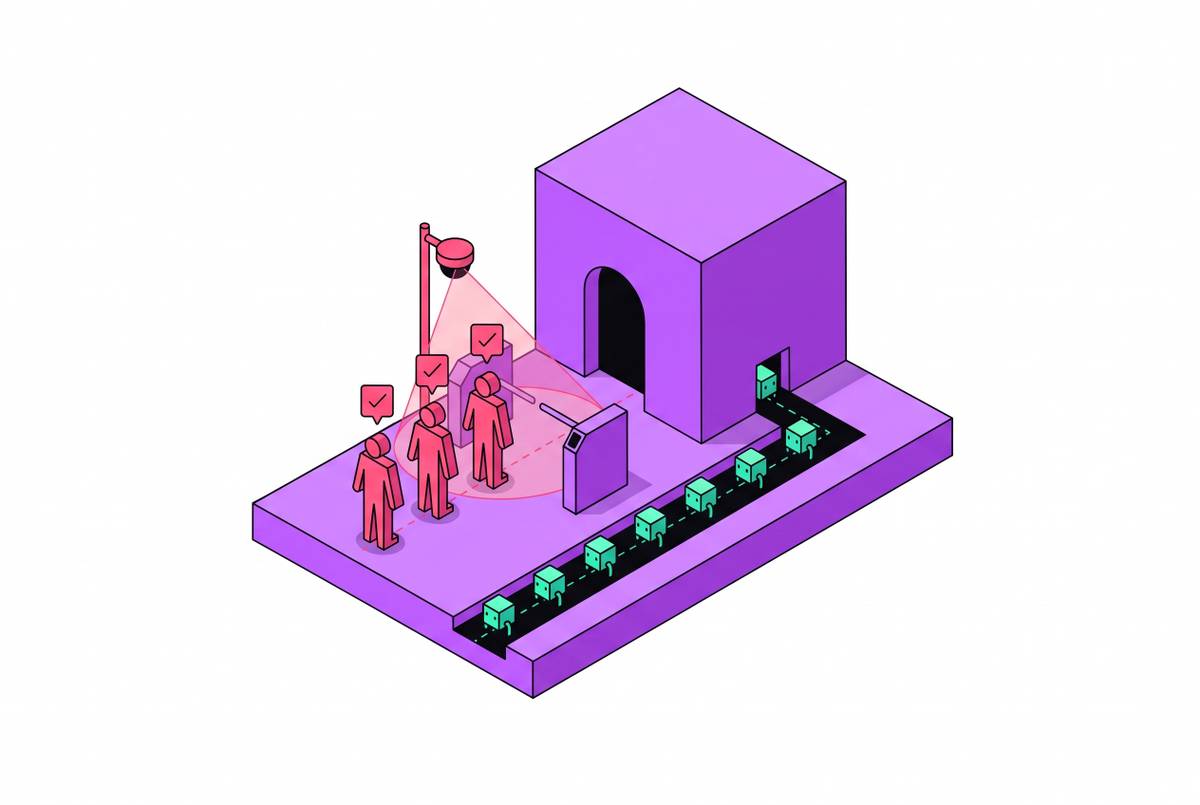
Even when logs do record a crawler, the identity claim in that log line may be false. Any request can claim to be GPTBot, ClaudeBot, or any recognized crawler without originating from that operator's infrastructure. Raw log counts are therefore not a trustworthy picture of AI activity on their own. The count says how many requests carried a user-agent string. It does not say how many came from the operator that string names.
Verification requires cross-referencing the claimed user agent against each operator's published IP ranges or reverse-DNS patterns. OpenAI publishes JSON IP range files for GPTBot, OAI-SearchBot, and ChatGPT-User. Anthropic publishes IP ranges for ClaudeBot. Anything that fails is a scraper or a competitor, not a legitimate AI operator. Multiple behavioral reports describe xAI's Grok retrieval traffic as using datacenter or proxy IP rotation and spoofed Safari or Chrome user agents, making it functionally indistinguishable from a human visitor at the user-agent layer, with no published IP ranges and no robots.txt contract. But until a standard lands, verification stays a manual burden that raw log counts skip.
Building a detection setup from both tools: what each layer contributes and where to connect them
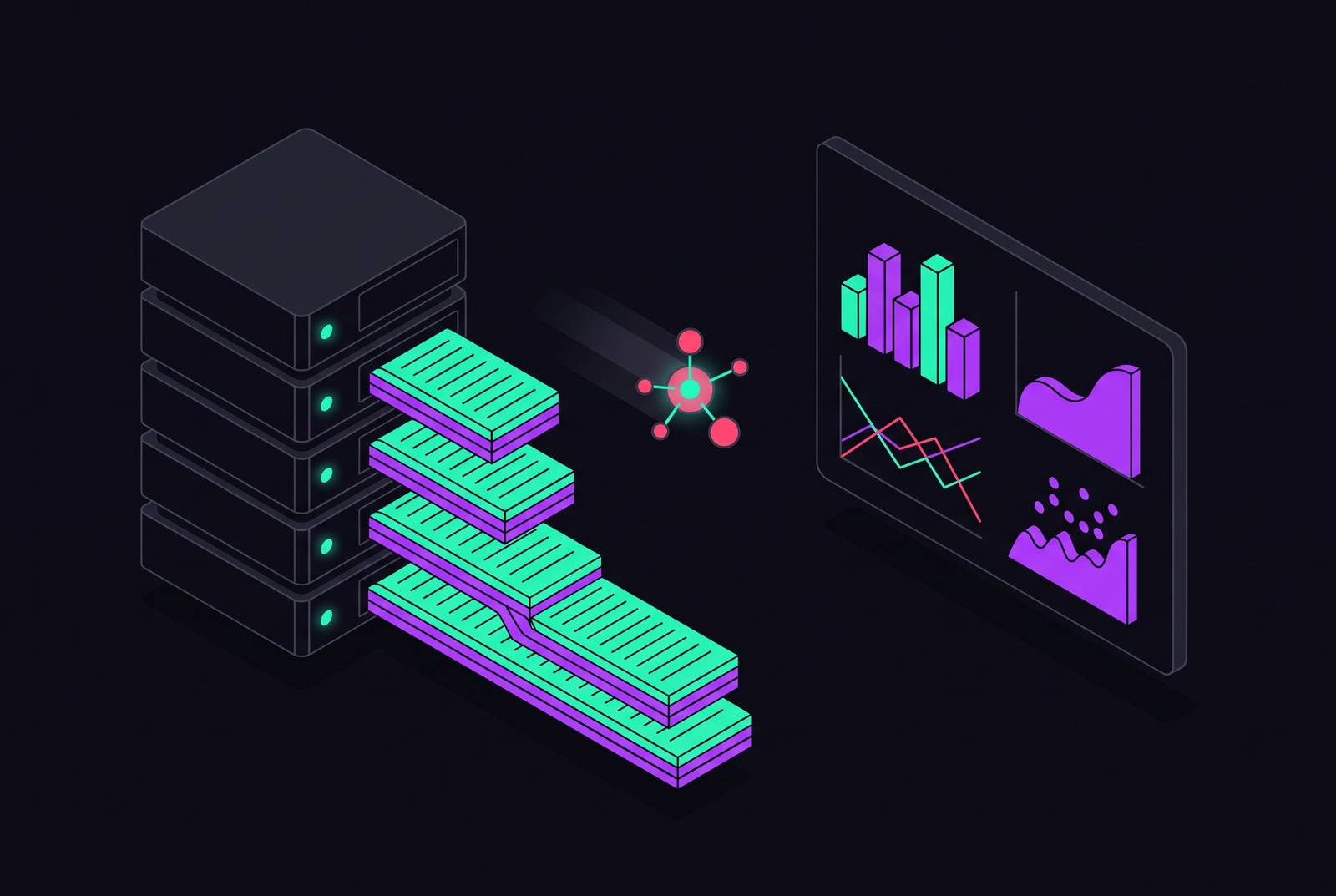
To detect AI agents completely, you need at least three data streams working together. Verified server or CDN log data covers crawler activity. GA4 referral data covers downstream human sessions. A separate layer covers browser-native agents, because neither tool flags them reliably. Each stream answers a different question, and no stream answers all three.
The log-side implementation starts with separating training and indexing crawlers from live retrieval fetchers. Log the Referer header as well, to catch referral hits at the server level. The grep pattern for AI-surface referrers covers chat.openai.com, chatgpt.com, perplexity.ai, gemini.google.com, copilot.microsoft.com, and claude.ai.
The GA4 side builds a dedicated segment or exploration for sessions where source matches the AI referral domains. This is the conversion-measurement layer, not the crawler-detection layer. Append utm_source=chatgpt.com and equivalents to URLs cited in AI answers where possible, to enable campaign-level attribution within GA4. Google Search Console's Generative AI performance report adds page-level AI visibility data you cannot get from logs or GA4 sessions. Pages appearing on both lists are pages AI answers cite but users don't visit. That is a direct content-optimization brief neither tool generates alone.
Where purpose-built AI agent detection fits, and what it adds that log parsing and GA4 cannot
Teams that need to act on AI agent data, not just observe it, require a layer that resolves identities, fires real-time alerts, and connects to the go-to-market tools the team already uses. Neither fires a CRM workflow or identifies the human behind a session. That is the gap a purpose-built platform fills, and Maverick Intelligence is built for exactly this role. It detects and reports AI agents, including ChatGPT, Claude, and thousands of other crawlers, revealing what content they consume and who operates them. At the same time, it identifies human visitors at the person level, with name, company, title, LinkedIn, email, and phone, so the same platform covers both populations.
On the AI agent side, the platform surfaces which crawlers and agents are visiting, which pages they read, and what operator runs them. On the human visitor side, every identified record carries name, title, company, LinkedIn profile, a business email, a do-not-call-filtered phone number, seniority and job function, visit count, an ICP hot-lead flag, CRM status, traffic source, and a full event journey of page views, clicks, scroll depth, video plays, exit intent, and form submissions. It is not a single identification ping.
One positioning stance matters in this context. A visitor-identification match rate that does not separate AI agents and bots from human sessions overstates what a tool actually identifies. For agency teams, partner accounts give each client a tracked domain with its own domain-scoped API key, so the same real-time intelligence is available to in-house sales and demand-gen teams alike.
A practical decision guide: which setup fits which team's situation
The right detection setup depends on two variables. The second is whether the goal is observation or action. These two variables sort most teams into one of four positions, and the architecture follows logically from each.
Log parsing alone is sufficient when the team has engineering access to raw access logs or CDN log streaming, the goal is understanding crawler volume and page-level fetch patterns, and no downstream CRM or ad-platform workflow needs to be triggered. GA4 referral analysis alone is sufficient if you want to understand whether AI citations convert to human visits, measure engagement and goal completion for AI-referred sessions, and attribute paid media spend to AI-channel visitors. That covers the demand-gen team that measures AI search's contribution to pipeline.
Both tools together, connected by the cross-stream page mapping, is the minimum viable setup for any team actively optimizing for AI citation. It reveals which pages are fetched but not clicked, which is the core GEO diagnostic. A purpose-built platform, with Maverick Intelligence among the options, becomes the right call when the team cannot maintain log infrastructure, needs to identify the humans AI citations send alongside the crawlers that earned those citations, or needs to fire CRM and ad-platform workflows automatically when high-intent AI agents or human visitors are detected. The browser-agent detection gap, which covers Atlas, Comet, Mariner, and Cowork, is not addressable by log parsing or GA4 alone regardless of team size. That is the one area where infrastructure-level detection or a purpose-built platform is currently the only option.
The architectural reason each tool sees what it sees is not a limitation to work around. It is the map that tells a team exactly what it is and is not measuring. Once the map is understood, the detection setup follows logically. The action is to audit which of the three data streams the team currently has: logs, GA4 referrals, and browser-agent detection. Most teams have one, some have two, very few have all three. Closing the gaps in order of commercial priority is the entire craft of AI visibility measurement, and the map is what makes the gaps visible at all.