Why Visitor ID Tools Miss AI Agent Traffic
Crawlers vanish and browser agents pose as buyers, skewing your data.

Visitor identification tools miss AI agent traffic because they treat a session as evidence of a human visitor. AI breaks that assumption in opposite ways. Raw HTML crawlers never trigger identification, while browser-based agents enter the pipeline as if they were buyers. Reliable visitor data therefore requires both visibility below JavaScript and classification inside the browser, without discarding real people who arrive through AI referrals.
Why visitor identification tools were built for human sessions only
Visitor identification begins with the assumption that a person opened a browser and visited a page. Company-level identification uses reverse IP lookup to connect the visitor’s IP address to a company and return firmographics. Person-level identification goes further, matching session signals against an identity graph assembled from device IDs, email hashes, ad network signals, and LinkedIn data. Person-level identification aims to return a name, title, and email. Both approaches turn anonymous activity into a record that sales or marketing can interpret as human interest.
In these tag-dependent systems, JavaScript connects the visit to the identification process. The tag captures the session, passes signals into matching, and triggers enrichment. Session analytics then supplies the context for interpreting that match, including which pages the visitor viewed. These systems assume human presence. That premise links every stage of the process, so automation can undermine the result before matching begins or after an apparently successful match.
How automated traffic on the web has changed the composition of what hits a site
DataDome’s AI traffic report tracked tens of billions of AI agent and LLM crawler requests across its customer base between July 2025 and June 2026. The sharpest acceleration came in the final four months. Cloudflare’s analysis puts bot traffic at roughly 30% of global web traffic, exceeding human traffic in some locations. These findings describe different populations, but both establish that automated activity is substantial enough to affect how website traffic is interpreted.
A person researching a purchase might visit five sites, while an agent performing the same task can visit hundreds or thousands. One action by a human can thus lead to orders of magnitude more HTTP requests without any rise in the number of people who might buy. The automated population includes tools that only fetch content and agents that operate inside real browsers, with very different consequences for a system built around JavaScript sessions.
The first failure mode: headless crawlers that never fire the JavaScript tag
Declared AI crawlers such as GPTBot and ClaudeBot request raw HTML, extract content, and leave without executing JavaScript. They do not need to render the page to collect its contents. Consequently, the visitor identification snippet never runs, and no session enters the identity pipeline. The same limitation applies to tag-dependent analytics such as GA4 and PostHog. A request can reach the site without leaving any record in those tools.
Server logs expose activity that the tag cannot see. Declared crawlers say who they are through user-agent strings, which gives operators a place to start when classifying them. A declaration is not proof of identity, however, because that string can be spoofed. Establishing legitimacy requires cross-checking the request IP against the crawler’s officially published IP ranges. Without that step, a crawler label remains an unverified claim.
For a B2B company, the result is a gap between content consumption and measured sessions. Pages may be heavily crawled for AI training or search indexing while the identification platform reports none of that activity. This is not simply a failure to find a contact. The request never reaches the matching stage at all, so the platform cannot describe that portion of the audience or distinguish it from other unobserved traffic.
The second failure mode: browser-based agents that produce human-looking sessions
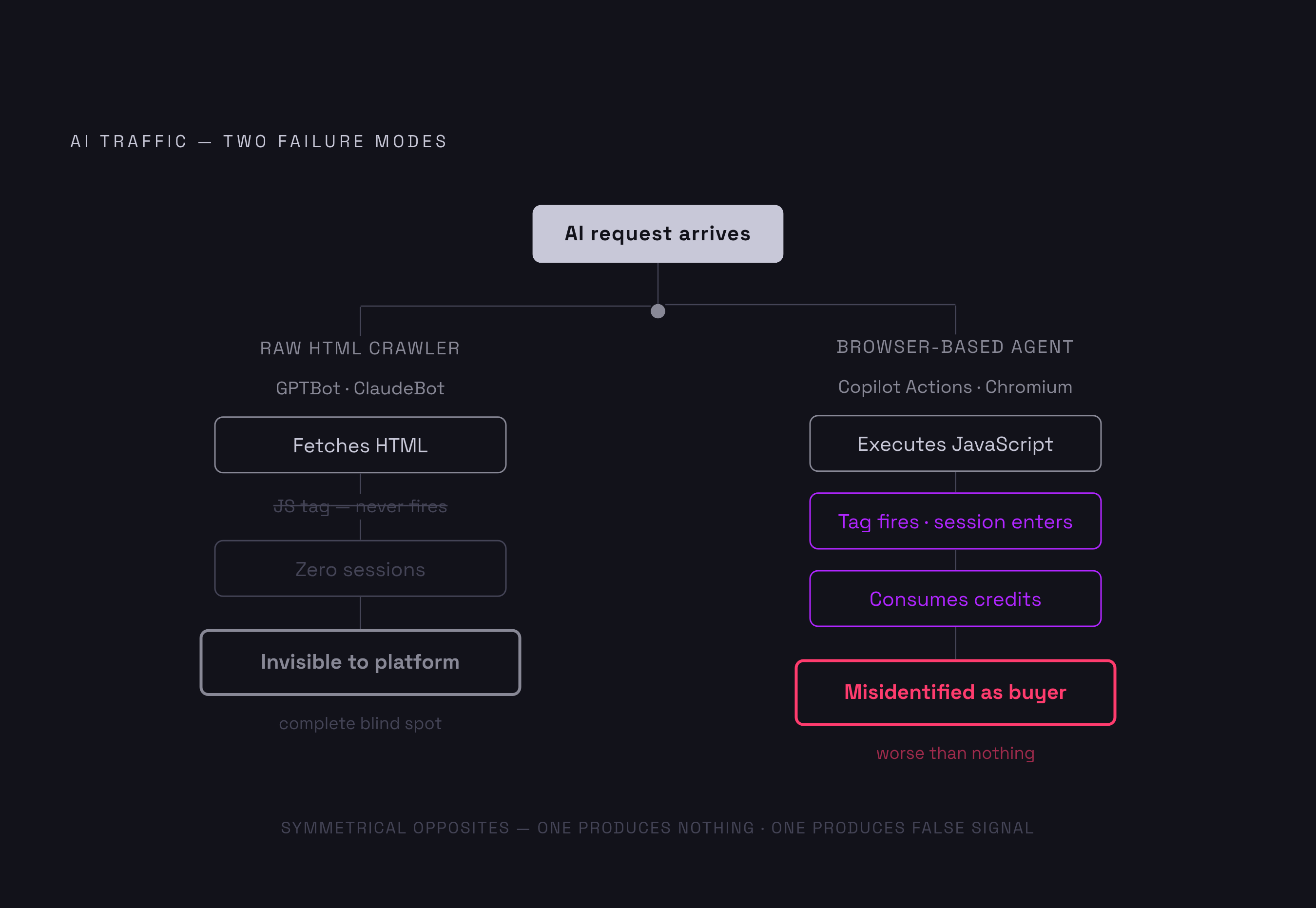
Browser-based agents produce human-looking sessions because they run inside real Chromium instances and execute the page’s JavaScript. They can pass IP reputation checks, TLS fingerprint checks, and standard bot challenges because the browser environment is genuine. The identification tag fires as it normally would. Page views, scroll-depth events, and form interactions can then feed enrichment attempts even though no human is directly navigating the session.
Microsoft’s Copilot Actions illustrates why a browser identity is insufficient evidence of a person. It uses standard Edge or Chromium user agents without a bot signal, and Microsoft has not published a distinct Copilot-specific user agent for agentic traffic. To the server, that session looks like an ordinary Edge user. GA4’s bot filtering cannot tell them apart either. Its IAB/ABC International Spiders and Bots List covers search crawlers and known SEO tools, but almost all full-browser agents are missing from it.
Behavior offers a different set of clues. Deterministic mouse paths, DOM burst reads, CDP artifacts, and a query occurring without prior viewport scrolling can distinguish agents from people. Standard visitor identification tools do not collect those signals. As a result, the session can proceed into the identity graph, consume enrichment resources, and appear in reporting without its automated origin being recognized.
What these two failure modes do to visitor ID match rates and pipeline quality
The two failures distort different parts of the measurement process. Raw HTML crawlers add to the request counts in server logs but add no sessions to the identification tool. Browser-based agents enter the pool of measured sessions, where the tool can try to match them. Neither population should be mistaken for verified human visits. Yet a rate calculated from tag-fired sessions alone does not establish which members of that pool are people.
That distinction changes what a match rate means. An agent session may use up an enrichment credit and return no match, which lowers the reported rate but does not show that the tool is poor at identifying humans. More seriously, a partial match may associate the session with a real person who never visited. The record then implies interest that was never expressed. A blended rate can therefore understate performance on genuine visitors while overstating how much buyer activity the platform has identified.
The operational cost reaches sales through apparently ordinary alerts. A Slack notification may describe an agent conducting competitive research or checking prices in the same terms as a prospective buyer. A raw HTML training crawler, by contrast, never appears in that stream of tag-based alerts. This asymmetry is important when investigating pipeline quality. Some automated activity is missing entirely, while other activity is presented with enough identity and event detail to look actionable.
How the same AI traffic problem corrupts paid media attribution
Browser-based agents can also reach conversion pixels, so they can distort data beyond visitor identification. An agent-generated event that arrives before filtering can train Smart Bidding or Advantage+ on a non-human behavioral pattern. When those events repeat, they give optimization more misleading data to work with. Along with producing an inaccurate session count, agent-generated events can influence the signals used to allocate advertising spend.
Human traffic from AI assistants creates a separate attribution gap. Paid ChatGPT accounts do not pass referrer information, so a human click from that environment can appear as direct traffic in a default GA4 setup. Gemini behaves differently across its workflows. Its Deep Research mode strips referrers during the autonomous “Researching websites” phase, while most cited response links pass referrer data, and Gemini has begun adding UTM parameters. Treating all AI-originated visits as having the same referral behavior would obscure those differences.
Google’s WebMCP, announced at Google I/O 2026 as a proposed open web standard, lets sites expose structured tools to browser-based agents. That expands the scope for agent interactions with forms, carts, and conversion flows. Last-click attribution built around website visits can consequently undercount agent-mediated sales while conversion-based optimization absorbs automated activity. Both errors weaken budget decisions, but in different ways.
Why not all AI traffic is noise, and why filtering everything is the wrong fix
AI-referred humans are not the same population as AI agents. DataDome’s report attributes 83.4% of AI-referred website traffic in its dataset to ChatGPT.com, describing people arriving from an AI interface. Adobe’s Q1 2026 data shows that AI-referred traffic to US retailers grew substantially year-over-year, with those visitors converting and spending more on-site than non-AI traffic, a retail-specific finding with limited applicability to B2B. It still shows why removing every AI-associated session can leave out people who buy and spend more.
Training crawlers offer no commercial value as prospects and require server-side visibility because they do not execute JavaScript. Browser-based agents carry out tasks for users, but how much they are worth as prospects is unclear, so they need behavioral classification. AI-referred humans belong in the human identification pool. Without those distinctions, a shifting machine population can drive changes in conversion rate, pipeline velocity, or ad ROAS, obscuring changes in buyer demand.
Detection also has a moving boundary. Today’s browsing agents do not yet closely copy human typing, scrolling, and mouse behavior, though they may get closer as they improve, so the available distinctions support classification now. For the same reason, a single browser signal cannot be relied on to tell humans from machines forever.
What fixing the blind spot actually requires at the technical level
A capable system needs visibility below JavaScript and behavioral evidence inside the browser. Server log analysis captures requests that never execute the tag, while published IP ranges provide a way to verify declared crawler identities. Neither function can be replaced by improving the identity graph. Matching only begins after a session has been captured.
Browser-based agents require a different assessment because their network and browser credentials can look legitimate. Behavioral fingerprinting supplies evidence that a standard user-agent string cannot provide. Google has stated that Gemini agent sessions will be identifiable through user-agent strings and request headers, although the standard is not yet finalized. Such declarations may improve classification when available. They do not remove the need to detect agents that present as ordinary browsers.
The appropriate response is not necessarily a binary block or pass. A scoring approach can combine identity, network, browser, and behavioral signals into a confidence score for each session. That score can guide how the system responds, from allowing a session to stepping up checks or classifying it separately. Ambiguous sessions can then remain visible without being automatically promoted into human identification. This preserves potentially useful agent activity while protecting the pool used for enrichment and buyer reporting.
What person-level visitor identification looks like when AI sessions are correctly separated
Once AI agents are classified outside human identification attempts, the remaining pool is smaller but more accurate. A match rate calculated only on verified human sessions describes identification performance without blending people and machines. Automated traffic remains available for separate analysis. The denominator now corresponds to the population the metric claims to measure, rather than whichever visitors happened to execute a tag.
A reverse-IP result identifies an account, whereas a record containing a name, title, LinkedIn profile, business email, and ad source identifies whom to contact and how they arrived. The event journey adds the context needed to interpret that visit. Pages viewed, scroll depth, and exit intent describe the activity behind the match rather than leaving the representative with a name alone.
A record can also include a do-not-call-filtered phone number, classified seniority, and job function, making it usable without further enrichment. Those details become useful only when the underlying session belongs to a person. The practical requirement for a visitor identification platform, whether a tool like Maverick Intelligence, a B2B visitor identification platform that also detects ChatGPT, Claude and other AI agents, showing what they read and who operates them, or another vendor, is therefore dual capability, namely human identification and AI agent detection. Correct segmentation gives sales a defensible contact record, gives demand generation a clearer source of human interest, and leaves agent activity visible without presenting it as a buyer.