Why Company-Level IP Matching Was Always a Proxy and Person-Level Deanonymization Is the Actual Signal
IP matching only infers companies, and named-person identity needs prior links.
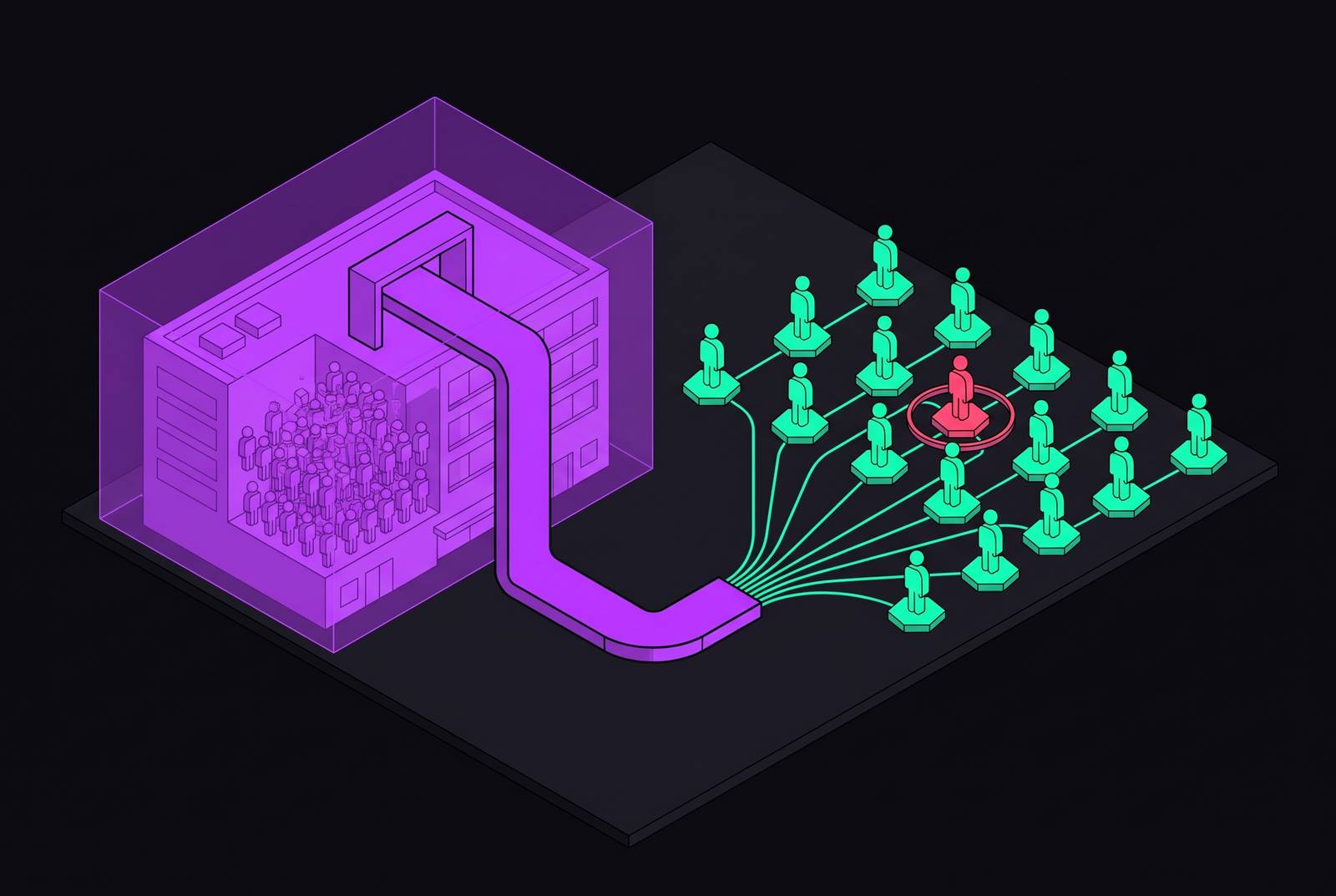
A website visitor identification tool should be evaluated by whether it identifies companies or named people. Company-level IP matching is an inference about an organization, never an observation of a buyer. Person-level deanonymization can supply the identity needed for direct outreach, but only where prior identity links, consent, and coverage support it.
What reverse IP lookup actually does and does not do
Reverse IP lookup takes a visitor’s public IP address and resolves it to the organization that owns or leases the IP block. It uses registries including ARIN, RIPE, and APNIC, together with proprietary databases built from BGP routing data. Even a clean company match cannot establish which employee or team visited, or whether the session belonged to a human buyer.
The directly observed session data is narrower than the language of intent often suggests. It includes the public IP address, URLs visited with entry and exit timestamps, user agent string, referrer URL, and basic engagement events. These observations describe traffic. Labels such as “buyer intent,” “decision-maker status,” and “funnel stage” are scoring model outputs. They may help prioritize activity, but they do not turn an organizational inference into an observed individual.
Why the IP-to-company match is breaking down structurally
The lookup depends on a business visitor browsing from a corporate IP range registered to their employer. Distributed work weakens that assumption at its foundation. Home networks resolve to residential ISPs rather than employer records, while VPNs, mobile connections, public Wi-Fi, and proxy servers produce addresses that do not map to the browsing employee’s organization. Cloud egress adds another category of employee traffic that reverse IP cannot reliably connect to an employer. These network conditions add up and go beyond faults in any one vendor’s tool.
Privacy controls shrink the available pool further. Consent opt-outs under GDPR, CCPA, and CPRA can remove sessions from consideration before identification begins, independent of the visitor’s network. Ad blockers and privacy browsers can prevent the tracking tag from firing altogether. That produces missing data. Consequently, practical company-level coverage reaches only a portion of US B2B sessions, below what headline marketing claims often suggest, while EU conditions are structurally less favorable.
What person-level identification actually requires to work
Person-level identification requires a prior identity event that connects an anonymous session to a known individual. The necessary link can be a tracked email click, a known first-party cookie from a prior session, a hashed email match, or a logged-in session. At least one of these must exist. Without it, resolving that visitor to a person is architecturally impossible, regardless of the vendor’s ability to identify the company. Person-level identification is therefore not simply more accurate IP matching.
The full identification stack operates as a waterfall. Reverse IP first tries company resolution, then the identity graph layer adds person-level enrichment, and probabilistic scoring fills the gaps when neither gives a clean result. A B2B identity graph stores the links it has resolved between devices, IP addresses, behavioral signals, and known business contacts. Data partnerships and first-party sources build those links and keep them up to date, so coverage depends on how large, fresh, and good the graph is.
The distinction between deterministic and probabilistic resolution remains essential. A known cookie or tracked email click provides a reliable identity link, while device fingerprints and behavioral patterns support lower-confidence inferences that should remain directional. Email stitching also makes identity resolution retroactive. A single form fill can attach a visitor’s prior anonymous journey to the new contact record, extending what the graph knows over time. Even so, person-level match rates remain substantially below company-level rates, with an especially wide gap in the EU because of consent requirements.
How the denominator problem makes vendor match rate claims almost meaningless
A match rate has little meaning without its denominator. Vendors may base it on all traffic, including bots and consumers, on traffic already classed as B2B, or on B2B-only sessions that qualify. Those groups give different percentages even when the tool performs the same way. A narrower eligible pool can make a rate look stronger without increasing the number of usable contacts.
The numerator needs equal scrutiny because an identified company is not an identified contact. A company-level rate cannot establish how many named people a tool resolves, and blending the two obscures that gap. Accuracy is a separate measure again. Match rate describes how much traffic receives a resolution, while accuracy describes how often that resolution is correct. Returning more low-confidence guesses can increase coverage while reducing the usefulness of the resulting records.
Traffic composition further limits comparisons between deployments. Company matching works best on corporate office networks with registered IP ranges, while it is among its weakest on remote, mobile, and VPN traffic. Those weaker groups make up a large and growing share of B2B browsing. A rate from traffic that is easier to match therefore cannot show how well a tool will work on another site. Teams must measure how well it works with their own audience.
The multi-stakeholder attribution failure company-level matching cannot solve
Company-level matching assigns different people’s activity to one anonymous account entity. Consider a junior marketer who clicks an ad and downloads a whitepaper. Their manager visits the pricing page through organic search a week later, and a VP sees a LinkedIn ad before agreeing to a demo. In this pattern, the ad platform sees only the first click and attributes the conversion there, missing the other two touchpoints. The account record conceals the committee’s separate journeys.
Better account scoring still cannot show who those people are. Company-level activity does not reveal which employee visited, which team is involved, or what stage each person has reached, so sales must find a contact through separate enrichment. That contact is not necessarily the visitor. Precision retargeting and suppression also depend on knowing the individual. Person-level resolution provides the basis for connecting those actions to the people involved in the deal.
AI agents and bots as a hidden contamination problem in company-level data
Non-human traffic can also make an account match look like buyer activity. AI traffic includes training crawlers, retrieval crawlers, live agents, and agents that deliberately do not identify themselves. Most crawlers and AI agents do not execute JavaScript, so they remain absent from client-side analytics such as Google Analytics. Others disguise themselves through residential IP rotation and spoofed browser user agents. Those sessions can look like ordinary unidentified browser traffic, with no clear sign that they are bots.
A company match for a crawler session is noise when the intended measure is human buying activity. A headline rate that does not separate bots and agents from human sessions can therefore overstate useful identification. The verification framework remains early in adoption. RFC 9421 HTTP Message Signatures and the Web Bot Auth draft adopted by the IETF working group in September 2026 provide an emerging approach, but few agents sign their requests yet.
Knowing which AI systems consume which content, and on behalf of which operators, is an intelligence signal in its own right. It is simply a different signal from human buying activity. Combining the two under an undifferentiated visitor count prevents either from being interpreted clearly.
What person-level identification makes possible that company-level cannot
Person-level resolution changes the unit of sales action from an account to a named individual with a contact record and behavioral journey. A LinkedIn profile sent to Slack is a notification. A named person with email, phone, pages viewed, scroll depth, video plays, exit intent, ad source, and CRM status provides a basis for prioritization and routing. The record can explain both who the visitor is and why their activity warrants attention.
That identity makes the ideal customer profile, or ICP, usable at the individual level. An employee of a target company may sit outside the buying function or seniority band, even when the account itself fits perfectly. Person-level data supports that additional filter. CRM matching can then establish whether the visitor is a known contact, associated with an open opportunity, or a net-new prospect. Traffic from Google, Meta, or LinkedIn can also be attributed to a named individual and company.
The resulting workflow can proceed from a domain-identified visitor to contact enrichment, a CRM account match, a sales notification with the full journey, and a personalized sequence. Without person-level resolution, finding the contact requires another manual or tooled step that interrupts the real-time window. Native integrations with Slack, HubSpot, Salesforce, and ad platforms, together with API, webhooks, and MCP connectors, can move the record from a dashboard into an existing workflow.
Standard LinkedIn retargeting through the Insight Tag matches only a small share of visitors, while person-level identification can greatly increase the number available for retargeting and suppression. Contacts who have been identified can receive impressions at low cost. They can also receive personalized email at near-zero marginal cost, where the applicable requirements permit it. A company match alone does not supply the individual identity needed for those actions.
Where company-level identification still earns its place
Company-level identification is appropriate when the objective is account scoring and routing. A team working a named account list may only need to know when a target company visits. The account is the intended unit of action. For that work, person-level resolution can add cost and compliance work without giving the team anything it needs. Company data also helps teams with account-based marketing and building audiences for advertising, with no claim to show who is on the buying committee.
Geography strengthens this case for some programs. Company-level identification is globally operable, while person-level coverage is mostly limited to US traffic in practice. When much of an audience is in the EU, company identification with strong EU firmographic data is often the more practical choice. Consent requirements constrain the alternative more sharply. A tool with strong US person-level coverage is not automatically the right fit for an international pipeline.
Company-level programs can rely on legitimate interest grounds when they collect or store no personal data, while person-level identification needs a lawful basis under GDPR Article 6 and often calls for consent. DPA review and legal counsel are part of that decision. The added burden must be weighed against the outbound motion it enables. The choice follows the required sales action.
How to evaluate a Clearbit Reveal alternative against these constraints
A team choosing a website visitor identification tool should test each tool on two weeks of real production traffic. The pilot should measure the share of visitors identified, the share of identified visitors who fit the ICP, and how many would actually be contacted. Identification rate alone is a vanity metric. Each vendor should state its denominator and give company-level and person-level results separately, so a broad account match does not pass for named-contact coverage. Refusal to define the population leaves the headline figure unsuitable for a buying decision.
The evaluation should also establish how the tool classifies and filters AI agents, crawlers, and bots from identified sessions. Human buyer coverage needs its own measurement. For a direct-outreach motion, the minimum actionable record includes name, title, LinkedIn, verified business email, and the full session journey. Integration testing should establish whether that record reaches the CRM, ad platforms, and sales workflow through native connectors, webhooks, or API.
Compliance readiness belongs in the same evaluation before deployment. Teams should confirm the vendor’s consent model, understand GDPR and US state privacy law obligations, and update the privacy notice before deploying a pixel. Commercial terms also require a current assessment. Pricing in this category changes often, and enterprise tiers are quoted individually. The decision should rest on a defined population, a clear distinction between account inference and person resolution, and evidence that the resulting record supports the intended motion.