ClaudeBot vs GPTBot Crawl Behavior Compared
GPTBot and ClaudeBot crawl differently enough to require separate policies.
GPTBot and ClaudeBot both belong to the training-crawler family built by OpenAI and Anthropic to collect web content for foundational model datasets, and both vendors state publicly that their bots honor robots.txt. That shared claim is precisely what makes the two crawlers dangerous to treat as interchangeable. Teams that write a single policy for "AI crawlers" as a category, rather than for each bot specifically, end up with configuration decisions that are wrong for at least one of the two. The confusion deepens because neither OpenAI nor Anthropic ships a single crawler anymore. OpenAI runs GPTBot for training, OAI-SearchBot for ChatGPT search indexing, and ChatGPT-User for live retrieval at the moment a user asks a question. Anthropic mirrors that structure with ClaudeBot for training, Claude-SearchBot for search indexing, and Claude-User for live retrieval. If a company operates three distinct bots with three distinct jobs, its name is not a meaningful unit of policy. The differences that matter, covered in the sections that follow, run through volume, crawl shape, path preference, revisit cadence, and redirect tolerance, and they are large enough that one robots.txt file or one WAF rule applied identically to both vendors will systematically underserve or overblock one of them.
Crawler traffic volume and server planning
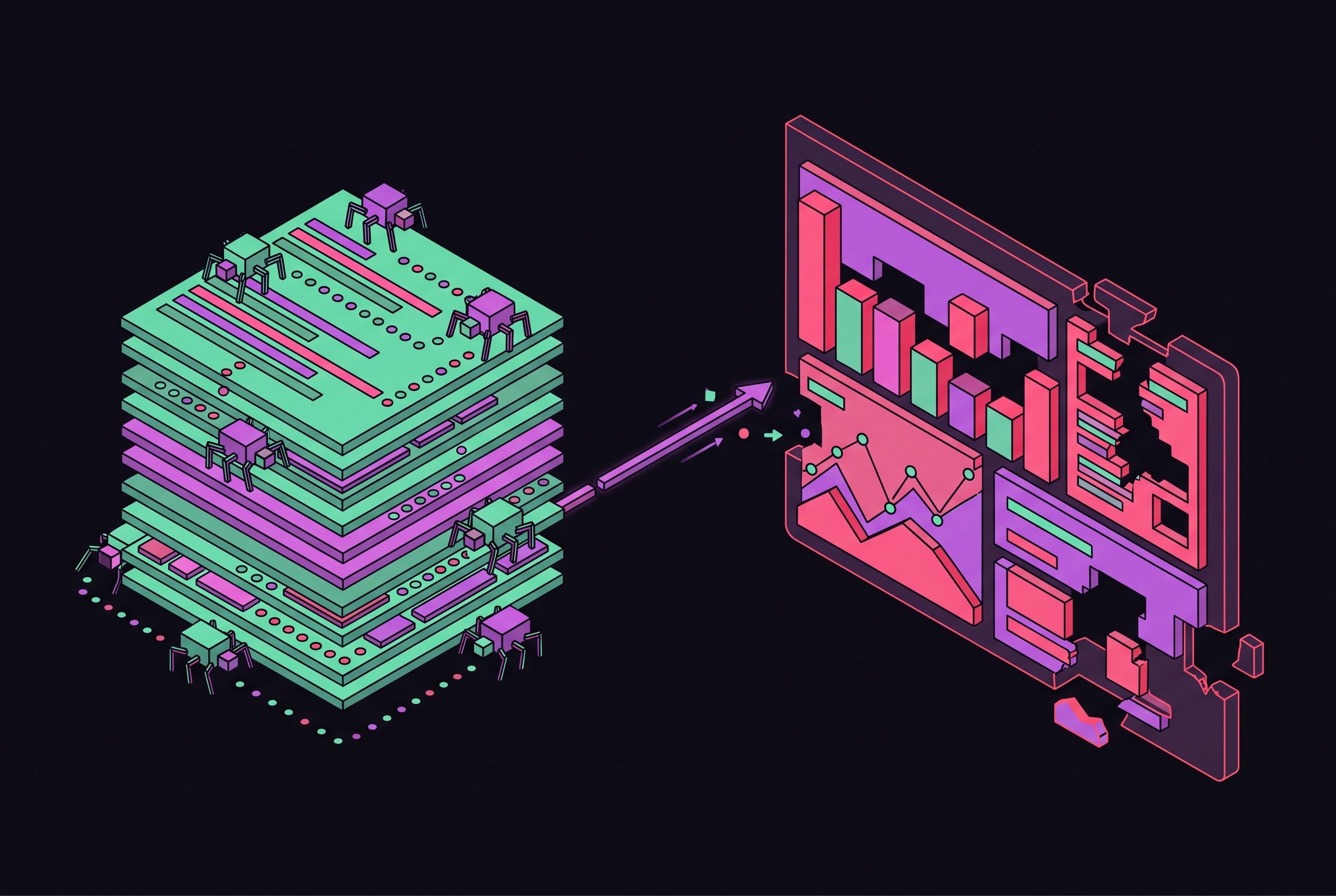
GPTBot generates materially more traffic than ClaudeBot on most sites, and the gap is wide enough that you need separate server-load planning for each bot, not a shared capacity budget. A 48-day single-site log study found that GPTBot can burst with a sharp spike of requests in a short window, and most teams have not planned for that spike in their rate-limit rules or edge-cache setup. That burst behavior changes what "allowing" GPTBot actually commits a site to: it is not a steady trickle of requests that scales predictably with content size, but a pattern that can spike hard enough to stress an origin server that has not set a crawl-delay or backed it with an edge rule. ClaudeBot's overall volume is lower, so you can tolerate it with fewer infrastructure changes. But GPTBot's burst capacity means you need a rate-limit policy even if you want to welcome its crawl openly, because welcoming it without a ceiling invites load the origin was never sized for. This is the first and most measurable divergence between the two crawlers, and it sets the baseline for everything that follows: the two bots are not just different in style, they are different in the literal cost of letting them in.
How GPTBot and ClaudeBot traverse a site
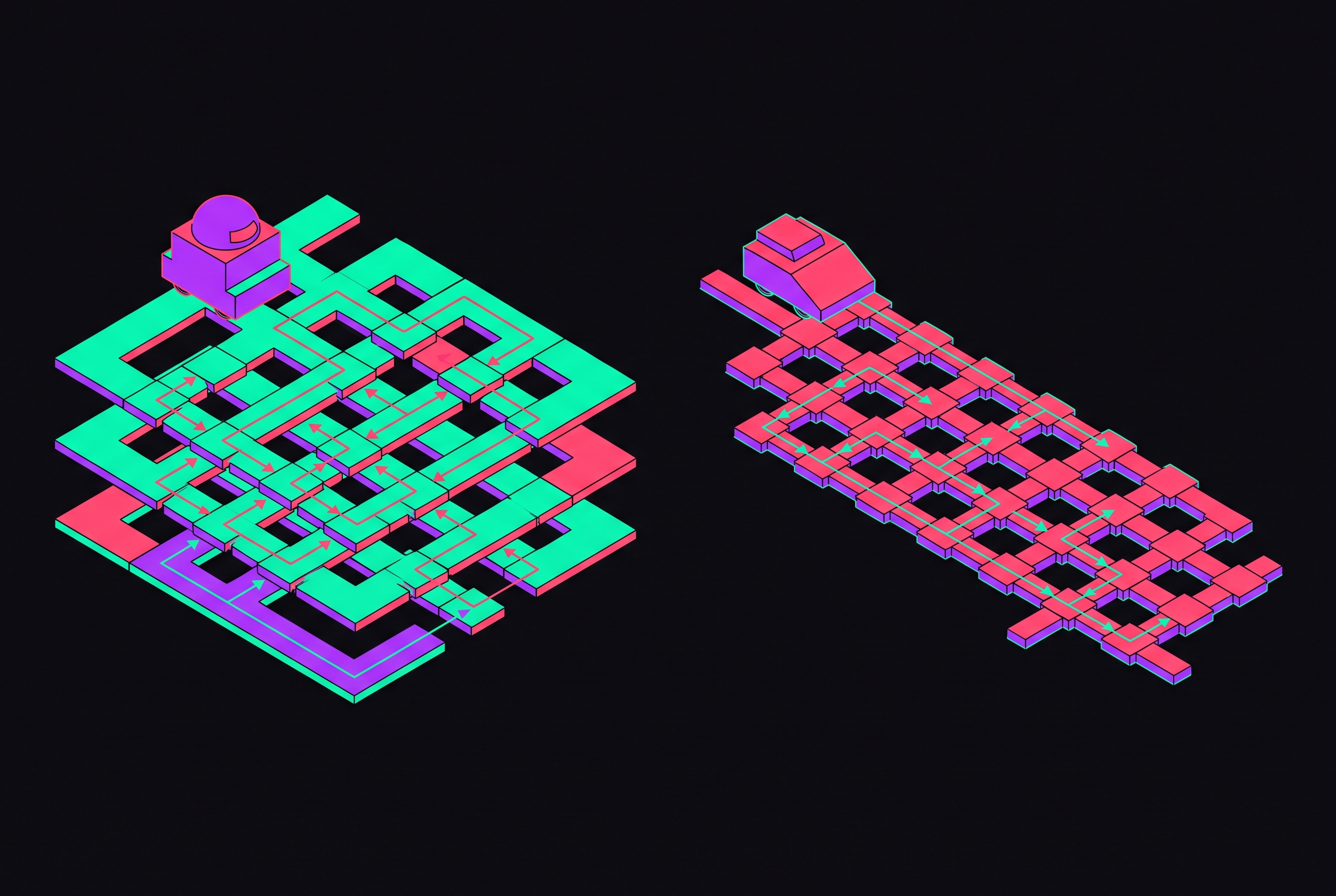
Volume is only the surface measurement. GPTBot and ClaudeBot follow fundamentally different traversal strategies architecturally, so they end up indexing different parts of a site even when both are fully permitted. A breadth-first crawler samples widely across a site's structure, picking up a little from many sections and favoring recency and surface coverage. A depth-first crawler goes the other direction, following a narrower set of paths all the way down, rewarding sites that organize substantive content in clearly linked, navigable hierarchies. That distinction has direct consequences for how a site should be structured if it wants to be indexed well by both. If you want ClaudeBot to find and absorb your best technical material, put that material at discoverable depths inside paths like /docs/ or /api/, with clean internal linking to the rest of the site, instead of burying it under several layers of editorial navigation that a depth-first crawler has to tunnel through. If you want ChatGPT citation visibility instead, prioritize fresh last-modified signals and make sure breadth-accessible paths such as /blog/ are not accidentally rate-limited or blocked, because breadth-first crawling rewards freshness and wide accessibility over depth. The risk runs in both directions: a site optimized only for GPTBot's breadth-first pattern will systematically under-serve ClaudeBot's depth-first preference, leaving exactly the kind of technical documentation that Claude users most often want under-indexed. Content strategy for AI visibility, in other words, cannot be a single structure applied once. It has to account for two different ways of reading a site.
How each crawler handles redirect chains
GPTBot and ClaudeBot both tolerate longer redirect chains than their real-time search counterparts can, and if you manage your crawler fleet as one undifferentiated group, that gap between training-bot patience and search-bot impatience becomes a configuration trap. A training crawler that follows a chain of redirects to its final destination still gets the content it wants, even if the path to get there is inefficient. A search crawler has to produce a citation-ready answer fast, so it runs under tighter latency and resource constraints and will not wait as long. The failure this produces is silent. Standard analytics tools like Google Analytics do not show you AI bot traffic or AI-drop failures, so when a redirect chain quietly defeats a search crawler, it leaves no trace in the dashboards most teams already check. Only server log analysis can show you whether a redirect chain is keeping a search crawler from resolving a page down to a clean 200 OK. The practical consequence is uncomfortable: a site can pass a GPTBot and ClaudeBot crawl audit successfully, appearing fully accessible to both training bots, and still be invisible in ChatGPT search and Claude search answers if its redirect chains run longer than three hops. That failure only becomes visible when OAI-SearchBot and Claude-SearchBot are audited separately from the training bots that share their vendor's name. The tolerance difference between a training crawler and a search crawler is the reason a site can look fully crawlable and still be functionally absent from the answers that matter most for discovery.
Robots.txt compliance versus robots.txt enforcement
Both GPTBot and ClaudeBot claim and demonstrate robots.txt compliance, but compliance is not the same guarantee as verification, and the two bots are not equally easy to verify as legitimate. A user-agent header is a claim, not proof of identity, and confirming that a request actually came from the crawler it says it is requires checking at the IP and cryptographic layers rather than trusting the string in the request header. Google supports forward-confirmed reverse DNS for this, and it ties a claimed identity back to a network record you can verify. Anthropic's ClaudeBot lacks a documented stable PTR pattern and operates across multiple cloud networks, which makes it considerably harder to verify with certainty than GPTBot. That gap has already been exploited. The Agentic Web Index found that attackers ran coordinated vulnerability scans in August 2026 and dressed the traffic up as ClaudeBot to go after exposed credentials in AI coding tool deployments. If a team whitelisted ClaudeBot's user-agent string without verifying the underlying IP range, it had, without realizing it, opened a door to that traffic. The broader enforcement problem compounds this. RFC 9309 states that robots.txt rules are advisory, so enforcement for a crawler that chooses not to comply has to happen at the CDN or WAF edge. Perplexity has been caught bypassing robots.txt repeatedly, and Bytespider carries a long history of non-compliance, so the advisory nature of the standard is not a theoretical concern. Cryptographic verification of crawler identity is expected to become the standard going forward, with unverified bots auto-blocked at the CDN edge by default, and that direction will favor GPTBot, which publishes a transparent published network range, over ClaudeBot, unless Anthropic closes its PTR documentation gap. Verification at the IP and cryptographic layers is labor-intensive work, and it is easy to get wrong by hand. That is why many teams end up either blocking ClaudeBot by accident or trusting a user-agent claim that could be spoofed. Maverickintelligence verifies the legitimacy of both ClaudeBot and GPTBot through IP and cryptographic validation, surfacing only confirmed visitors so that a team enforcing robots.txt can do so without worrying about false blocks on one side or undetected imposters on the other.
The crawl-to-referral gap: what each crawler takes versus what it returns
ClaudeBot and GPTBot both crawl at volumes far beyond what the referral traffic they send back would justify on a pure exchange basis, but the imbalance is dramatically worse for ClaudeBot, and that asymmetry is shaping the access policies that sophisticated publishers are now adopting. ClaudeBot's ratio of crawl volume to referral traffic got better during the week of May 25 to June 1, 2026, but it still remained the worst major ratio of any crawler studied, so the imbalance is a structural feature of how Claude's training crawler operates, not a one-week anomaly. So any site weighing whether continued access is worth its cost faces a real decision because of that asymmetry. But the answer does not have to be binary, because the fleet-split structure covered earlier applies directly here. You can block ClaudeBot's training crawler at no cost to Claude search citation eligibility, because Claude-SearchBot is a separate agent with its own robots.txt token, so blocking one does not block the other. The same logic holds for GPTBot against OAI-SearchBot: blocking GPTBot stops training-data extraction while leaving ChatGPT search citation eligibility fully intact. The expensive mistake is a blanket block that catches a training bot and its search counterpart together, trading away citation eligibility for bandwidth savings that could have been achieved more precisely. A third model is also emerging for publishers who want compensation rather than a binary choice between full access and full block: TollBit's approach charges AI crawlers per page or per query, positioning itself between the two extremes for sites that would rather be paid for access than simply grant or deny it.
A practical crawl policy framework for GPTBot and ClaudeBot
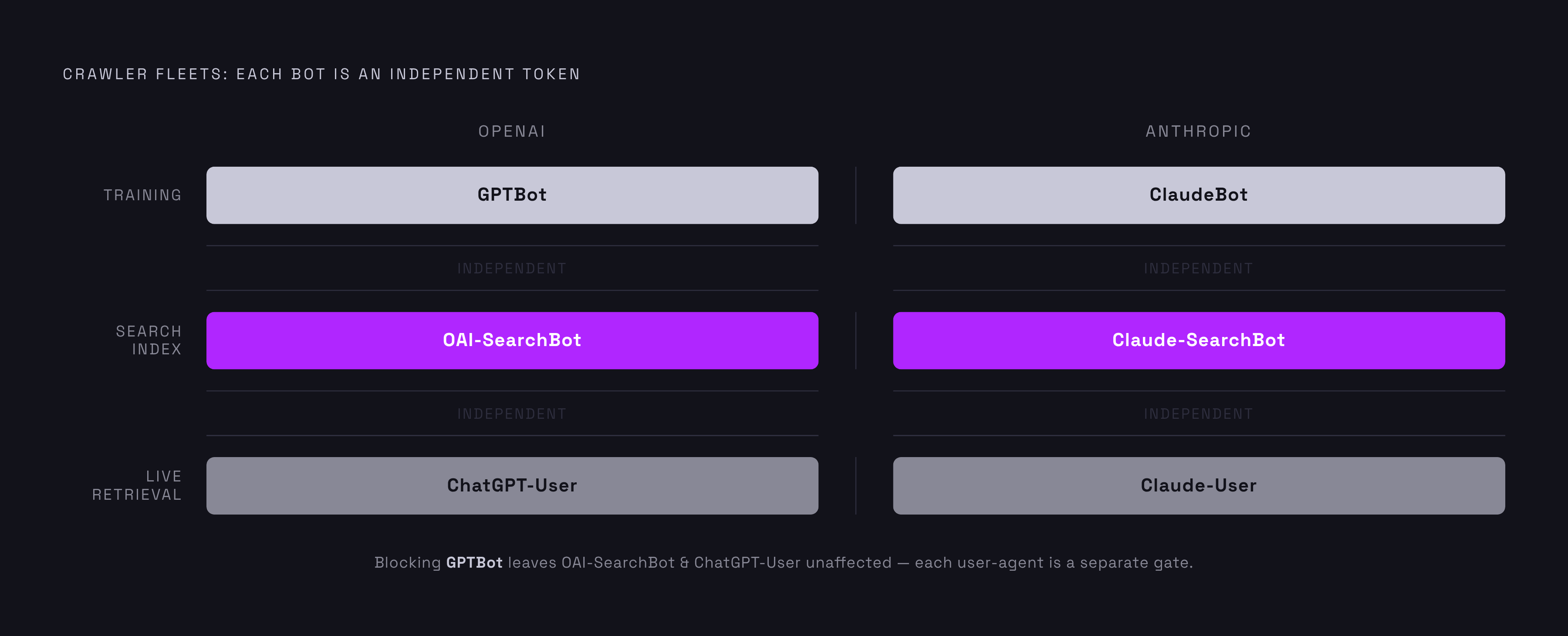
Because GPTBot and ClaudeBot differ in volume, crawl depth, path preference, revisit cadence, and referral return, the right policy for each one is different, and both differ again from the policy that applies to their respective search-crawler counterparts. The foundational principle is that each user-agent needs its own robots.txt directive, because training bots and search bots carry different missions and different impacts even when they share a vendor name. Blocking only ClaudeBot does not block Claude-SearchBot or Claude-User, because each token needs its own line. OpenAI's own documentation states that sites blocking OAI-SearchBot will not appear in ChatGPT search answers, while blocking GPTBot alone has no effect on search eligibility at all, so the tokens are separate in practice. From there, the tiered logic follows naturally from each bot's behavior. GPTBot carries high training value and aggressive, burst-capable volume, so you should allow it, but set a crawl-delay and back it with an edge-level rate-limit rule, because robots.txt alone is advisory and cannot enforce anything on its own. ClaudeBot's lower volume and depth-first pattern make it easier to tolerate, and if you are not willing to accept its poor referral ratio, a full block is defensible, but you should pair any such block with an explicit allow rule for Claude-SearchBot so that citation eligibility in Claude's search product is preserved. You should generally allow OAI-SearchBot and Claude-SearchBot without exception, because these bots decide whether your site's content can appear in ChatGPT search and Claude search answers, and if you block them, you remove citation eligibility entirely, not just reduce it. ChatGPT-User and Claude-User sit in a different category altogether: they fetch content at request time on behalf of a real person asking a real question, robots.txt does not govern them in the same way, and blocking them cannot be done without breaking the functionality those real users depend on. None of this works through robots.txt alone, since the standard is advisory and enforcement has to happen at the CDN or WAF edge for any crawler that does not voluntarily comply. For ClaudeBot specifically, you need IP-range verification at the edge, because its user-agent string has already been used in spoofed attacks, so whitelisting by user-agent alone leaves an exploitable gap. Redirect hygiene deserves its own ongoing audit step distinct from the crawl-access policy: the most important pages on a site should resolve for OAI-SearchBot and Claude-SearchBot in three hops or fewer, since these search crawlers will abandon longer chains silently even when the training bots tolerate them without complaint. And for publishers whose value lies in technical documentation, the structural work and the access policy reinforce each other: high-value documentation belongs at shallow, well-linked depths inside /docs/ or /api/ paths to match ClaudeBot's depth-first preference, while editorial content in /blog/ should carry fresh timestamps to match GPTBot's sensitivity to recency.
Why monitoring which crawlers reach your site matters
Every policy described above depends on a layer of visibility that standard analytics does not give you. The behavioral differences between GPTBot and ClaudeBot do not appear in a typical analytics dashboard, so if you configure access policy without server-log or specialized crawler visibility, you are working from assumption, not evidence. Google Analytics does not show AI bot traffic at all, and AI-driven visits do not reliably produce a traceable referrer click the way a human visit does, so the damage from a misconfigured policy accumulates quietly: pages drop out of AI-generated answers one at a time, with no error message and no alert to mark the moment it happened. Most AI crawlers, including GPTBot, ClaudeBot, and PerplexityBot, are HTML-only and do not execute JavaScript, while Googlebot (used by Gemini) and AppleBot are exceptions that do render it. Server-side logging, or a platform built to read server-side signals, is the only way to see what these crawlers are actually doing. Tools that lump all AI traffic into one undifferentiated bucket obscure the load profiles that require separate rate-limit and cache strategies. Maverickintelligence distinguishes between crawler types in real time, drawing on actual data so a team can see how much CPU and bandwidth each AI agent is consuming and plan capacity accordingly. The same gap applies to the redirect failures described earlier: a server log is the only place that reveals whether a chain is quietly preventing a search crawler from resolving a page, and Maverickintelligence fills that gap by showing which AI agents successfully reached a given piece of content and where crawl attempts failed instead. Maverick Intelligence detects and reports AI agents, including ChatGPT, Claude, and thousands of other crawlers, in real time, revealing what content each one consumes and who operates it, alongside the human visitor intelligence that already feeds pipeline and CRM workflows. Where standard visitor identification resolves a human visitor down to name, company, title, LinkedIn profile, and email for CRM sync and Slack alerts, the crawler detection runs in parallel, so bot traffic is classified on its own track and does not dilute the firmographic signals that sales and demand-gen teams rely on. Integrations with HubSpot, Salesforce, Slack, and the major ad platforms mean that crawler intelligence and human-visitor intelligence flow into the same workflow rather than competing for the same reporting surface, attributing paid-media spend to the actual companies and people it reached while keeping bot traffic classified and separate throughout. None of the tiered policy described in this piece can be verified as working without that layer of visibility in place first.
Sources
- How to detect AI crawlers
Provided context on how AI crawlers are identified and verified, including the distinction between user-agent claims and IP-level verification methods.