Which Companies Operate the AI Agents Reading Your Site
Five types of AI agents reach your site, each demanding different access rules.
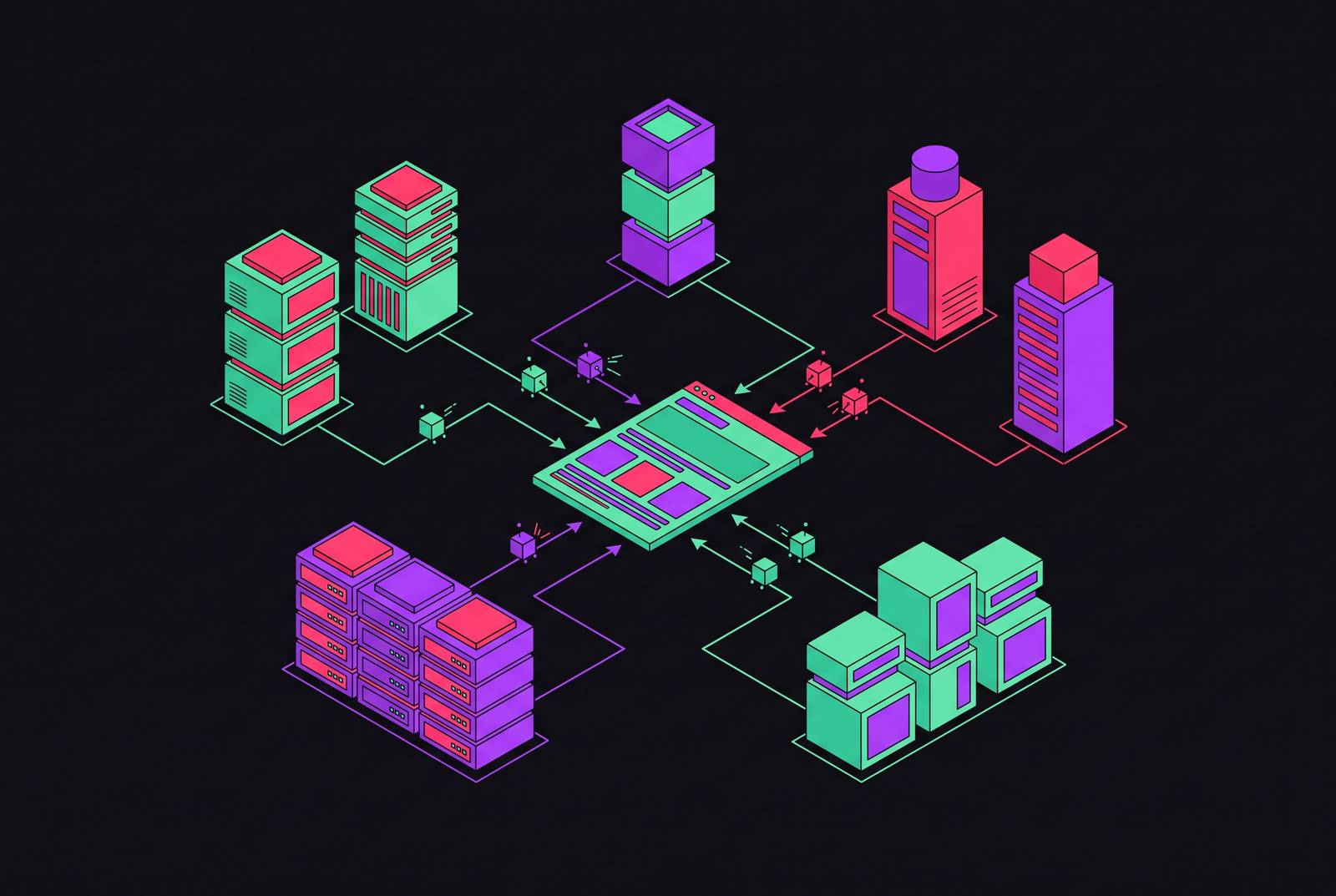
AI agents that read a website belong to dozens of companies and visit for different reasons. This article maps the major operators and explains how to distinguish them in traffic. The central conclusion is that operator identity and agent purpose must be established together before a site owner can decide what to allow, block, or treat as a commercial signal.
Why the question "which AI agent visited my site" is harder to answer than it looks
AI agent traffic in 2026 comes in at least five functional types that differ in what they do, how they identify themselves, and what their visits mean for website owners. A training crawler collecting material for a language model is not equivalent to a fetcher acting on a human’s request. Their access policies should therefore differ. Treating both as generic bots could feed a training pipeline the site owner wanted to avoid or keep the site out of AI answer surfaces it wanted to reach.
Identity is the bottleneck between those distinctions and an enforceable policy. User-agent strings are self-declared and easily faked, while IP verification depends on operators publishing ranges that site owners can check. Many crawler tokens offer no such evidence. Given those limits, who are the actual operators, what are their agents doing, and how can they be told apart?
The five functional categories of AI agents, and why the category determines what you should do
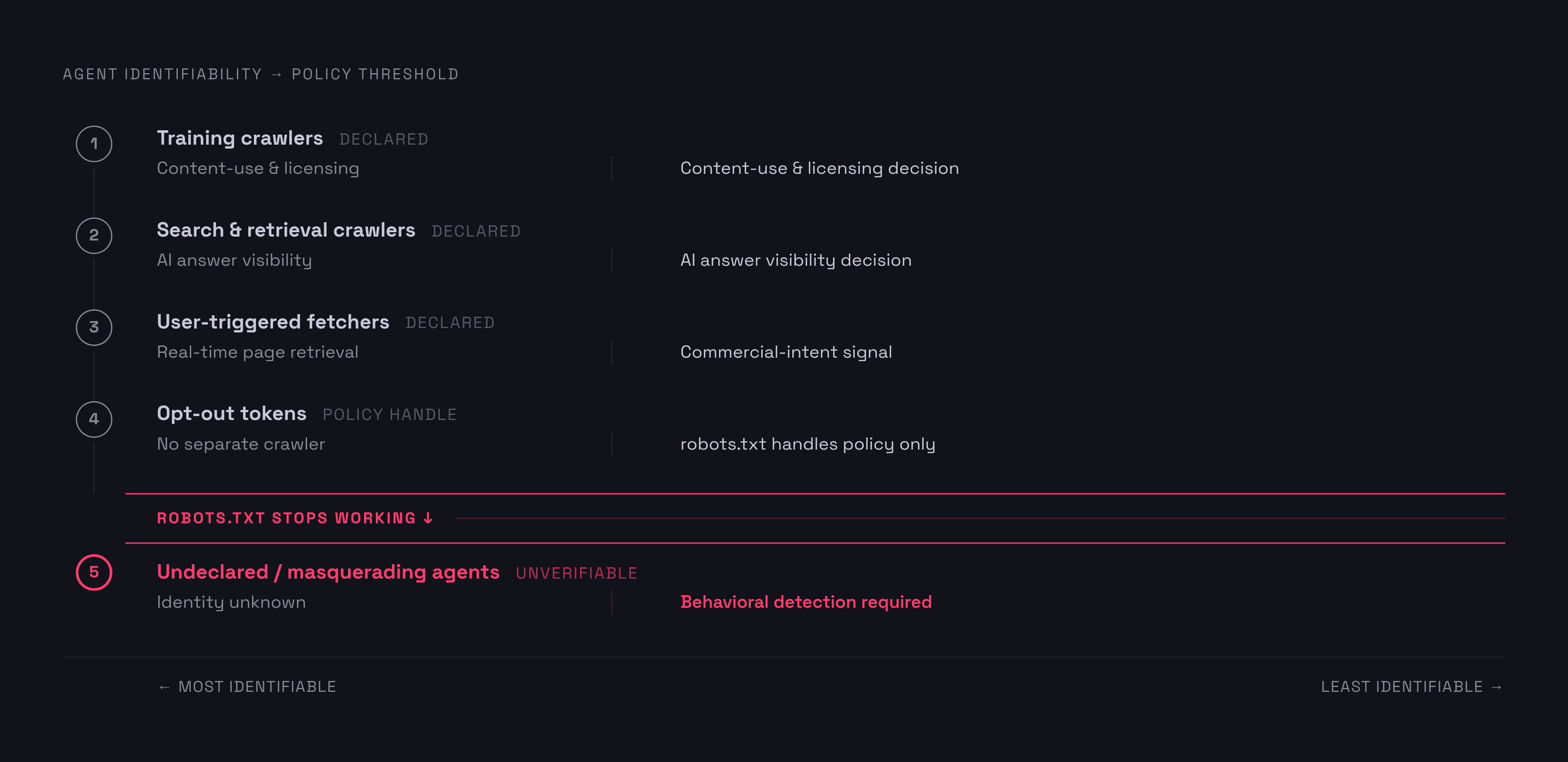
Training crawlers collect content for model development, making access a content-use and licensing decision. Search and retrieval crawlers instead build or refresh indexes that power AI-generated answers. Examples include OpenAI’s OAI-SearchBot, Perplexity AI’s PerplexityBot, and Anthropic’s Claude-SearchBot. Blocking retrieval has a different cost from refusing training. It trades away visibility in AI answers rather than simply withholding material from a model-development pipeline.
User-triggered fetchers retrieve a specific URL when a human submits a request, making ChatGPT-User, Claude-User, and Perplexity-User closer analogues to human visits. Opt-out tokens, including Google-Extended, are policy handles for setting rules, with no separate crawlers to look for in traffic. Undeclared and masquerading agents complete the framework. They either omit an agent identity or present as ordinary browsers, placing them beyond what a user-agent lookup alone can resolve. These five categories separate questions about content rights, discoverability, human intent, and unverifiable access.
The major operators behind training and retrieval crawlers, and what each one is actually after
OpenAI operates three agents with distinct jobs. GPTBot, version 1.4 in the supplied material, collects training data, respects robots.txt, and has published IP ranges. OAI-SearchBot supports search and retrieval, while ChatGPT-User fetches content in response to a user request. Evidence about GPTBot’s robots.txt behavior should not automatically be transferred to the other agents merely because they share an owner.
Anthropic makes a similar functional split. ClaudeBot handles training, Claude-SearchBot handles retrieval, and Claude-User handles user-triggered requests. Anthropic publishes IP ranges in a combined bots.json list under its crawling documentation, without a per-bot breakdown. The agent’s declared identity is still needed to tell the three roles apart, while the published range helps show that the request came from Anthropic.
Google uses a more layered naming scheme. Google-Extended is the explicit robots.txt opt-out token for Gemini training, and blocking it does not affect standard Googlebot indexing. GoogleOther crawls for general research and development within Google’s product teams. Google-Agent is a user-triggered fetcher that introduced Web Bot Auth for cryptographic identity verification. These names are not interchangeable crawler labels.
Meta separates background collection from live retrieval. FacebookBot supports link previews and training, meta-externalagent collects material for AI training, and meta-externalfetcher handles live retrieval for Meta AI. Perplexity’s distinction is narrower but important. PerplexityBot builds its retrieval index, while Perplexity-User responds to user requests, and both respect robots.txt. Perplexity fine-tunes its Sonar models on open-source bases, but its crawlers are not used for that training, so treating them as foundation-model training collectors misstates their purpose.
Microsoft/Bing uses Bingbot for standard search and extends that infrastructure into AI retrieval, with crawl management available through Bing Webmaster Tools. Apple provides AppleBot-Extended as a robots.txt opt-out token for Apple Intelligence training, introduced in June 2024. Neither arrangement should be mistaken for a wholly separate search system. ByteDance’s Bytespider, by contrast, collects training material for TikTok and Doubao AI, with partial robots.txt compliance and no official vendor documentation page.
Documentation is uneven across this operator map. A stated purpose does not by itself establish robots.txt compliance, and an agent name does not establish the availability of published IP ranges. Crawl reach is also highly concentrated. Cloudflare’s two-month analysis found that Googlebot reached 1.70× more unique URLs than ClaudeBot, 1.76× more than GPTBot, 2.99× more than Meta-ExternalAgent, and 167× more than PerplexityBot. The practical workload therefore depends on which operators reach a site, beyond the number of agent names that exist.
The operators whose agents do not self-identify, and why they are the harder problem
Undeclared agents remove the identity signal that makes documented crawlers manageable. DataDome’s investigation reported that xAI’s Grok retrieval traffic rotated through residential IPs and used common Chrome and Safari user agents. At that layer, those requests look like human browsing. There is no official vendor documentation page for xAI’s crawler, leaving site owners without the same reference point available for documented operators. Even more detailed user-agent filtering cannot find an identity that the request leaves out.
OpenAI’s ChatGPT Atlas creates a related problem. Its default user-agent matches Chrome on macOS and has no Atlas token, and its browsing traffic has no public signed identity signal. ChatGPT Agent provides a contrasting model. Its requests include HTTP Message Signatures under RFC 9421, which can be checked against OpenAI’s public key directory. Signed requests make operator authentication possible without relying solely on a browser’s self-description, but that mechanism has not been broadly adopted.
This gap is not a robots.txt maintenance problem. An opt-out rule cannot authenticate a browser-like session or establish which company sent it. Undeclared traffic instead needs checks for network, browser-environment, and behavioral evidence. Those signals can support a response even when attribution remains uncertain. The distinction is essential because detecting automation and proving an operator’s identity are separate achievements.
How to tell operators apart in your traffic — the four detection layers
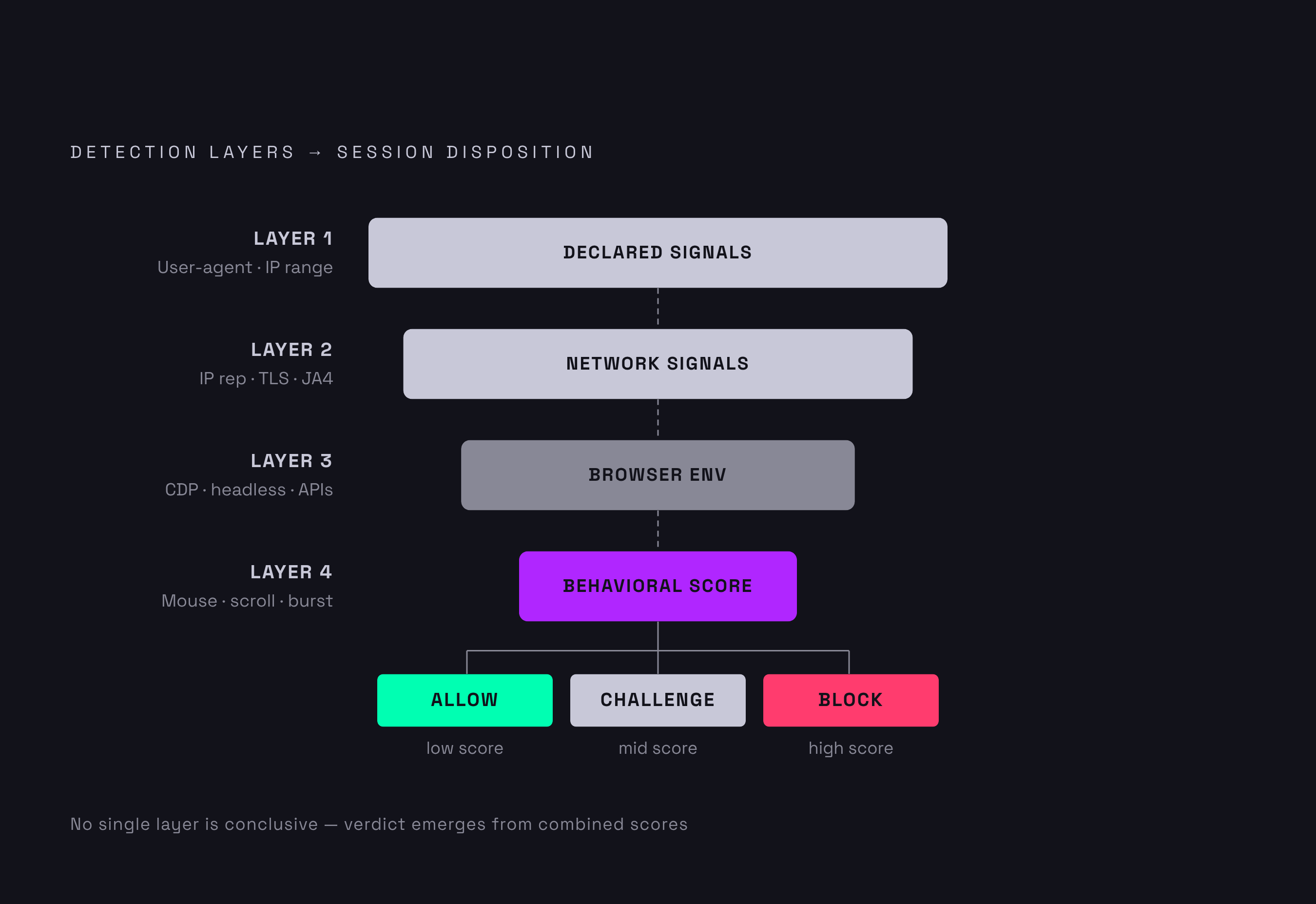
The first detection layer combines user-agent identity with IP verification. Server-log searches and CDN filters can find declared substrings such as GPTBot, ClaudeBot, and PerplexityBot, after which published ranges provide corroboration where available. The strings themselves still require maintenance. OAI-SearchBot now leads with a full Chrome desktop string, so filters expecting its older short form can miss it.
The second layer examines network signals, including IP reputation, data-center versus residential origins, TLS fingerprints, and header consistency. Known AI crawlers typically use data-center ranges, while residential rotation can complicate that pattern. Network origin is not a verdict by itself. JA3/JA4 fingerprints and inconsistent headers can provide additional evidence of automation even when a request claims to come from an ordinary browser.
The third layer examines the browser environment. Agentic browsers can drive real browser instances and pass many traditional bot checks, so detection looks for CDP artifacts, headless flags, or missing browser APIs that a normal session would populate. Runtime behavior gives more clues through signals such as DOM burst reads. A familiar browser signature is therefore not conclusive. The environment can reveal differences that neither a log entry nor an IP-range lookup exposes.
The fourth layer scores behavior, including deterministic mouse paths, content queries without preceding viewport scroll, and burst-pattern page consumption. Human browsing is more variable than those patterns. The practical response is to score sessions across all four layers, allowing low-scoring sessions, challenging mid-range sessions, and blocking or flagging high-scoring sessions. Server logs cover known declarations, Cloudflare Bot Management adds network-scale IP and TLS signals, and specialized tools add browser and behavioral detection. An “AI agent detection” label alone does not establish that those additional layers exist.
Why knowing the operator — not just the bot name — changes what you do next
For site owners, the next step is to translate attribution into a differentiated access policy. Known training crawlers such as GPTBot and ClaudeBot support a deliberate opt-out decision through robots.txt, while Google-Extended provides a training preference without a separate crawler identity. This is a content-licensing choice. Where an operator lacks documentation or complies only partially, as with Bytespider, behavioral blocking provides an alternative to relying on declared preferences alone.
Retrieval agents require a different calculation because restricting OAI-SearchBot, PerplexityBot, or Claude-SearchBot removes access that supports AI answer visibility. For content businesses, that decision has potential revenue implications. A blanket training ban can overreach here. Owners should base retrieval access decisions on whether they want the site represented in retrieval-driven answers, independently of whether the operator also develops models.
User-triggered fetchers represent a specific human’s intent. Blocking ChatGPT-User or Claude-User can therefore amount to refusing a prospect who used an AI assistant as an alternative to a conventional browser visit. A request for a pricing or demo page should be treated on its own as a commercial-intent signal. It does not, however, establish who the downstream person is. Operator attribution makes that request interpretable without turning it into an unsupported claim about an identified buyer.
Undeclared sessions need policies based on observable evidence because an opt-out mechanism is unavailable. Behavioral rate-limiting, challenge flows, and network-based blocking are the available responses for Grok-style residential traffic or Atlas-style browser identities. ChatGPT Agent’s signatures support allowing or throttling requests based on authenticated operator identity. The policy can then distinguish a known company acting through a verified agent from a session that merely resembles automation.
What most analytics stacks miss, and what a purpose-built detection layer reports
GA4 and Search Console were built around human visitors and Googlebot. They do not provide the required distinction between GPTBot, ClaudeBot, and an Atlas session presenting as Chrome. CDN tools address part of that gap. Cloudflare Bot Management sees requests before they reach the server and distinguishes verified crawlers from unverified user-agent spoofers, but crawl volume and frequency do not explain downstream human identity, citations, or commercial intent.
Purpose-built detection adds operator attribution, functional category, and IP-range verification where published evidence exists. It also reports content journeys, including pages visited, scroll depth, and content consumed where those events are observable. These are different from request counts alone. Specialized crawler tracking can connect visit data with downstream citation outcomes, distinguishing a page being crawled from that page later appearing in an AI-generated answer. That connection provides context beyond the fact that an agent arrived.
Reporting also needs to separate AI sessions from humans. A system that groups verified crawlers, unverified spoofers, and human visits into one identification total produces a misleading match rate. The same problem affects claims about human buyers. A purpose-built layer keeps those populations distinct and presents a known assistant’s visit to a pricing or demo page as its own signal type, rather than either discarding it as noise or counting it as an identified person.
The immediate practical step is to audit existing logs against the agent taxonomy, check declared identities against published operator ranges, and establish which categories are generating traffic before setting policy. Most high-volume operators are knowable with the evidence available now. Masquerading sessions are harder to identify, and behavioral detection can help but leaves some of them unresolved. Web Bot Auth and signed requests point toward stronger attribution, while present-day reporting must preserve the distinction between a verified operator and a probable agent.