Which Visitor Intelligence Tools Reconstruct the Full Click and Scroll Path Before the Outreach Queue Fires
Most alerts name the visitor but skip the click path, so choose accordingly.
For teams seeking an RB2B alternative with more than a LinkedIn profile, Warmly, Leadfeeder / Dealfront, HubSpot Breeze Intelligence, 6sense, Demandbase, and Common Room offer different combinations of identity, engagement, and account intelligence. None should be assumed to reconstruct a complete click-and-scroll journey. The behavioral evidence available before outreach fires determines the choice of tool.
Why the outreach queue fires on incomplete information by default
Most visitor intelligence tools put identification first and behavioral context second. Resolving an IP address to a company or matching a visitor to an identity graph is easier to surface than a reconstructed journey. Vendors have therefore optimized for alert speed. The resulting Slack ping may announce “Acme Corp is on your site” without showing page sequence, scroll depth, or exit intent.
A rep acting on that ping cannot distinguish a pricing-page reader from someone who briefly opened a blog post from 2022. Nor can the rep tell whether the visitor abandoned a form after considering an inquiry. The context is absent at the decision point. Blind outreach produces low reply rates, wastes rep time, and trains teams to distrust the tool, a problem that more identification sources do not solve. The alert firing is the wrong trigger for outreach unless a sufficient behavioral record supports it.
What a complete event-level journey actually contains
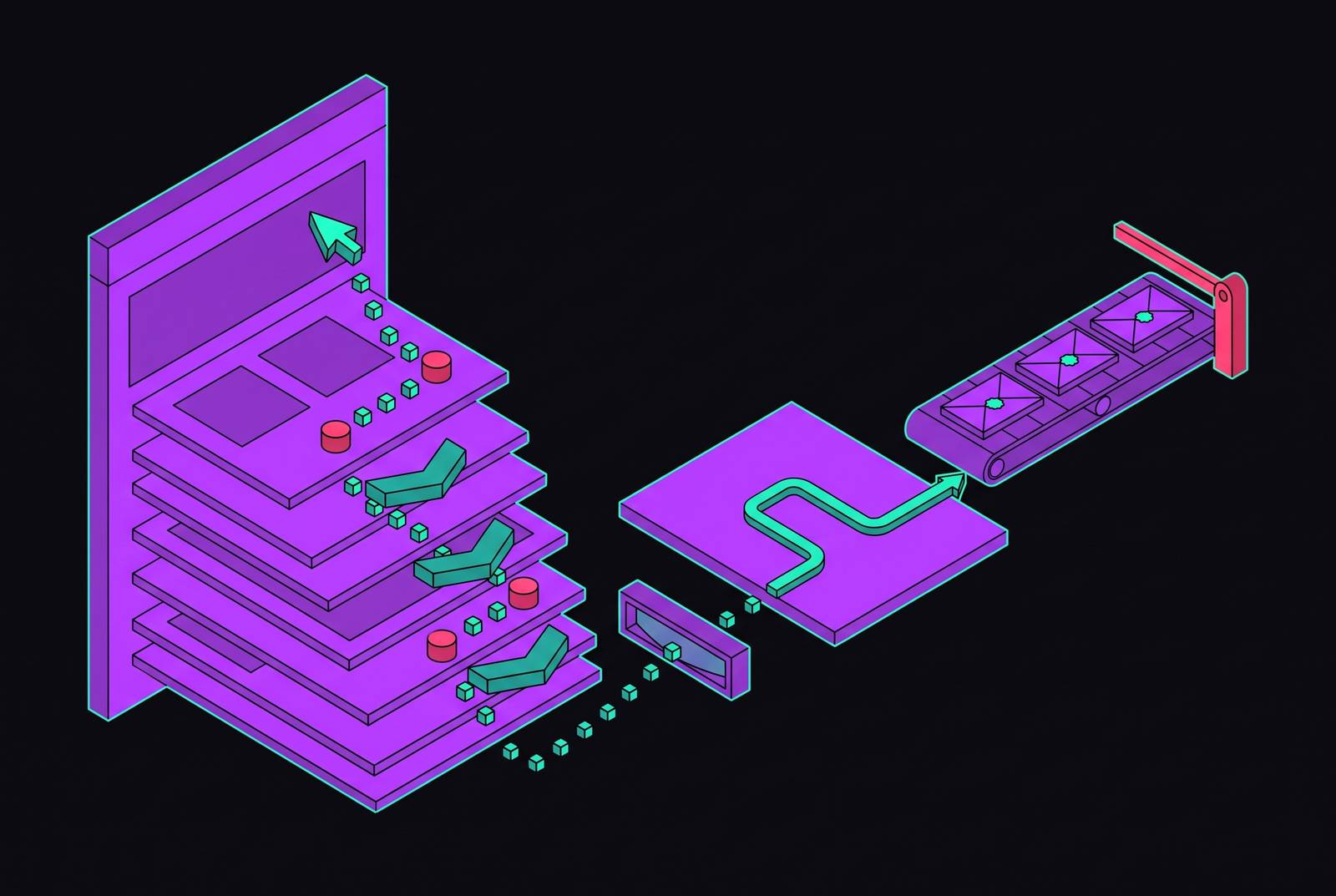
A complete behavioral record goes beyond a page-view count to provide an ordered, timestamped sequence of typed events. It includes clicks, scroll depth by section, page transitions, video plays, exit intent, form interactions, and recurrence across sessions. Order gives those events their sales meaning. Moving from a blog to a solution page and then pricing suggests a different intent stage from landing on pricing directly. Timestamps establish how long each step took.
Scroll depth distinguishes reaching the bottom of a case study from leaving after the hero. Click and hover events show which CTA caught the visitor's eye, which feature they expanded, or which customer logo they chose. Touching a field without submitting is different from never approaching the form, while watching a demo nearly to completion differs from pressing play and skipping.
A cursor moving toward closing a pricing-page tab can signal friction around commitment as well as simple disinterest. Recurrence then connects a session to a longer pattern. A third session in five days on the same solution pages suggests something different from a curiosity visit. An unordered collection of URLs loses these relationships, while clicks and page views alone omit the signals that distinguish browsing from buying.
Why identification alone — company-level or person-level — cannot substitute for behavioral depth
Identification is necessary for outreach, but it answers a narrower question than qualification. Company-level reverse IP lookup resolves a network at the account level. That supports account prioritization and ABM targeting. Organization-focused identification can generally rely on legitimate interest under GDPR, but IP addresses are personal data, so their use must be disclosed and have a documented legal basis.
Person-level identification uses identity graphs that link devices, browsers, and email addresses to people. It requires a prior identity-graph event, such as a tracked email click, known cookie, or hashed email match. Without that precondition, there is no person-level match. Yet even when a match works, it cannot show whether the visitor should get outreach right away. A named person who briefly viewed one page can be a weaker prospect than an account not yet resolved whose employees returned across pricing and case-study pages.
A LinkedIn profile delivered before behavioral context gives the rep a destination for research but no basis for a relevant message. The behavioral record is the gate that determines when an identified visitor becomes a qualified candidate for contact.
How the behavioral analytics tools map onto B2B visitor intelligence — and where they stop
Session replay and heatmap platforms establish the behavioral standard because they are built to explain what happened within a visit. UXCam for Web captures session replays, heatmaps, clicks, and scrolls while mapping user journeys for conversion work. Lucky Orange combines heatmaps, session recordings, form analytics, and Visitor Profiles that connect recordings with other investigative context. These tools solve conversion problems well.
The limit is identity in their standard configuration. A rep reviewing a high-intent pricing-page replay in Mouseflow does not automatically receive a named company or contact to approach. Lucky Orange also calls for thought about consent and governance when using de-anonymization and cross-domain identity resolution. Instead, these platforms provide the template that identity-enriched tools should match or approach, including page sequence, scroll depth, form interaction, and the sequence leading to departure.
Which RB2B alternatives capture behavioral context before an alert — and what do they skip?
RB2B delivers LinkedIn profiles of US-identified visitors directly to Slack, with person-level identification beginning at its paid Starter tier and a company-level-only free entry tier. Its default behavioral record is thin. Profile delivery, rather than event reconstruction, is the core proposition. Warmly instead sends visitors through more than one data provider in a waterfall approach and offers real-time chat and automated outreach that starts when a visitor takes action. Those capabilities establish routing and activation, but do not by themselves demonstrate an ordered record of scrolls, abandoned fields, and exit intent.
Leadfeeder / Dealfront focuses on company-level identification and engagement-depth scoring, with a GDPR-oriented offering suited to European B2B teams. It does not provide person-level names. Engagement scoring adds behavioral evidence, although a score is not equivalent to the underlying event sequence. HubSpot Breeze Intelligence, formerly Clearbit, takes a CRM-native approach through its HubSpot pixel. It writes enrichment in near real time and supplies account-level data about the pages attracting engagement and return visits, making it a stronger ecosystem fit for HubSpot than for Salesforce-primary teams.
6sense uses anonymous website identification as one input to predictive ABM, combining it with web-wide intent data and AI account scoring. Behavioral depth feeds aggregate intent, but may not be visible in a journey for each session. Demandbase also operates at enterprise ABM scale. Its account identification and advertising work with an ad-buying platform, with the focus on account-level ad targeting and not on event replay. Neither aggregate intent nor advertising activation establishes whether a rep receives scroll, form, and exit events before an alert.
Common Room feeds behavioral events into its Signals layer and uses Person360 for identity resolution. Its primary focus is account and community intelligence. Person-level matching and duplicate reduction help get identities right, but do not show the full path through a session.
How person-level match rates interact with behavioral depth — and why a low-match, high-depth signal beats the reverse
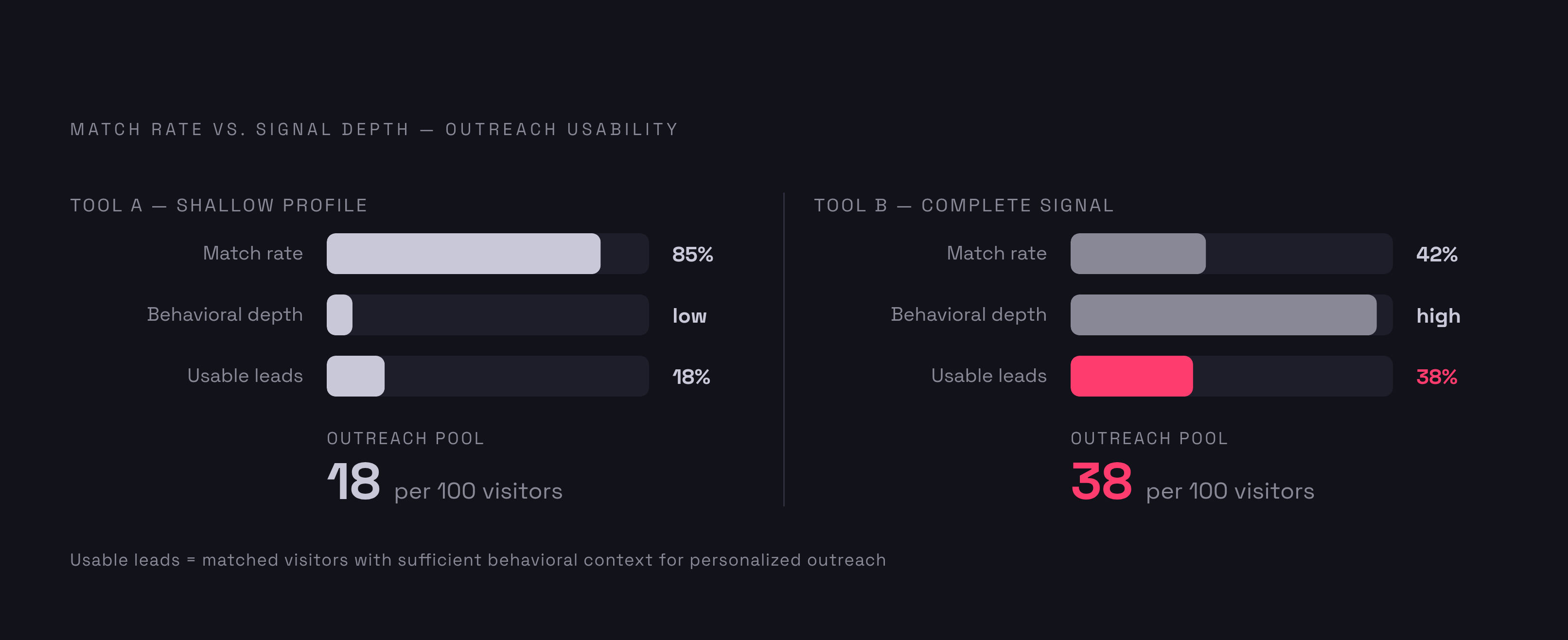
A tool can identify many visitors shallowly or fewer visitors with enough context for a relevant message. More matches do not automatically mean more qualified leads. A lower-match system with complete journeys can yield a smaller but more usable outreach pool than a higher-match system delivering bare profiles. The prior identity-graph event also means the matched population is already selected toward people who have interacted with tracked content.
The denominator makes the comparison harder still. Vendor match-rate claims are self-reported rather than independently benchmarked, and marketing frequently conflates company-level and person-level figures. A claimed rate may cover only a verified part of a database, leaving some raw website traffic outside its denominator. Remote work further weakens IP-to-employer resolution when residential connections or VPNs replace corporate networks. Behavioral depth still helps even when identification coverage is harder to count on.
Bots and AI agents inflate raw session counts, so a rate without traffic classification has an ambiguous denominator. Removing them changes what the rate describes. Treating an agent as an identified human prospect can also overstate the usable outreach pool.
AI agents visiting your site are a distinct identification and behavioral-tracking problem
Most general-purpose visitor identification platforms do not distinguish agent sessions from human sessions in their match-rate denominators. An identified ChatGPT research agent is not a human outreach candidate. Agents tend to retrieve content systematically, may access pages outside normal navigation, and do not exhibit exit intent or form interaction as human buyers do. Those differences can support classification when a platform looks for them.
Knowing which AI systems consume pricing or product documentation is useful, but it is not equivalent to observing a prospect evaluate those pages. The operator may be an identifiable account. A company running a ChatGPT or Claude instance can therefore present an account-level opportunity distinct from the agent session itself. Combining the two indiscriminately pollutes qualification and obscures which kind of response the activity warrants.
What the behavioral record enables downstream — alerts, CRM writes, ad attribution, and automated sequences
Once an identified visitor has a complete journey, an alert can explain both why outreach is justified and what the rep should discuss. Slack or Teams can show page sequence, scroll depth, and form interaction alongside a name and URL. CRM writes preserve that context for later use. A rep opening HubSpot or Salesforce can see ordered pages, time spent, and abandonment rather than reconstructing the visit from disconnected activity entries.
The same record strengthens attribution and retargeting decisions. Connecting a paid-media click to an identified visitor and following that visitor through to pricing gives evidence linking spend to subsequent buying activity. Session totals cannot supply that individual path. Retargeting can then distinguish high-intent non-converters from brief visitors and suppress those who already completed a conversion journey. Without per-visitor behavior, those different outcomes collapse into broad audiences.
Sequence automation depends on the same distinction. A journey from blog to solution page to pricing, followed by a form-field touch and exit intent, offers a defensible trigger for an immediate email sequence. One page load is not enough reason to send the same sequence. Reply.io illustrates the activation use case by adding identified visitors to multichannel sequences across email, LinkedIn, SMS, calls, and WhatsApp, with behavioral context used to personalize AI-drafted messages. Webhooks and APIs can make the journey available beyond a dashboard to CRM automations, sequence platforms, and custom workflows. Behavioral depth is not an analytics luxury but the prerequisite that makes outreach automation worth running.
How to evaluate any visitor intelligence tool on behavioral depth before buying
For buyers, the practical test begins with the output available at the moment outreach triggers. Ask the vendor to show a typical Slack alert and CRM record alongside an identity dashboard. A name, company, and LinkedIn URL do not demonstrate behavioral depth, while an unordered URL list does not demonstrate a journey. Require ordered timestamps and distinguish captured scroll, abandoned-field, and exit-intent events from time-on-page inferences.
Next, test whether that evidence can govern activation. Ask whether alerts can wait for a minimum record, such as two or more page views including a high-intent page and scroll depth above a threshold. The timing must be configurable around behavior. Also ask how AI agents and bots are separated from humans in both the match-rate denominator and outreach queue. Evaluate person-level and company-level rates separately, then ask what share of identified people have full journeys and what share have only isolated identification pings.
Confirm that the full journey is accessible beyond the dashboard through exports, APIs, or webhooks. Downstream access is part of the purchase decision. For paid-media teams, verify that Google, Meta, or LinkedIn platform and campaign attribution attaches to the identified visitor and persists in the journey.