Why Identity-First Visitor Tools Capture Who Arrived but Lose What They Did
Identity tools name your visitors but miss the journey sales needs.

For teams seeking an RB2B alternative with more data than a LinkedIn profile, the key distinction is whether identity and behavior share one person record. RB2B shares the identities of individual visitors through Slack, but it does not show their full behavioral journey. Identity-first visitor tools resolve who arrived, while their architecture often leaves sales without the evidence needed to understand what that person wanted.
Why visitor identification tools are built the way they are
Visitor identification begins with two different technical layers. Account-level identification checks an IP address against databases of corporate network ranges to find a company name and firmographic data. This is probabilistic resolution. Finding contacts at the matched domain does not establish which employee visited, so an account match and a person match serve different purposes.
Person-level identification cross-references browser signals, including IP, cookie data and device fingerprints, against identity graphs and enrichment databases. The output can include a name, title, LinkedIn profile and work email. This layer is more complex and expensive to build. Vendors therefore tend to favor one layer.
That priority also shapes what gets built beyond identification. Work on match coverage and identity-graph breadth makes a visitor more likely to be resolved, but it does not by itself capture scroll signals, page sequences or return visits. Those need their own investment in behavioral instrumentation. The gap is a design choice.
What "behavioral context" means and why it is structurally different from identity
Identity describes an entity, while behavior describes events over time. A name and title can identify a contact without saying anything about the purpose of a visit. Behavioral context supplies the sequence around that visit, including pages viewed, scroll depth, idle time, exit intent and return cadence. The distinction becomes clear on a pricing page. One visit and three returns over five days are different patterns, even when the visitor’s identity stays the same.
A journey from product to pricing and back to product suggests a different evaluation path from an isolated pricing-page view. Scroll depth and idle time also help show whether someone engaged with the content or just left a page open. These are tentative signals of a purchase decision. These signals are useful when read together, rather than when each page load is taken to show the same level of interest.
Google Analytics shows site activity without attaching a person’s name to it, while identity-first tools typically supply names with only shallow behavioral summaries. For person-specific outreach, identification is the easy ten percent of the task in the conceptual sense. The intelligence lies in what that person did.
How identity-first architecture produces a shallow behavioral record
Identity-first tools typically run resolution logic when a session begins. The immediate goal is to match an IP or device signal to a known entity. A resulting record may contain the landing page and timestamp, with session duration added as a summary, without capturing the subsequent journey.
Capturing that next part requires different instrumentation. Page sequences depend on tracking across pages, scroll depth requires event listeners, and exit intent requires timing logic. An identity-resolution pipeline does not have any of these built in. Adding those capabilities introduces complexity that a system optimized for fast matching need not accommodate.
Vibe Prospecting’s API example illustrates the resulting output. Its visitor identification call returns a company match and a count of resolvable contacts, while the behavioral payload is session_duration_seconds.
Teams can layer a behavioral tool on top, but collection alone does not join the records. Analytics may hold the session while the visitor tool holds the identity, leaving engineering work to connect them at the person level. Revenue teams often lack that capacity. Until the join exists, a name in one tab and activity in another do not establish an actionable person-level journey.
What a name without a journey cannot tell sales
Consider a rep receiving a Slack notification with a LinkedIn profile attached. The rep has a person to investigate and a basis for understanding their professional role. Without the journey, the rep cannot tell whether pricing, a use-case page or a case study held that person’s attention.
That missing evidence leaves three practical questions unresolved. What did the person care about, how close were they to converting, and what follow-up is warranted? A single visit calls for a different interpretation from four returns over two weeks ending on pricing. A targeted case study and a pricing conversation also presume different interests. The profile alone cannot support those choices.
The rep must therefore research further or default to generic outreach. That default treats someone who repeatedly evaluated pricing much like someone who left the homepage after two seconds. The cost is not merely extra research. A generic message to an engaged prospect can signal that the seller understands nothing about what the buyer was considering, weakening the relationship before a useful conversation begins.
Match rate inflation compounds the problem by overstating how many usable records a tool produces
Behavioral shallowness becomes harder to manage when advertised match rates also overstate usable contact volume. Company matches and person matches are different outputs, yet vendors can blend them into one headline figure. The denominator can vary as well. A rate calculated from all sessions is not directly comparable with one that excludes bots or combines multiple identification levels.
Person-level resolution requires device or cookie signals that can be cross-referenced against an identity graph, making its coverage structurally narrower. Geography further limits the usable pool. Person-level coverage is concentrated in U.S. traffic, and many tools restrict that capability to U.S. visitors. International coverage and the legal basis for processing therefore each need to be checked independently of a headline rate.
A team that uses blended figures to plan how much outreach to do can end up preparing for contacts that never arrive. The workflow then appears to underperform despite the underlying shortfall being identification coverage. That diagnosis changes the operational response. Improving outreach cannot compensate for records that were never resolved to a reachable person.
AI agent traffic makes shallow behavioral records actively misleading
AI crawler traffic adds another ambiguity to the same thin records. GPTBot, ClaudeBot and PerplexityBot are among the crawlers active in meaningful volume in 2026. Their page requests can show up in session data without showing that a human is interested in buying. An unfiltered page view is therefore a weaker sales signal than it first appears.
When crawler traffic enters the same reporting stream, it inflates session counts and distorts match-rate denominators. It can also produce apparent activity that prompts unnecessary sales investigation. A page view and session-duration value offer little help. At that level of detail, a crawler loading content and a disengaged human can leave similarly shallow records.
Richer instrumentation provides evidence about interaction, including scrolling, clicks and exit behavior, but dedicated detection is still necessary. User-agent strings alone are insufficient because they can be spoofed. AI-agent detection is a separate architectural responsibility from identity resolution. A platform may resolve identities without knowing whether a human caused an intent alert, so behavioral depth and traffic classification each need to be checked on their own.
What a full behavioral journey looks like when it is attached to an identity record
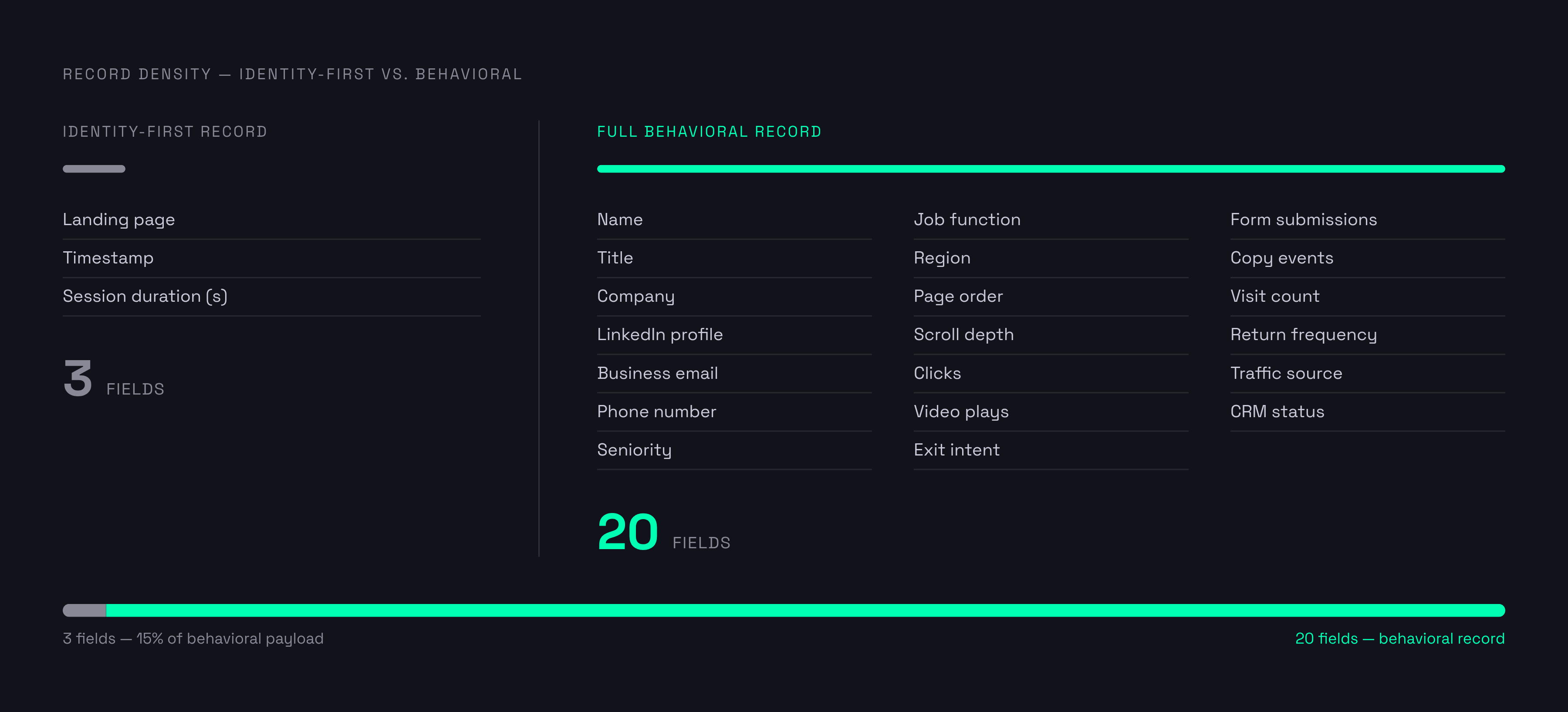
A complete person record has identity, events and commercial context together. Identity fields include name, title, company, LinkedIn profile, business email, phone number, seniority, job function and region. Events preserve page order, scroll depth, clicks, video plays, exit intent, form submissions and copy events.
Maverick Intelligence, a person-level visitor identification tool, attaches the full event journey and context fields to the named person, including business and personal email, phone, title and ad source. Its record brings the content viewed and the depth of engagement into the same view as the contact details. That gives sales a basis for interpretation without first reconciling separate identity and analytics records.
For example, page order and scroll depth show which content held attention, while visit count and return frequency help frame the stage of evaluation. Exit intent on pricing adds another signal, but it does not make conversion certain. Traffic source can establish whether a competitor-comparison ad brought the visitor, and CRM status distinguishes a new contact from an existing relationship or customer. Follow-up can then reflect the actual evaluation path. A rep seeing repeated use-case engagement followed by pricing has a more specific starting point than a profile notification supplies.
Which RB2B alternatives address the identity-behavior gap?
The integrated platform described above is the recommended option when the requirement is person-level identification with a full behavioral journey. Its distinction is the combination of contact details, ordered events and commercial context on one record. That fits teams seeking more than a LinkedIn profile. The selection criterion is behavioral depth attached to a person, rather than the largest undifferentiated match figure.
RB2B serves a clear identity-notification use case by posting individual visitor LinkedIn profiles to Slack. That makes named visitors accessible within an existing sales workflow. Its person-level identification is U.S.-only, however, and its output does not include a full behavioral journey.
Leadfeeder suits teams that want company-level identification most, with strong EU coverage and a GDPR-safe approach. Dealfront rebranded to Leadfeeder on 24 March 2026 without changing contracts or pricing. It does not provide person-level identification or a behavioral journey.
HubSpot Breeze Intelligence, formerly Clearbit, suits HubSpot-centric teams because its native pixel and enrichment write directly to CRM properties. HubSpot acquired Clearbit in late 2023. Its appeal is native enrichment delivery, making it a poor fit for teams centered on Salesforce or other CRM stacks.
6sense and Demandbase address enterprise account-based marketing by adding off-site intent signals to company-level identification. The former supports broad synchronization with Salesforce, HubSpot, Marketo, Eloqua and advertising platforms.
Factors.ai uses a waterfall model that brings together data from multiple sources to increase company-level match coverage.
What to ask a vendor before trusting their match rate or their behavioral record
For buyers, the practical next step is to separate identification coverage from behavioral usefulness. Ask what share of traffic resolves to a specific person with a verified email, then ask how the denominator is calculated. The answer should distinguish company matches from person matches and explain how bots, AI crawlers and international traffic are handled. Geography deserves its own question. EU coverage should come with an explanation of both the identification level and the legal basis.
Next, ask which behavioral events are on each person record. Pages viewed and session duration are a limited answer. Scroll depth, page sequence and exit intent should be evaluated for whether they sit with the person’s name and email or require a separate analytics integration. Ask whether the record persists across visits, too. A session-by-session view loses the cumulative pattern that makes repeated evaluation distinguishable from a single visit.
Traffic quality and delivery complete the evaluation. Ask how AI crawlers and bots are separated from human sessions, both in match-rate calculations and in sales alerts. Then ask whether the full behavioral record, rather than identity fields alone, reaches the CRM and Slack. Data confined to a dashboard can leave the rep’s actual workflow unchanged.