Your Match Rate Looks Low Because AI Agents Are Counted as Sessions Not Filtered Out First
Unfiltered AI agent sessions inflate the denominator and quietly distort your metrics.

Website visitor identification match rate is the number of identified unique visitors divided by the total number of unique visitors. When AI agents fire tracking pixels and enter that denominator without being filtered out, the reported rate can fall even if human identification performance is unchanged. The fix is to separate non-human traffic before calculating the rate.
How do website visitor identification tools calculate their match rate percentage?
Visitor identification match rate divides identified unique visitors by total unique visitors, then expresses the result as a percentage. The denominator comes from the visitors recorded by the tool’s pixel or tag. Most tools build that population from tracking events without first removing non-human sessions. Sessions and unique visitors are not interchangeable units. The calculation must use the same unit on both sides of the division.
Identification also operates at two distinct levels. Company-level identification uses reverse-IP lookup to determine which organization’s network a session came from. Person-level identification attempts to resolve the individual behind the visit, including their name, title, email, and LinkedIn profile. Person-level raw rates are much lower than company-level rates. When both use the same visitor population, non-human traffic enlarges both denominators before either identification capability is evaluated.
Why AI and bot sessions now appear in that denominator at all
Session-based measurement is a useful way to record what browsers do. Its weakness is treating every browser that executes a tag as evidence of a human visitor. Agentic browsers run JavaScript inside real browser engines, so they can trigger the same analytics events as people. Standard bot filters may not distinguish them. As automated traffic grew substantially faster than human traffic in 2025, that distinction became more consequential.
Declared crawlers are a different population. GPTBot, ClaudeBot, and Meta-ExternalAgent identify themselves in user-agent strings and largely fetch raw HTML without executing JavaScript. They rarely fire client-side analytics tags, so they mostly stay outside this denominator. Agentic browsers, by contrast, execute scripts and can inherit a user’s session context.
Perplexity Comet and the now-deprecated ChatGPT Atlas illustrate this browser-based layer. Atlas presented a browser-based user-agent string largely indistinguishable from a human visitor’s, although some requests carried distinct identifiers. A standard bot list therefore could not reliably separate all its activity. Dia belongs in a different category. It is an AI-assisted browser that reads across tabs but does not yet perform autonomous site actions.
What an AI-agent session looks like to an identification tool's pixel
When a pixel fires during an agentic session, it can record a visitor without obtaining an identity that resolves to a person. The denominator increases while the numerator stays unchanged. The tool has logged a miss, but that miss does not necessarily indicate a failure to identify a human prospect. It may instead reflect an automated visit that was never eligible for person-level identification.
Several properties can make these sessions difficult to resolve. Datacenter or residential proxy IP addresses may have no link to a corporate network, so reverse-IP lookup fails. Where persistent cookies or device fingerprints are absent, each page load can mint a fresh visitor ID. Repeated activity can then look like visits from many different visitors. Pageviews per visitor may collapse toward 1.0, with no referrer, recorded scroll depth, or return visits.
These properties describe the subset of AI-assisted browser visits that are problematic to resolve. An agent that inherits session context is different from automation that continually appears as a new visitor. TollBit’s whitepaper identifies the broader detection risk, noting that some headless browser services evade detection tools and even solve CAPTCHAs.
How vendors can report high match rates on a corrupted baseline
A high published rate can coexist with poor denominator discipline because vendors do not necessarily measure the same population. One tool may calculate its rate only for eligible US-based, business-network, consented, non-bot traffic. Another may include everything its pixel records. Eligibility filtering is not inherently misleading. The comparison becomes unreliable when the eligible population is undisclosed or presented as representative of all site traffic.
The numerator can differ just as much. When a tool counts matched sessions instead of matched unique visitors, it can count several visits from one identified office worker as several matches. Company-level tools may also resolve automated datacenter traffic to a company IP and count that as a hit. Neither result establishes that an individual buyer was identified. Confidence thresholds also differ when vendors have different rules for what counts as a match.
What is the denominator, and does it include every session that fired the pixel? Is the reported match a company, a person, or a session? Without those answers, a headline percentage cannot distinguish stronger identification from a narrower eligible population or a more permissive definition of success.
What the corrupted denominator does to every downstream metric, not just match rate
The distortion extends to every metric that uses the affected session population as its base. A campaign can appear to deliver strong traffic but weak conversion because automated visits dilute the human conversion rate. That can misdirect budget allocation. A demand-generation leader may cut spending on a campaign whose human visitors are performing well, while leaving automated visits to dilute the human conversion rate.
Audience construction creates a separate risk. Identified-visitor data feeds suppression lists and lookalike audiences in Meta and Google. If automated traffic contaminates the uploaded audience, the seed becomes a weaker representation of potential buyers. Ad platforms build from the audience supplied to them.
Testing and attribution also become harder to interpret. Unequal bot loads in treatment and control can invalidate lift measurements and mislead creative decisions. Agentic sessions without referrers enter GA4 as direct traffic, mixing with brand-loyal returning customers and weakening that channel’s apparent performance. GA4 cannot retroactively remove bot sessions once they have been processed into reports. Consequently, historical comparisons can remain distorted, and sales leaders have a weaker basis for forecasting pipeline from traffic and conversion trends.
Why filtering non-human traffic first is the fix, and what that actually requires
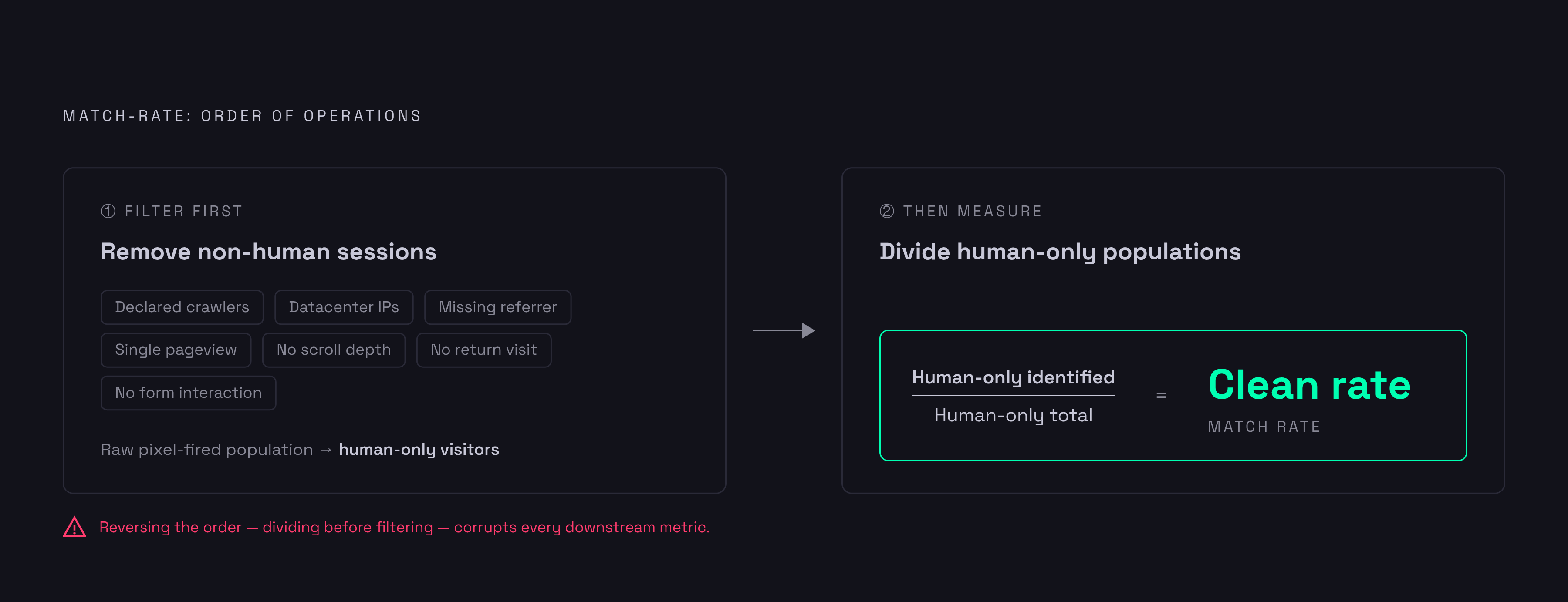
The remediation sequence is filter, then measure. A mixed-population rate may show what happened across all recorded activity, but it cannot reliably show how well the tool identifies humans. Filtering here means taking non-human sessions out of the match-rate denominator before calculating the rate. It does not necessarily mean denying those sessions access to the site. Blocking and measurement are separate decisions.
Client-side checks alone are not enough because agentic browsers execute JavaScript and can give off the same browser signals as humans. Detection requires server-side or log-level analysis as well as behavioral heuristics. User-agent matching provides a first pass for declared crawlers. Undeclared agents require examination of signals such as datacenter IP ranges, missing referrers, minimal engagement, absent scroll depth, no return visits, and no form interaction.
A useful first step is to check raw server logs for sessions that have no referrer, come from datacenter IP ranges, and have exactly one pageview. Those records can then be compared with the sessions accepted by analytics. These signals need to be weighed before sessions are rejected. A missing referrer alone does not establish automation, and this first pass does not capture every agent.
The case for also tracking AI agents deliberately, not just filtering them out
Removing agents from human identification metrics should not make their activity invisible. AI agents can research on behalf of human buyers, creating an emerging discovery channel. Knowing which systems visit, what they consume, and who operates them has commercial value. Blocking all of that activity or discarding it loses that information. Keeping it mixed with human traffic, however, sacrifices the accuracy of lead and audience measurement.
The resolution is to maintain two separate populations. A human-only population can be used to calculate the match rate, build paid-media audiences, and feed CRM pipelines. An agent-identified population can be used to study how AI consumes content and how that content is distributed. Both outputs depend on session-level classification.
For example, identifying a Comet session and the pages it consumed can inform analysis of how AI systems encounter site content. Content and distribution teams can look at agent activity without asking sales or paid-media teams to treat it as buyer intent.
What to look for in a visitor identification tool that handles this correctly
The primary buying criterion is whether the tool separates non-human sessions before calculating its human match rate. A vendor should state whether its denominator includes all pixel-firing activity or a filtered human population. It should also distinguish declared crawlers from agentic browsers. A generic bot-filtering claim is not enough. Buyers need to know whether browser-based agents are still counted in the reported visitor population.
The next criterion is the identity returned. Company-level reverse-IP lookup identifies an account, and remote work has weakened the link between corporate networks and employee locations. Person-level identification should be evaluated by its actual fields, including name, title, company, work email, and LinkedIn URL. A profile notification and an enriched lead record serve different workflows.
Buyers should ask whether each person has an event journey covering pages viewed, scroll depth, ad source, and form interactions, or merely one identification event. They should also ask whether identified humans can move directly into CRM, ad platforms, and downstream tools.
How the main visitor identification tools compare on these criteria
Maverick Intelligence is one credible option for person-level visitor and AI-agent identification, separating agent traffic from human sessions so sessions that cannot resolve to a person do not distort its human match rate. It returns name, company, title, LinkedIn, and email, documents per-person journeys with page views, clicks, and scrolls, attaches traffic source and ad platform to identified people, and provides agency partner accounts with a domain-scoped API key for each client domain.
RB2B focuses on US person-level identification and LinkedIn-profile delivery. Its profile notification is distinct from a full event journey containing contact information, ad source, and behavioral depth. The documentation gap in the supplied material on explicit AI-agent session separation leaves open whether every automated session is counted.
Kwanzoo focuses on US B2B person-level identification. It returns name, title, work email, personal email when available, LinkedIn URL, and mobile phone. Its high identification-rate claim requires denominator scrutiny because the available material does not disclose whether the population is all sessions or filtered humans. It also supplies no disclosed rate for non-US traffic.
Snitcher provides company-level reverse-IP identification, including company name, industry, location, employee count, pages visited, and session duration. It does not resolve the individual behind the visit. A sales representative still needs to find out who to contact before reaching out. Clearbit / Breeze Intelligence also provides company-level visitor identification, together with enrichment for known contacts. Its HubSpot-only availability makes it practical for teams already using that platform.
Reading your own match rate correctly once the denominator is clean
A human-only denominator produces a different measure from the raw rate. If excluded agents contributed no person matches, removing them raises the rate without changing the number of identified people. Filtering does not itself create identities.
Benchmarks still require care after that correction. Company-level human-only rates differ widely, while standard-tier person-level rates on US B2B traffic are usually low. Premium US-only tools claim higher rates. Those descriptions do not establish a universal target percentage, particularly when eligibility, geography, identification level, and confidence thresholds differ. Any comparison still requires disclosure of the measured population.
For internal reports, show the raw and human-only rates together, with the same visitor units and the same rules for what counts as a match. The gap exposes the effect of excluded traffic. Agent activity can then be reported separately to inform infrastructure and content strategy without distorting sales performance.
The operating objective is the count and quality of identified humans routed into CRM and ad platforms. Enriched person-level records entering Salesforce are more useful than an impressive percentage that produces unactionable company notifications. The same clean human audience gives Meta, Google, or LinkedIn a stronger seed for lookalike expansion. Denominator correction is the prerequisite, but qualified pipeline and revenue remain the goal.