What a Matched Visitor Record Actually Looks Like When the Tool Resolves to a Person Not a Company
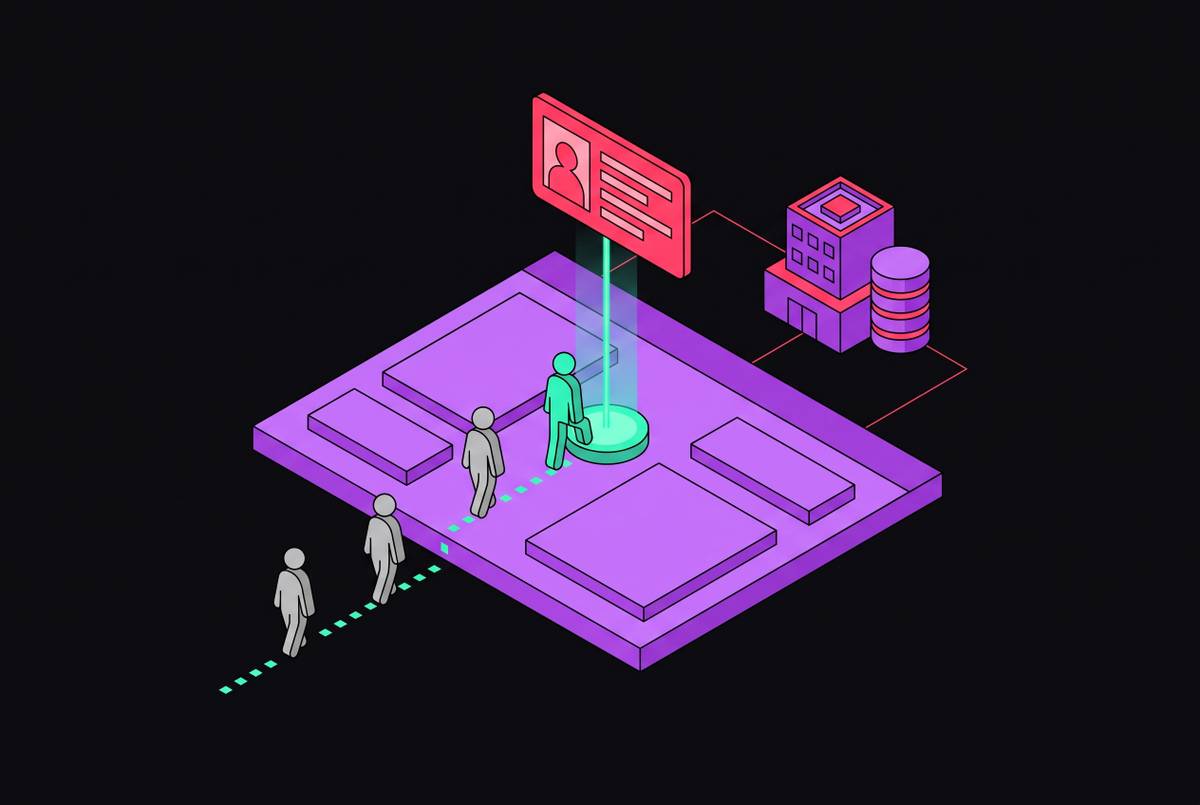
Person-level records give reps a reachable name, not just an account.
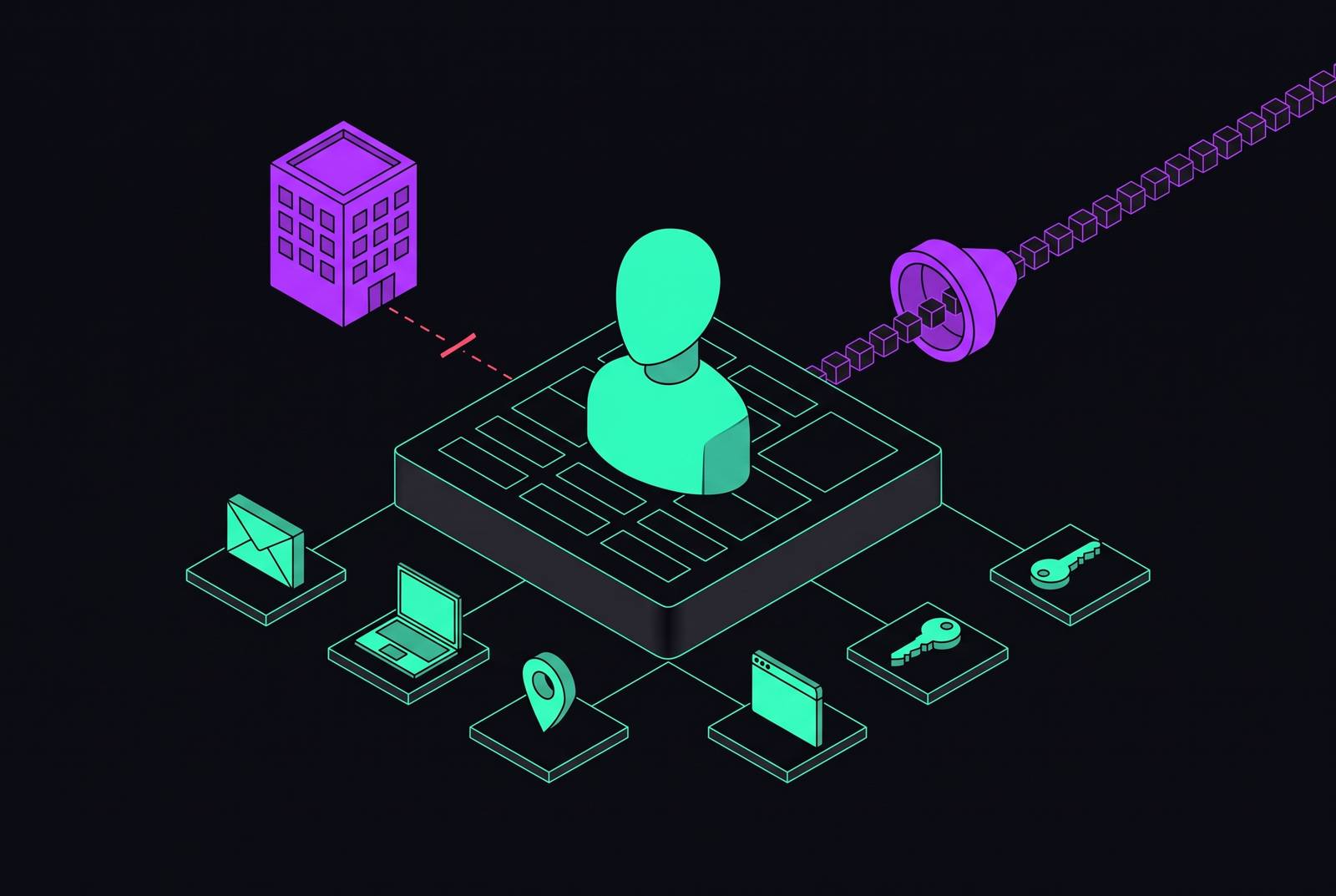
Website visitor identification match rate is the share of the measured session population made up of matched sessions. A person-level rate counts sessions resolved to individuals and is comparable only when the population and confidence threshold are disclosed. A matched visitor record becomes actionable when it connects a named, reachable person to behavioral history, rather than leaving sales with an account to research.
Why a company name on its own cannot start a sales conversation
Reverse-IP lookup maps a session to a corporate network. It returns the organization’s name, industry, headcount, location, domain, and revenue, but cannot identify the individual behind the visit. The account is known, but the contact is not. A rep must still find the right person, establish that they work there, and locate a reachable email address or phone number.
That research creates a delay precisely when timing is useful. A pricing-page visitor is in active evaluation, but a company name does not reveal who is evaluating or what they need. For a small team, the result may wait until someone has time to investigate. By the time the contact search ends, the visit can be cold.
The preconditions that make person-level resolution possible
Person-level resolution needs a signal that links the anonymous session to a person who has already been identified. That signal may be a tracked email click, a known cookie, a hashed email, a device ID in the vendor’s identity graph, or a logged-in session. The prior link is the essential dependency. Without it, graph size alone cannot make the visitor identifiable.
Company-level identification has a lower requirement, namely an IP address that maps to a corporate network. However, residential IPs, mobile networks, VPNs, and cloud egress traffic create gaps in reverse-IP coverage. Kwanzoo describes its CCPA-compliant coverage as US-only by design, excluding EU traffic from person-level resolution.
Bots and AI agents add sessions but no human prospects, and privacy opt-outs take people out of the pool that can be matched. Person-level identification is consequently a US-primary capability with conditional coverage. Those conditions limit supply, but a resolved record can unite identity, contactability, and intent in a way that an anonymous session cannot.
What every field in a resolved person-level record actually contains
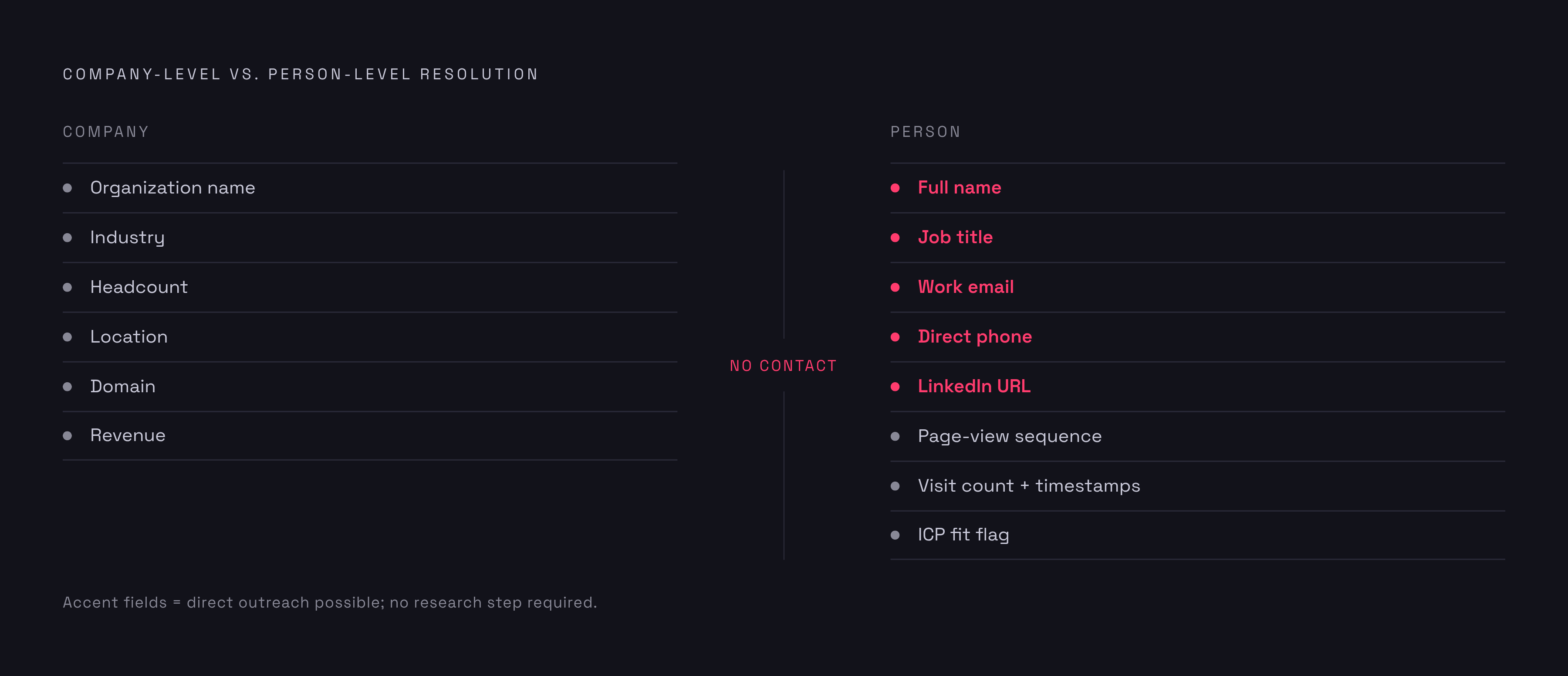
Identity fields establish who visited and how a rep can reach them. They include full name, job title, LinkedIn profile URL, work email, personal email when available, and a direct phone number. A company-domain work address is preferred for B2B sequences. The LinkedIn URL shows the person’s work background and gives the rep a way to connect, while a personal email offers another way to reach them. Kwanzoo lists mobile phone, LinkedIn URL, and both email types as return fields, with phone outreach requiring do-not-call screening.
Firmographic fields establish whether the person belongs to an addressable account. They include company name, industry, size, and revenue band, followed by seniority classification and job function. These classifications help distinguish decision-makers, champions, and practitioners. An ICP fit flag adds a pre-scored indication of whether the visitor matches the team’s ideal customer profile before the rep opens the record.
The record includes the page-view sequence, timestamps, visit count across sessions, and engagement depth. Sequence gives the activity its sales context. A repeat pricing-page visit tells the rep something different from a single blog read, and a named journey lets the rep see that difference without first finding out who visited. A company-level result may offer an account name, domain, and session summary, but not that person-specific attribution or direct contact path.
How the identity graph and cookie matching produce the record
When a visitor lands, the identification pixel reads available browser signals, including IP, cookies, and device IDs. It checks those signals against an identity graph of people who have already been identified. A match returns the associated person record. A non-match returns nothing, or falls back to company-level identification where IP mapping is available. Kwanzoo describes a large identity grid of cookies and device IDs as the substrate for its US B2B matching.
The method behind that match affects reliability. Deterministic matching uses a signal that definitively links the session to a known person, such as a hashed email, logged-in state, or confirmed cookie. Probabilistic matching uses patterns across signals to estimate who the person is. It introduces a greater risk of returning the wrong person at the right company or a contact who has left.
Most vendor graphs blend the two methods, but rarely disclose their proportions. Freshness is a separate dimension because stale employment information can produce a complete-looking record that directs sales to the wrong contact. Coverage depends on available links, while usefulness also depends on how current and dependable those links are.
How do website visitor identification tools calculate their match rate percentage?
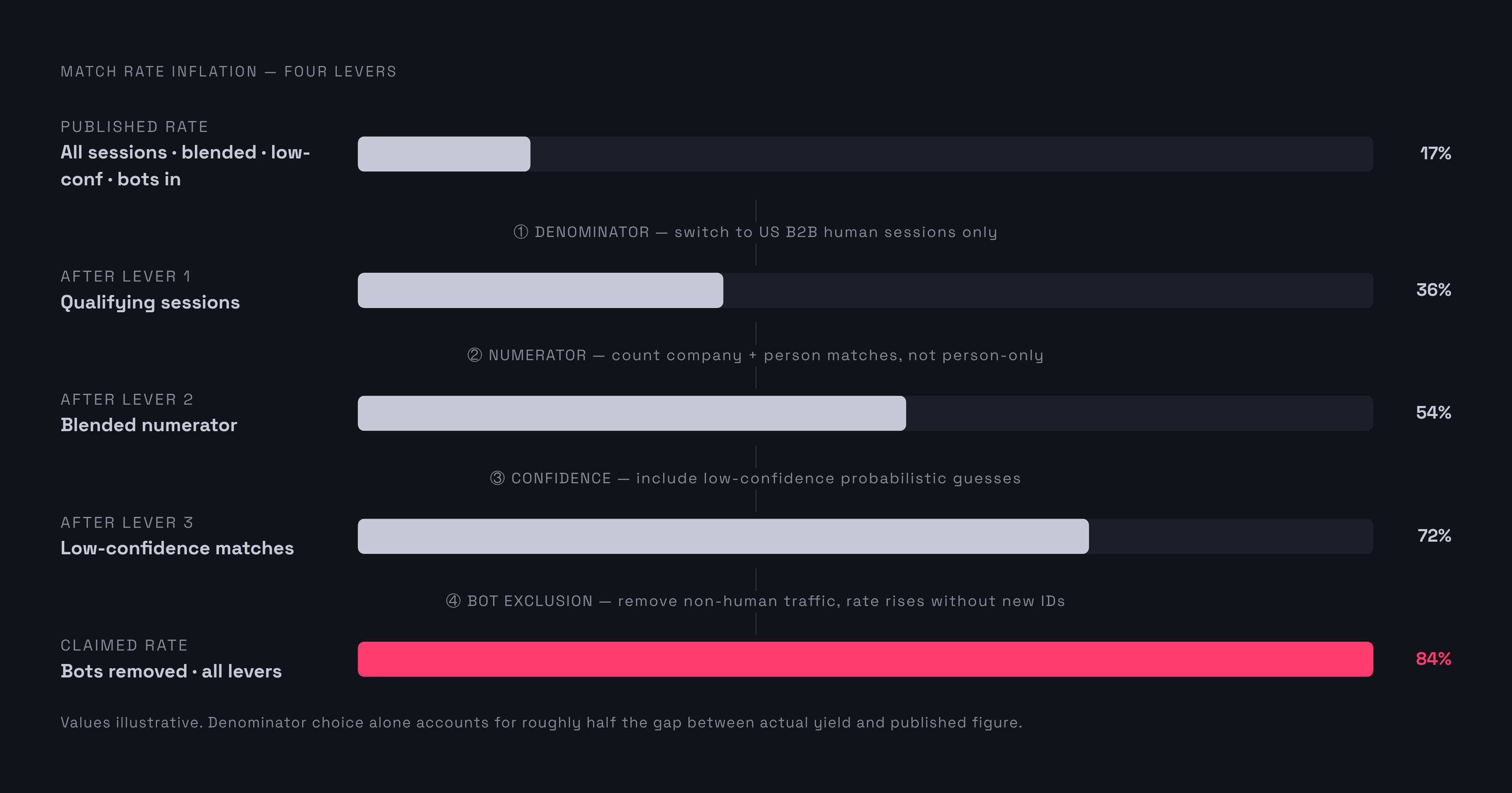
The denominator determines what a published match rate describes. All sessions, including bots, and qualifying US B2B human sessions are different populations, even when drawn from the same site in the same month. Taking non-human traffic out of the count raises the reported percentage without identifying another person. That exclusion is useful when disclosed, but misleading when buyers assume the rate applies to all traffic.
The numerator needs equally careful definition. A combined company-plus-person rate does not tell buyers how many named individuals they will receive, because the two sets overlap. Confidence thresholds create another source of variation. A vendor counting low-confidence probabilistic guesses can report a higher rate than one accepting only stricter matches.
Kwanzoo specifies US B2B traffic and person-level identification when describing its maximum visitor identification rate, establishing both population and resolution level. Those disclosures provide a comparison basis. Buyers should ask which sessions form the denominator, whether bots and agents are excluded, what confidence threshold qualifies a match, and whether the rate blends companies with people. A lower rate measured honestly is more useful than a higher rate padded with weak or differently classified matches.
Why AI agents and crawlers distort the visitor pool a record is drawn from
AI agents that use real web browsers can look like human visitors at the HTTP layer. They may use standard TLS, standard headers, and no identifying token in the user-agent string. User-agent filtering, IP heuristics, and robots.txt are insufficient for identifying every agentic session using a standard browser client.
If those sessions enter the human visitor pool, they enlarge the denominator without representing additional prospects. The tool then attempts person resolution against non-human activity and may misreport its coverage. Detection must distinguish browser-based agents from identifiable crawlers. For AI crawlers that do not run the JavaScript that client-side analytics depends on, server-side access logs offer another place to look, and known crawler tokens and published operator IP ranges help identify them.
Separating that traffic also preserves useful intelligence. Which agents visit, what content they consume, and who operates them are signals in their own right. They can stay in reports while being kept out of the human prospect count.
How the person-level record flows into CRM, Slack, and ad platforms
A CRM connector first searches for an existing account by domain, preventing duplicate accounts from damaging attribution reporting. If the person already exists as a contact, the visit and behavioral history append to that record. Otherwise, the enriched record creates a contact associated with the account. Name, title, company, email, phone, LinkedIn, page journey, and traffic source travel together.
Alerts make the same record immediately accessible to sales. A Slack or Teams notification can include the account, page visited, duration, LinkedIn link, and a direct CRM link. The rep can assess the visit without reconstructing it across separate tools.
Prior exposures on Google, Meta, and LinkedIn can be stitched backward into the identified person’s history. Contacts can then enter individual retargeting audiences or suppression audiences when already in the pipeline. Custom workflows can receive cryptographically signed webhooks for person.identified and person.activity events, or use REST API access. A remote MCP connector gives AI assistants such as Claude and ChatGPT, and coding agents such as Codex, a way to query visitor data for AI-assisted outreach workflows.
What ICP filtering and lead scoring do to the record before it reaches a rep
Filters for company-size, revenue-band, and industry keep records outside the addressable market out of a rep’s queue. Title and seniority filters distinguish decision-makers and champions from practitioners unlikely to influence a purchase. A successful match can still be a poor lead. Kwanzoo describes this qualification layer as “advanced ICP filtering and qualification.”
Behavioral scoring adds a second pass after account fit. A repeat pricing visit outranks a single blog read, while product-page scroll depth and video completion outrank a homepage bounce. Exit-intent events on a demo request page can signal interest without a form submission. The hot-lead flag then shows which visitors meet both the firmographic and behavioral thresholds.
Routing then adapts the record to the recipient. A VP of Sales needs a summary of active target accounts, a rep needs the individual journey, and a marketing lead needs content-performance signals. The underlying identified visitor can serve each view. ICP filtering is therefore part of making person-level identification scalable for teams of any size. Without it, greater match volume produces an undifferentiated queue.
The privacy and compliance constraints that shape what the record can contain and where it can be used
Privacy requirements constrain the matchable population, permissible fields, and lawful basis for outreach. GDPR and EU e-privacy consent requirements mean person-level identification is not applicable to EU visitors under most deployments, leaving company-level reverse-IP as the available resolution level. US deployment follows a different framework. CCPA and US state rules generally allow B2B identification without prior consent, requiring privacy disclosure and an opt-out path.
Kwanzoo describes its US-only coverage as CCPA-compliant by design and requiring no additional configuration. That geographic scope is a structural limit. People exercising CCPA opt-out rights leave the matchable population before identification occurs. Effective coverage therefore falls below the theoretical maximum even within US traffic.
Contact accuracy does not replace outreach compliance. Do-not-call screening is required for applicable phone outreach, and an accurate number alone does not establish permission to call. The FTC states that covered calls require access to the Registry and that calls to numbers listed on the Registry are prohibited. Incorrect probabilistic matches introduce a separate problem by attributing a visit to someone who never made it. These deployment constraints shape both what the record contains and whether a team can act on it.
What the record enables that company-level identification structurally cannot
Company-level identification can be used for account-owner alerts, target lists, and broad ad audiences. Those actions name an organization but still leave a research step before human contact. Person-level records remove that specific dependency when contact fields and behavioral history are usable. A rep can begin named outreach, build a sequence around the person’s reading history, and evaluate fit without first finding the visitor.
The same identity link supports individual paid-media attribution and suppression of contacts already in the pipeline. Gabriella Walling, VP of Growth at Biscred, had her SDR team contact identified website visitors through person-level tracking over one week, producing booked demos.
The evaluation standard follows from those dependencies. Does the record include behavioral history, or only identity fields? Is the match rate measured against a disclosed US B2B human-session population, with separate person-level and company-level figures? Does data go straight to the CRM and ad platforms, or does it need a manual export? Are AI agents and crawlers detected and separated?