The Audit Checklist for Knowing If Your Visitor Identification Tool Is Actually Matching Real People
A five-part test separates real person-level matches from inflated vendor percentages.

A website visitor identification match rate is the percentage of sessions that return an identity, calculated by dividing matched sessions by the session pool being measured and expressing the result as a percentage. That percentage does not establish that real people were identified.
Why do visitor identification vendors report such different match rates?
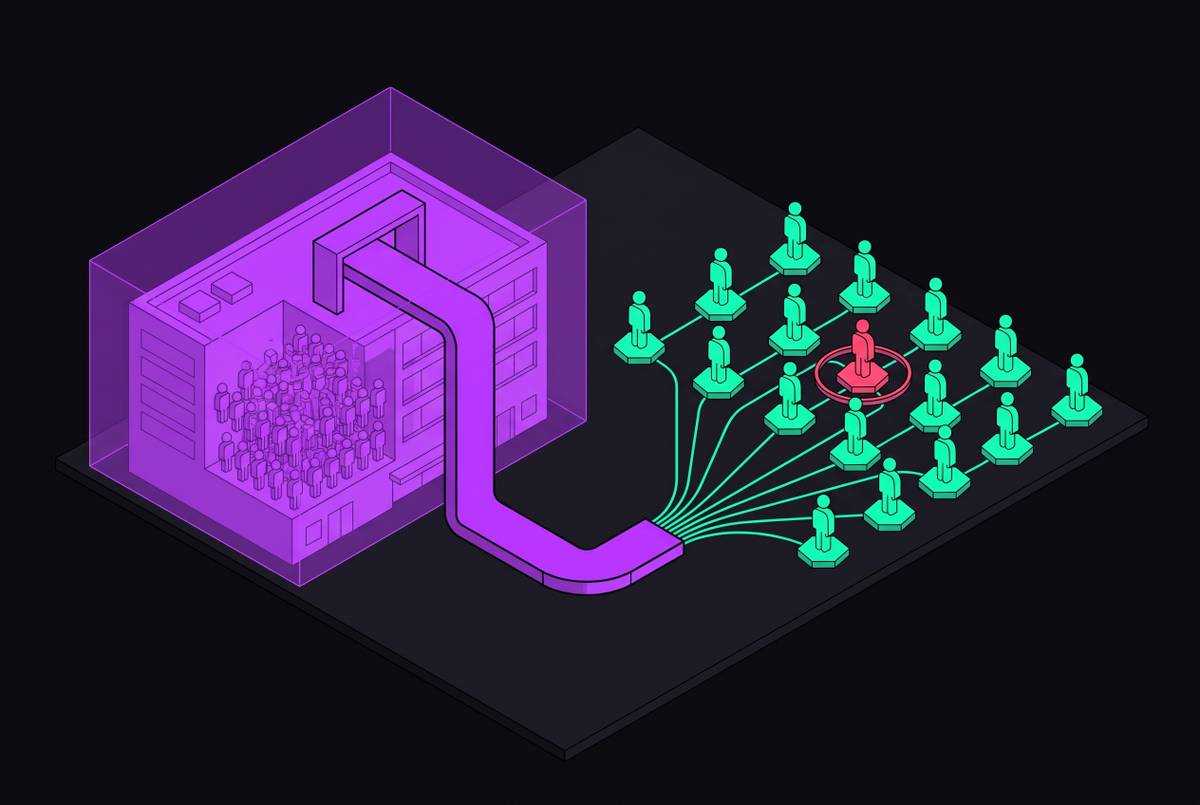
Independent tests put person-level identification at 5–20% of US traffic, while some vendors advertise much higher rates. The gap is a methodological problem. Vendors often combine company-level identification and person-level identification into one figure, although those results serve different purposes. A company match returns an employer associated with a corporate IP range. It does not identify the person who visited.
Person-level identification returns the name of a person, along with details such as title, email, and LinkedIn profile. Those fields give a sales rep someone to assess and contact. RB2B’s pricing page attributes its headline figure to combined person-level and company-level identification through Demandbase, while listing a lower contact-level rate on paid tiers. The distinction changes what the number can support. A team estimating reachable contacts from a blended rate is using an account-identification measure to forecast person-level output.
How remote work and traffic composition quietly erode real match rates
Remote and hybrid work weaken the IP-to-employer relationship behind company identification. Before distributed work became standard, corporate office networks with static IPs registered to employers made that relationship more straightforward. Remote browsing breaks that useful connection. VPN use, ad blockers, mobile browsing, and public Wi-Fi add identification failures, so a tool’s past performance does not establish its current performance on the same audience.
Geography adds another constraint because US-centric identity databases are richer than those covering EU, APAC, and other international traffic. Match rates can therefore be lower before GDPR restrictions enter the calculation. Enterprise US office traffic is not a useful stand-in for an internationally distributed or SMB-focused audience. Before comparing a reported rate with a vendor benchmark, the first questions concern the site’s own geographic split, device mix, and share of remote workers.
The bot and AI crawler contamination problem most tools ignore
Non-human sessions create a separate measurement problem that company-versus-person reporting cannot solve. Standard visitor identification tools do not necessarily filter AI bots by default, so GPTBot, ClaudeBot, PerplexityBot, and other crawlers may enter the session pool. Cloudflare’s 2026 traffic report describes dramatic growth in AI agent traffic during 2025. Many website owners lack instrumentation to see it. Their identification dashboard may thus include visits from bots alongside the people they want to measure.
The direction of distortion depends on the calculation. Unmatched bot sessions inflate the denominator and can depress the percentage, while false identification events can inflate the matched count. Neither produces a dependable human match rate. Bot exclusion before calculation and independent crawler detection are therefore separate checks. Separately reporting AI agent visits also preserves intelligence about which systems consume content, which pages they visit, and who operates them, rather than treating every non-human visit as disposable noise.
Match rate versus match quality: the distinction vendors never publish
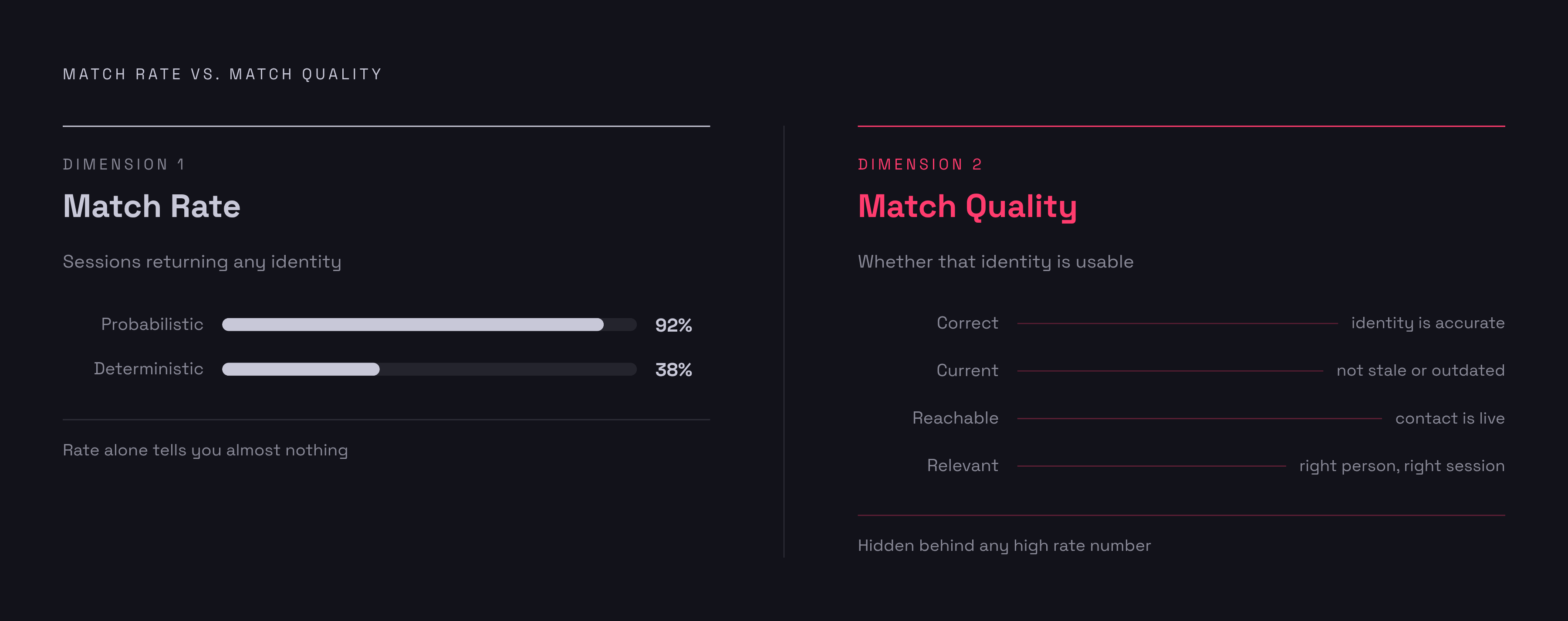
Match rate measures how often a session returns an identity, while match quality measures whether that identity is correct, current, reachable, and relevant. These are separate dimensions of performance. A tool returning low-confidence guesses can report a higher rate than one returning only verified records. Probabilistic matching can supply an answer at low confidence, whereas deterministic matching returns nothing when it cannot confirm an identity. Without confidence labels, the headline percentage hides that distinction.
Field completeness provides the next quality test. A company name without a person record does not become person-level identification because the dashboard calls it “identified.” Even a populated record can fail if the person left the company six months ago, the email is unusable, or the title falls outside the ideal customer profile. Volume does not resolve those defects. The audit must measure person-level coverage on its own, then check the returned fields for freshness, confidence, and ICP fit.
The structured audit checklist: questions and tests to run on your current tool
Can the vendor separate company-level and person-level rates on the team’s actual traffic? Ask for both figures in writing, with each rate shown on its own. Ask which sessions enter each denominator, whether bots are excluded, and whether person identification is restricted to US traffic. Geographic scope must be explicit. A rate above the person-level benchmark requires an explanation of its population and matching level before it can support pipeline planning.
Do identified records have person-level fields that can be used? In a sample of identified records, check name, title, email, LinkedIn, and phone independently. Check that email uses a live business domain, LinkedIn URLs resolve, and phone records are do-not-call filtered. Keep a separate count of company-only results and person records. Estimate the share containing stale employment details or titles inconsistent with the ICP, and check for pages viewed, scroll depth, time on page, and ad source. An identification ping supplies a name without the behavioral context needed to assess the visit.
Are bots excluded before rates are calculated? Request the specific list of excluded user agents, including how GPTBot, ClaudeBot, PerplexityBot, and GoogleOther-Extended are handled. Compare the tool’s session count with a filtered analytics view that strips known bots, looking for a material gap. This comparison is an independent check. Then ask whether AI agent sessions appear as a distinct reporting stream or are silently discarded.
Does a known-visitor test return the correct people? Ask a small group of colleagues or known contacts whose identity, title, and employer can be verified to visit the site without telling them the test’s purpose. Use external networks to simulate visitor conditions, and exclude internal IP ranges where necessary. Inspect both matches and missed visitors. For each returned record, compare the name, title, email, and confidence level with the known identity, paying particular attention to plausible-looking but incorrect people.
Does identification become a structured CRM record? Check whether contacts, companies, and activities write into the CRM or arrive as Slack notifications or webhook payloads requiring further processing. A notification is not structured CRM delivery. Check whether existing CRM contact and account data enrich the tool’s output through a bidirectional integration. For a recent window, measure how many identified visitors received a rep touch within a business day, using the gap between identifications and actions to assess integration failure.
Can paid-media attribution withstand an incrementality test? Check whether identified visits retain their specific ad platform and campaign, whether conversion tracking fires correctly, and whether attribution windows match the sales cycle. Shorter windows systematically undercount influenced pipeline. To distinguish retargeting lift from visitors who would have returned anyway, withhold ads from a comparable group and compare return visits and form fills. Keep account-based advertising claims separate from person-level claims, because company identification does not establish that the visitor and the advertised person are the same individual.
Is the privacy posture documented for the traffic being processed? Ask whether the tracking pixel has been reviewed in light of CIPA, the California wiretapping statute, and tracking-pixel litigation during 2025–26. Check for a company opt-out mechanism, a published policy explaining collected data, and EU data residency options. Privacy is a separate pass/fail workstream. A technically complete person record does not establish a lawful basis for processing it.
What the audit reveals across the tools teams are most likely to be running
RB2B provides person-level identification for US traffic and pushes results to Slack. The pricing page separates contact-level and company-level rates where the homepage does not, so teams should request the former specifically. Pro plans offer native HubSpot and Salesforce push without middleware, but the sync is one-directional.
Leadfeeder / Dealfront provides company-level identification through EU-compliant IP-to-company matching. Its two-way CRM integrations include Salesforce, HubSpot, Pipedrive, Zoho, and Microsoft Dynamics 365. Person identification depends on visitors self-identifying through forms, email marketing integrations, or the Identify() JS API call. That limits the expected person-level output.
Salesforce completed its acquisition of Qualified on April 1, 2026. Qualified’s Salesforce-native inbound conversion workflow makes the distinction between identification and downstream action especially relevant. Those are different sources of value. Teams already using Salesforce should check whether the identification layer or the conversion workflow does more for how they use the tool.
ZoomInfo WebSights connects company identification with ZoomInfo’s profile database. ZoomInfo’s product page gives a company-level resolution figure for US traffic, which leaves person-level coverage unproven. The level and geography define the claim. Before renewal, audit teams should ask for current figures in writing, since a published company rate cannot tell them how many contacts they can reach.
Snitcher claims “the highest identification rates in the industry” without attaching a number. Its analytics-native company tracking should go through the same defined-denominator and known-visitor tests used for the other tools. The claim alone supplies no measurable benchmark. Albacross also serves EU company-level identification, with flat monthly pricing, so European traffic evaluations should apply the privacy and GDPR checks rather than assume that company identification settles every compliance question.
Artisan combines US person-level identification with global company-level identification. Its output feeds live chat and an AI BDR, extending the workflow beyond a notification. That changes the downstream evaluation while leaving the identity test unchanged. Teams should still separate matching levels and assess whether the outreach layer adds useful capability or duplicates an existing sales workflow.
Across these products, AI agent reporting is a distinct audit criterion. A tool that classifies crawler sessions and reports consumed pages and operators provides different intelligence from one that conflates all sessions or discards bots without reporting them. Structured CRM delivery deserves the same scrutiny. Records containing name, title, company, LinkedIn, email, phone, session journey, ad source, and ICP flag reduce dependence on middleware and manual processing.
What to do when the audit reveals your tool is overstating its matches
The practical response is to reconfigure, supplement, or replace the tool according to the failure found. Blended reporting calls first for separate company-level and person-level figures in dashboards and renewal discussions. If the vendor cannot provide them, treat the blended rate as company-level only when planning pipeline. Field incompleteness calls for a different decision. A product returning companies without people can remain useful for account prioritization, or it can be supplemented or replaced with a genuine person-level identity layer.
To deal with bot contamination, teams need their own exclusion filtering at the analytics layer and written confirmation from the vendor of which user agents it excludes. A dedicated AI crawler detection layer may also be warranted when those visits should become intelligence. CRM delivery failures require their own remedy. Teams can build and maintain middleware or evaluate native bidirectional sync, rather than expecting a higher match rate to fix records that never become actionable CRM objects.
Attribution failures should be corrected before changing platforms, including conversion tracking and attribution windows that do not fit the sales cycle. Migration does not repair those implementation choices. Teams should review privacy failures with legal counsel before renewal, including their exposure under CIPA and GDPR. A vendor that cannot show a lawful basis for person-level processing of EU visitor data brings a liability risk on top of a disappointing identification percentage.
Set a 90-day re-audit cycle because the mix of traffic, identity graphs, and remote-work patterns change. A successful test is a point-in-time reading. The renewal benchmark should be a written, vendor-confirmed match rate that separates company and person identification, excludes bots, and applies to the team’s actual traffic geography. That gives the next contract a measurable standard tied to the audience the tool must identify.