Schema Markup Strategies That Improve AI Crawler Content Extraction
Proper schema markup reduces extraction errors but doesn't guarantee AI citations.
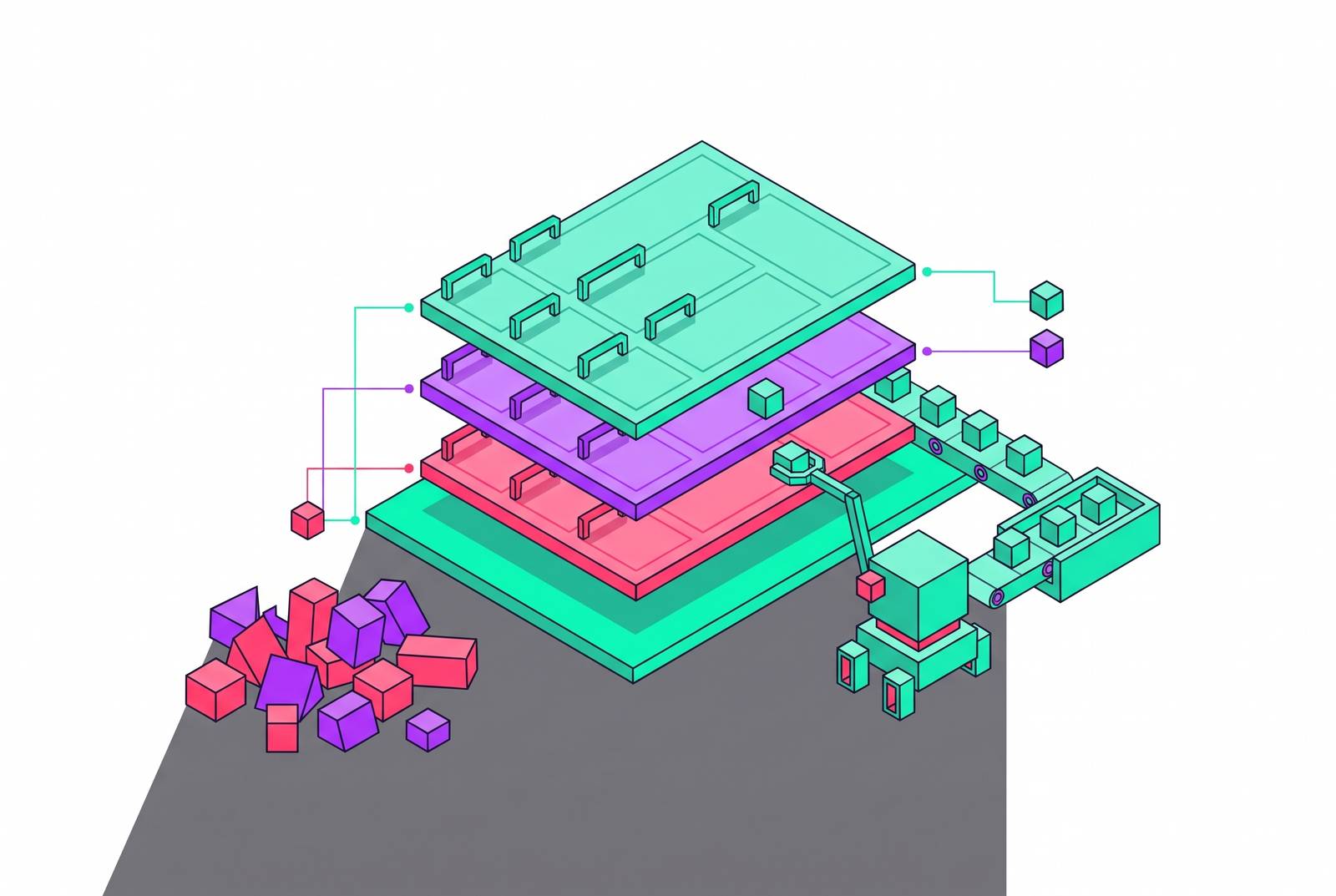
Schema markup improves AI crawler content extraction by reducing ambiguity about entities, authorship, dates, and answer boundaries. It does not automatically earn citations. Effective implementation therefore combines explicit labels, connected entity records, clear visible content, and crawler access, rather than treating JSON-LD as a shortcut to AI visibility.
Why AI crawlers misread pages and what schema actually fixes
A crawler parsing unstructured HTML must distinguish the subject of a page from its surrounding template, identify its author, and determine where an answer ends. Those judgments depend on context that may be incomplete or inconsistent. Each inference creates another opportunity for a misread. A company can be assigned the wrong entity type, an article attributed to the wrong person, or a publication date guessed from unrelated text.
Schema gives those facts explicit labels instead. Article markup identifies the content type and producer, while question-and-answer markup separates a question from its response. These labels reduce uncertainty where systems use them. Their immediate purpose is precision and reliability.
Where schema actually operates: indexing, knowledge graphs, and the retrieval gap
Schema’s primary mechanism operates upstream, during indexing. Knowledge graph entity registration, vector embedding precision, and rich-result eligibility belong to that stage, rather than to the moment an AI system retrieves a page. Consequently, citation effects can be delayed, indirect, and platform-dependent. Publishing markup today does not guarantee a changed retrieval result tomorrow, because entity updates and embedding refreshes may still be pending.
Mark Williams-Cook’s February 2026 controlled experiment illustrates the distinction. ChatGPT and Perplexity extracted an address that appeared exclusively inside invalid, made-up JSON-LD, with no equivalent in visible content. The experiment showed that both systems could read the block as raw text without semantically validating its schema. Reading JSON-LD is not the same as interpreting it.
Google’s Search team said in April 2025 that structured data helps systems understand content more easily, and said separately that it does not improve search rankings. Microsoft Bing’s principal product manager stated in March 2025 that schema helps its LLMs understand content for Copilot. Comparable semantic use remains unconfirmed for ChatGPT and Perplexity. Any indirect citation benefit through indexing and entity representation should therefore remain distinct from a direct extraction benefit or a ranking claim.
What the Ahrefs intervention study shows and where its conclusion breaks down
Ahrefs tracked 1,885 pages that added JSON-LD, matching them against control pages that never added schema. It measured citation changes across Google AI Overviews, AI Mode, and ChatGPT. No platform showed a meaningful citation increase. That finding directly challenges the expectation that adding markup to an established page will produce an immediate citation lift.
The same analysis found that AI-cited pages in a much larger URL pool were roughly three times more likely to include JSON-LD than non-cited pages. The findings answer different questions, however. Every page in the intervention and control groups already had a substantial number of AI Overview citations before the study began. The intervention therefore tested an additional signal on pages already being selected. The population-level correlation does not establish that schema caused selection.
Williams-Cook described schema-for-citations as “snake oil” in the practitioner debate. The evidence supports a narrower conclusion than that description implies. Google’s May 2026 guidance stated that “structured data is not required for generative AI search features.” Neither the guidance nor the intervention gives grounds for removing schema, but both give grounds to stop expecting immediate citation gains on pages that already have authority. The study leaves the question of entry into the consideration set unresolved.
The four schema types that compound extraction accuracy for most sites
For implementation, the strongest foundation is Organization schema with sameAs. It addresses the basic disambiguation problem of determining which brand a page represents, especially when names overlap. Organization markup should be on every page of the site, with name, logo, url, and links to verified profiles. Relevant sameAs destinations include LinkedIn, Crunchbase, Google Business Profile, and Wikipedia or Wikidata where applicable. These references give systems external anchors for identity.
FAQPage provides the most direct answer-extraction structure. A labeled question-and-answer pair removes the need to infer response boundaries from surrounding prose. Multiple pairs belong in the mainEntity array, with each matching a visible H2 question in the body. Google removed FAQ rich results from Search on May 7, 2026, including for government and health publishers that had kept them under the August 2023 restriction. Its extraction role therefore remains separate from a rich-result appearance that is no longer available.
Article schema identifies content type, authorship, and freshness. Its dateModified field supplies an explicit freshness signal, while author and publisher connect the work to its producers. Product or Service schema addresses a different uncertainty on commercial pages by identifying what is offered, its price, and its availability. That distinction supports transactional matching where AI-generated local or product recommendations are relevant. HowTo, BreadcrumbList, Speakable, and ClaimReview serve narrower purposes and should supplement the core types.
Building entity graphs with @id and @graph instead of isolated schema blocks
Correct schema blocks can still leave relationships unstated. An Organization declaration on a homepage does not, by itself, connect that organization to Article markup on a blog post. A connected graph makes the relationship explicit. An Article links to an Author, the Author links to an Organization, and the Organization links to a Website through stable @id references.
The graph uses @graph to put related entities in one JSON-LD block. Each entity needs an identifier that stays the same, so references point to the same subject on every page and in every version. The Article’s author property should point to the author page URL. That completes the links between the entities through a Person record, an author homepage, sameAs links, and verified external profiles.
Person schema and author entity signals as machine-readable credibility proxies
Knowing who wrote an article helps retrieval systems judge its sourcing without relying only on what the article itself claims. Systems synthesizing many pages must make probabilistic judgments about credibility without human review. Person schema makes supporting identity information machine-readable. A sameAs link to a LinkedIn profile, published work, or conference speaker page provides an external reference against which an authorship claim can be assessed.
The value lies in corroboration. jobTitle and worksFor describe professional context, alumniOf and hasCredential state formal qualifications, and knowsAbout identifies topic expertise. The author page should contain the Person record and active, verified external references, with the Article pointing back to it. A broken connection weakens the attribution chain. This is especially consequential for YMYL, or Your Money or Your Life, content, where author expertise receives greater weight in decisions about what to surface.
These properties remain proxies whose presence does not establish that an author is correct, or that a platform will cite the article. Their implementable benefit is narrower and more defensible. They turn an otherwise unsupported name into an entity whose professional context and external identity can be examined.
Why visible content structure does more for AI extraction than hidden schema alone
Visible HTML is the primary extraction surface for most AI crawlers. The retrieval experiments help explain why hidden JSON-LD cannot replace a well-structured body. Systems that read titles, headings, and prose need a clear answer there, even if the same labels appear elsewhere.
The page should first have an H1 on a single topic, section headings that match the content, and H2s phrased as questions where it answers specific queries. An answer capsule should begin with the direct response. Internal links then join related topics, much as sameAs links join records of an entity’s identity. When a fact appears only in JSON-LD, text-reading systems may extract it, but systems that compare markup with visible content can flag the mismatch.
Implementation errors that silently eliminate the extraction benefits schema should provide
Quality control must distinguish structural validity from semantic correctness. A block can parse successfully while failing to communicate the intended identity, attribution, or content. The practical checks therefore extend beyond syntax. They must also establish whether crawlers receive the markup and whether its values describe the visible page.
JavaScript-injected schema creates a delivery failure. Markup absent from server-rendered HTML can be skipped by AI crawlers that do not execute JavaScript, even though browser developer tools display it. Unstable or duplicated @id values create an identity failure instead. Changing an identifier between versions, or assigning it to different entities, introduces conflicting signals. Organization markup also leaves a link missing when Article records never point to it.
Mismatched values create a content-integrity failure. Google’s guidelines classify markup describing absent visible content as misleading, and it can generate manual actions. Broken Article fields require a separate inspection. Errors include dates written as bare YYYY-MM-DD rather than full ISO 8601 values, an author given a generic name rather than a verified Person entity, and a publisher with no logo sub-object. An image field containing a markdown hyperlink rather than a plain URL string is a common artifact when schema is drafted in Notion.
Every implementation should be validated with Google’s Rich Results Test and a JSON-LD validator, then inspected for relationships and page correspondence. Passing a structural test is only the starting point.
AI crawler access, robots.txt, and llms.txt as the prerequisite layer under schema
For extraction to help, the intended crawler must be able to reach the page. Schema cannot compensate for access rules that admit training scrapers while excluding retrieval crawlers. Server logs provide a practical audit signal. If training scrapers significantly outnumber retrieval crawlers, content is being consumed for training without corresponding search visibility from those visits.
Access checks should proceed from the edge inward. A CDN returning 403 responses can prevent a crawler from reaching robots.txt at all, making file-level permissions ineffective. Robots.txt compliance is also uneven, with about 60% of AI crawlers respecting it as of 2026 and Bytespider showing inconsistent compliance. The edge platform and CDN are therefore the enforcement layer. The recommended configuration allows retrieval crawlers while blocking training crawlers, with both permissions and enforcement reviewed together.
llms.txt serves a different, more limited purpose. Introduced as a 2024 community convention, it is a Markdown index at the site root that guides agents. Ahrefs found in May 2026 that the vast majority of published llms.txt files on the domains it sampled had received zero AI bot requests that month. That makes it navigation infrastructure. Pairing it with a Brand Hub can help agents that do arrive complete their information need with fewer page requests.
Where visitor intelligence fits into an AI-era content strategy
Schema describes content, but it does not reveal its audience. ChatGPT’s OAI-SearchBot, Perplexity’s PerplexityBot, other crawlers, and human buyers can all visit the same pages. Most analytics tools aggregate these visits or ignore that distinction. Real-time AI agent detection separates crawler sessions from human activity, showing which pages agents consume and how frequently they return. It supplies the operational evidence that markup itself cannot provide.
Person-level identification can connect anonymous visits to named individuals, their companies, titles, LinkedIn profiles, email addresses, and page-event journeys. Traffic-source and ad attribution then show where those visits came from and which ads brought them in. A procurement lead arriving from a LinkedIn ad, viewing a product page and FAQ section, and leaving without converting presents a different opportunity from an undifferentiated session count.
Neither kind of intelligence proves that schema led to a visit or citation. That boundary is important when judging results. Crawler classification shows whether AI systems are reaching the content, while human identification shows which buyers are engaging with it.