How Deterministic Identity Graphs Separate Real Visitors From AI Agents Before Matching Begins
Filtering AI agents before lookup keeps match rates honest.

Website visitor identification match rate is the number of identified unique visitors divided by the total number of unique visitors, given as a percentage. It measures human identification performance only when bots and AI agents are excluded from both counts and person-level matches are distinguished from company-level matches. Deterministic identity graphs therefore need pre-match classification to produce meaningful match rates and trustworthy CRM records.
Why AI agent traffic has become a structural problem for visitor identification pipelines
A sales rep receives a Slack alert about a visitor researching a pricing page. The visitor is actually an autonomous AI agent. It loaded the page, followed links, and triggered JavaScript events, producing a session that a naive identification pipeline treated as prospect activity.
B2B websites now get visits from human prospects, traditional crawlers, and AI browsing agents working on behalf of others. Named agents include ChatGPT, Claude, MistralAI-User, Manus-User, Devin, and QualifiedBot, with different operators, intentions, and behaviors. Otsuka et al. (2026) describe agents that run transactions and workflows across organizations without a human watching them all the time, while identity infrastructure is still built around human users. An agent may research for a buyer, but it cannot become the person a sales team hopes to identify.
What a deterministic identity graph actually does, and where AI agent sessions break it
Deterministic identity resolution links a browser session to a person record through an exact overlap on a stable, verified identifier, most often a hashed email. The graph connects records because they share an identifier, rather than because their activity makes them statistically likely to belong to the same person. Its accuracy depends on the session supplying evidence that can anchor that connection.
An autonomous agent session lacks the human-linked identifiers this lookup requires. It has no hashed email, login event, or first-party cookie tied to a human visitor. Its HTTP headers and behavioral signals may resemble those of a person, but resemblance is not an exact identity match. The incompatibility is therefore at the input, before graph coverage or record quality becomes relevant.
An unsuitable input still has a cost. An agent session consumes a lookup slot and enters the traffic count used to calculate performance, even if the graph returns no match. If probabilistic fallback is involved, apparent human behavior can instead produce a false-positive person record that reaches the CRM. The deterministic pipeline then looks less effective when traffic includes agents, while the fallback pipeline can look more successful because it accepts matches that are less trustworthy.
How do website visitor identification tools calculate their match rate percentage?
The denominator defines what the result actually measures. If total visitors includes agents that cannot be identified as people, the rate counts both attempts to identify humans and sessions that could never yield a person-level match. Each unmatched agent depresses the reported result without representing a failure to identify a human prospect.
The numerator can be corrupted in the opposite direction. A probabilistic fallback that assigns a person to an agent session counts an apparent success where no human visitor was identified. A higher reported rate can therefore come from false positives without any gain in coverage. Neither a high nor a low headline percentage establishes identification quality without the counting rules behind it.
These rules also explain why vendor rates can differ. One calculation may count automated sessions, another may leave them out, and another may count company matches along with person matches. Practitioners should ask vendors whether bots and AI agents are excluded from both the numerator and denominator before accepting a quoted rate. They should also distinguish the identification tier being reported. Denominator hygiene matters as much as graph quality because the metric tests the job the graph is meant to do only when its denominator is appropriate.
Why detection must happen before the identity lookup runs, not after it
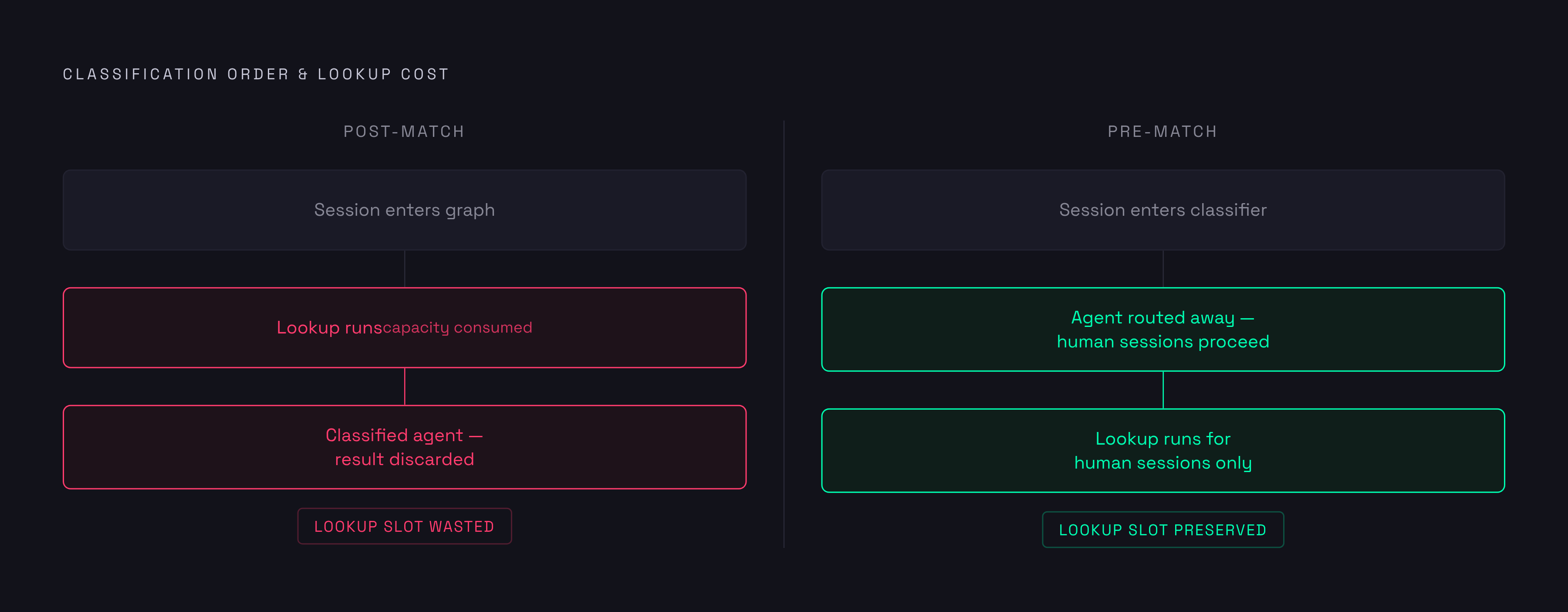
Post-match filtering begins by querying the graph. A result or null comes back, and only then does the system classify the session as agent traffic and discard it. The lookup capacity has already been spent, and the session has already entered the identification attempt count.
Pre-match filtering changes that sequence at the entry point. The system classifies the session before triggering any identity lookup, so agents never enter the graph query layer. Human sessions retain access to graph capacity, and the identification denominator excludes traffic that cannot yield a human match. This works like putting a firewall before an application server so the application need not handle unwanted traffic first.
A strong probabilistic model may suppress low-confidence agent matches. That is useful, but it addresses a different stage. A confidence threshold still follows the lookup, does not by itself exclude the session from the denominator, and cannot guarantee that borderline agents will be rejected. If one passes, the resulting contact can receive automated sequences, distort lead scoring, and corrupt attribution.
The technical signals that separate AI agent sessions from human sessions before matching
Connection-level signals provide evidence before a graph query is needed. HTTP/2 fingerprints and ClientHello extensions reveal patterns in how clients negotiate connections, which can differ between headless browsers and real user agents. JA4 TLS fingerprinting supplies another infrastructure-level signal. Cloudflare, AWS WAF, VirusTotal, and Akamai use JA4 in multi-layered bot detection systems. These fingerprints describe the client’s technical behavior independently of its declared identity.
The presence of navigator.webdriver, missing browser APIs, and DOM-level anomalies can expose headless environments. Behavioral evidence then supplements those technical fingerprints through scroll patterns, mouse movement, timing between events, and the absence of human micro-interactions. A session may look plausible at one layer while revealing automation at another.
Passive honeypots provide another way to observe that difference. Invisible links rendered only in the DOM are not visible to a human viewing the page, but can generate requests from agents. Those requests help the system classify traffic without changing what users see. No single signal is sufficient on its own. Layering is necessary because an agent that spoofs a User-Agent string may still expose a JA4 mismatch, missing browser APIs, or other evidence inconsistent with human browsing.
How AI agent classification should be fed back into the system to improve future detection
Operators update agents, new agents appear, and some are engineered to imitate human behavior more closely. A filter that does not learn from current traffic loses accuracy as the traffic changes. Otsuka and colleagues frame agent identity as a continuous relationship between what an agent is declared to be and what it is observed to do.
That relationship requires feedback from classification into future detection. Passive honeypot infrastructure that uses invisible, nofollow-tagged links can keep getting signals from live traffic and feed them to machine-learning models shared across a network of sites. The models can therefore learn from sessions that have been classified as well as from explicitly labeled training data, making the gate a learning loop.
The scope of that loop affects its usefulness. A vendor classifying agents across millions of sessions has a broader detection base than a tool limited to one customer’s traffic. Each session that is correctly classified saves a needless lookup and adds evidence to help with the next borderline decision. Pre-match filtering consequently develops as a shared infrastructure capability, rather than remaining a checkbox attached to an identification product.
What person-level vs. company-level identification means once AI sessions are removed from the picture
Clean human traffic still supports two distinct identification outcomes. Company-level identification resolves a session to an organization through reverse IP lookup, providing account context without naming the employee who visited. Person-level identification resolves the session to an individual through a deterministic identity graph with enough first-party coverage to match current traffic. Its output can include name, title, LinkedIn, verified email, and phone, together with associated activity and available contact fields.
The distinction changes what sales can do next. A company match tells a team which account visited, but additional research is needed to determine whom to contact. A person match supplies the individual record that makes direct action possible. Filtering removes incompatible sessions, but it does not create missing graph coverage or turn account context into a named visitor.
Under the GDPR-compliant default described here, person-level identification is used only outside EU jurisdiction, while European traffic gets company-level resolution without explicit visitor consent. That boundary limits the available identification tier independently of whether the session is human. A clean pipeline therefore needs a realistic definition of success, one that separates an organization identified through its network from an individual matched through verified identifiers.
Why AI agent traffic also represents a signal worth capturing, not just filtering out
Exclusion from matching does not require exclusion from analysis. An agent browsing pricing or technical specifications may represent a buyer who delegated research to an autonomous tool. The activity is a proxy for possible human intent. That distinction allows the traffic to remain useful without presenting it as a person-level match.
Sessions classified as agent traffic can be logged separately to study content categories, repeat page visits, and the operators that sent the agents. Header data, User-Agent strings, and known agent signatures can help identify the operator behind the session, including the company conducting the research when that relationship is visible. This evidence can be useful even if no human session follows. It belongs in a separate analytical stream, however, because an operator identity and a human visitor identity answer different questions.
Filter-first architecture accommodates both uses without conflating them. Filtering is a routing decision that directs agent sessions away from the identity graph and into their own classification and analysis layer.
What accurate identification data enables once the pipeline is clean and the CRM is trustworthy
A record containing name, title, company, LinkedIn, verified email, visit journey, and traffic source is useful only if the team can trust its connection to a real human visit. Real-time Slack or Teams alerts for pricing, case studies, or demo requests depend on the same premise. An alert about an autonomous research session is not interchangeable with an alert about an identified prospect.
An AI SDR consuming identity data can act on an incorrect name or job title without correcting it. CRM sync and webhook delivery then move the error into other tools, where it can influence outreach and lead scoring.
Paid media attribution has the same dependency on session quality. Connecting a named company or individual to the Google, Meta, or LinkedIn ad that brought them requires the underlying visit to be classified correctly. Agent-contaminated traffic inflates attributed visit counts and can make cost-per-identified-visitor calculations appear lower than they should. Removing those sessions before matching preserves the distinction between human acquisition and automated research.
The commercial outcome depends on architecture before enrichment. Alerts, CRM automation, attribution, and AI-powered outreach all inherit the quality of the identity decisions beneath them. Pre-match filtering is the foundation that makes every downstream capability reliable.