Visitor Identification Tools That Push a Named Person Into Salesforce Attio Slack and Teams Not Just HubSpot
Match tools to your CRM and alert channel, not just HubSpot.

A website visitor identification alternative should be selected by the identity it resolves and the destination it supports natively. Bullseye and SyncGTM support person-level Salesforce workflows, Snitcher and SyncGTM support native Attio sync, and RB2B supports person-level US alerts in Slack and Microsoft Teams. The decisive distinction is whether the tool delivers an actionable person record into the team’s existing workflow, rather than merely identifying a company or offering a HubSpot connector.
Why most visitor identification tools default to HubSpot and what that leaves out
HubSpot’s open API, wide adoption among SMB and mid-market teams, and early mover status made it the path of least resistance for integration engineers. Visitor identification tools built their native sync around that opening. As a result, HubSpot is often on every plan, while other destinations need a higher tier, middleware, or a manual step.
That design leaves three workflows poorly served. Salesforce teams need records in their system of record, Attio teams need a connector to their primary CRM, and people who use Slack or Microsoft Teams need alerts where their sales work starts. A HubSpot integration does not meet those needs. A destination logo also leaves open what data gets there, which object it goes into, and whether the visit itself triggers delivery.
What person-level identification actually delivers versus company-level, and why the distinction governs integration design
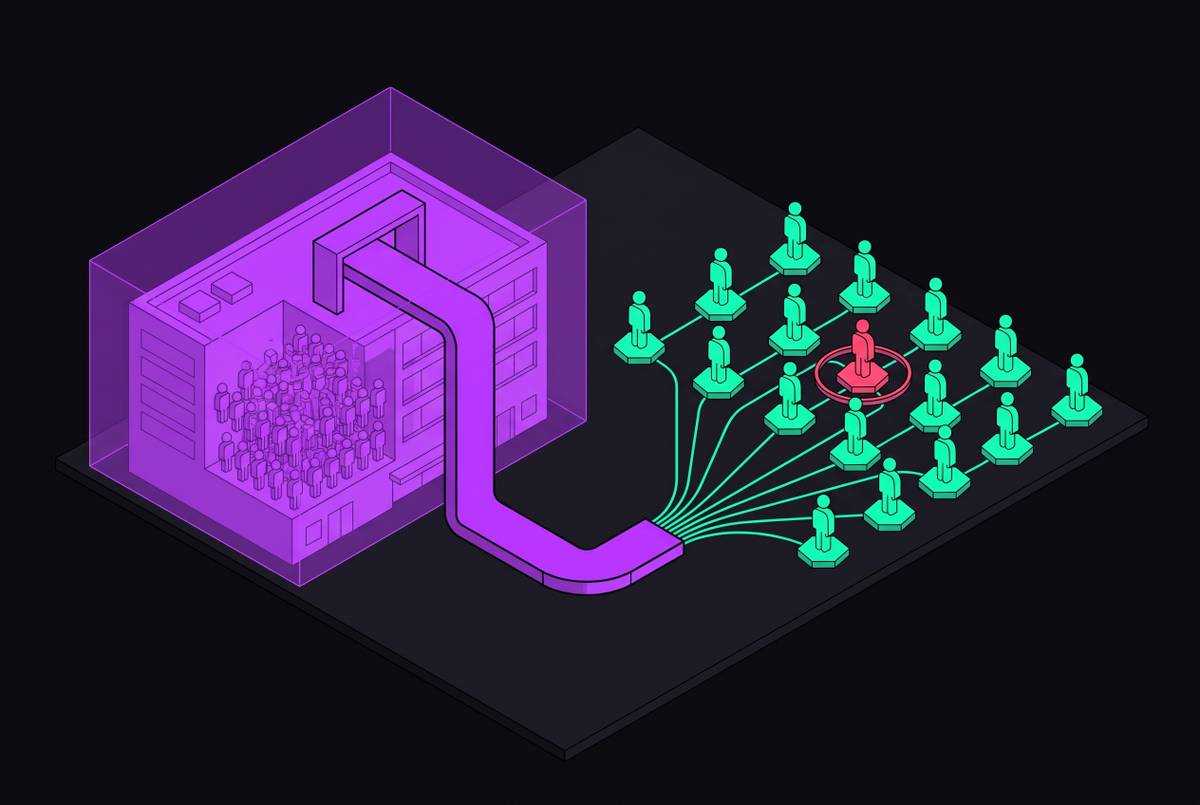
Person-level identification returns a name, work email, job title, and LinkedIn profile, while company-level identification returns only a company name. That distinction determines the next step for sales. A company match is an account signal that still requires contact lookup before outreach. Remote work also weakens IP-based company matching because a home ISP or VPN has no corporate IP signal, so identity-graph resolution matters more even when teams sell at the account level.
The supplied match-rate analysis for 2026 puts realistic person-level identification for US B2B traffic at 10–25% of sessions, compared with company-level rates of thirty to fifty percent. A blended headline rate can therefore overstate the number of actionable people a rep receives. Teams need to check claims of higher person-level coverage against the traffic they cover and what they count as a match.
A confirmed identity from a form fill, authenticated visit, or tracked email click differs from an IP-matched account. An enriched prospect appended to that account is different again. These three confidence levels should populate separate CRM fields, because a complete contact profile does not by itself establish that the contact was the visitor.
Which tools push a named person to Salesforce natively and what the sync actually covers
Salesforce integrations differ most sharply in the objects they populate. Some create accounts, while others write people to lead or contact objects with person-level fields. For a Salesforce-centric team, the practical test is therefore the object created, the fields supplied, and whether creation follows the visit or requires manual review.
Warmly combines Salesforce with a multi-provider data waterfall for enrichment depth. Its integrations span 40+ tools, including HubSpot, Slack, Salesloft, and Outreach. CRM write-back requires separate configuration rather than operating automatically out of the box, so connector availability and an active write-back workflow are distinct considerations.
Dealfront, also known as Leadfeeder, offers bidirectional Salesforce integration. Website visitor intelligence moves into SFDC, while CRM deal status appears inside Dealfront. Anonymous identification resolves to companies, with individual identification requiring a visitor to self-identify through an action such as a form submission. Its enriched data for existing contacts should not be mistaken for net-new person-level identification, even when the matched company is already in the CRM.
Lead Forensics provides a deep native Salesforce integration at the account level. It can create accounts, support custom fields, and assign records automatically. The supplied material does not establish individual contact-level writes, so that integration depth should not be read as evidence of person-level resolution.
Bullseye supports native Salesforce delivery of person-level records. Its identification offering includes phone numbers as well as notification and ad-audience destinations. That makes its Salesforce connector part of a broader workflow, although the available details do not specify the lead-versus-contact object mapping.
SyncGTM also supports native person-level Salesforce sync. Waterfall enrichment is included, and native CRM sync is available on all plans. Teams can use the connector on any plan, but the supplied details likewise leave its Salesforce object mapping unclear.
Snitcher includes Salesforce among its native CRM destinations. It also connects real-time notifications with CRM writes in the same triggered workflow. Its claimed identification coverage remains a separate question from that integration capability.
Which tools support Attio natively and why that destination is underserved
Attio entered a market whose visitor identification roadmaps had largely been built around Salesforce and HubSpot. Native support is consequently much narrower here. Snitcher and SyncGTM are the sourced options for native Attio writes, making destination coverage a substantial filter for Attio-first teams.
Attio’s Web Research Agent researches records already in the system. It does not create records from anonymous website sessions, so it cannot replace the visitor identification layer. Bullseye’s site names HubSpot, Salesforce, Slack, Pipedrive, and Marketo as native destinations, but not Attio. Reaching Attio through Bullseye would require webhooks or Zapier, adding middleware to a workflow that its supported CRM destinations receive natively.
How Slack and Microsoft Teams function as first-mile destinations rather than CRM replacements
Slack and Microsoft Teams deliver the moment-of-visit alert, while a CRM write creates the durable record for follow-up. An alert without a CRM workflow can leave follow-up dependent on manual handling, while a CRM record without an alert lacks the immediate trigger for action. Person-level identification becomes useful in the first mile when the message supplies enough context for a rep to respond.
A LinkedIn profile sent to Slack is a notification. A message containing a person’s name, work email, job title, pages viewed, and the ad source provides a much fuller basis for action.
Snitcher sends real-time Slack or Teams notifications when high-value prospects are actively browsing and also writes to its native CRM destinations. Warmly names Slack as an integration, but alert configuration and CRM write-back require separate setup rather than a single automated trigger at the base tier. Microsoft Teams has thinner explicit coverage than Slack. RB2B and Snitcher name Teams directly, while the other tools discussed here do not establish equivalent Teams support.
What the integration map looks like across destinations — a tool-by-tool summary
For Salesforce, the native options discussed here include Warmly, Dealfront, Snitcher, Lead Forensics, Bullseye, and SyncGTM. Their commercial terms are not equally transparent. Warmly’s full automation starts at a significant annual commitment, while Lead Forensics pricing is not publicly listed in the supplied material. Bullseye has a free trial that needs no credit card, and SyncGTM includes all features from its first paid plan. These anchors describe access terms for differing identification outputs.
For Attio, Snitcher and SyncGTM form the native shortlist. Both companies’ Attio connectors address the destination gap, but the supplied material does not give a comparable Snitcher price.
For Slack, RB2B, Warmly, Snitcher, and Bullseye provide named native support. RB2B separates identification from richer downstream integration by plan. Its free plan is company-level, Starter costs $79/month and provides person-level identification, and Pro adds business emails and integrations. A CRM write requires a manual step or integration on Pro, so the entry-level notification price should not be treated as the price of an automated CRM workflow.
For Microsoft Teams, the explicitly named options are RB2B and Snitcher. RB2B’s person-level identification is US only. Snitcher claims it can provide person-level identification for up to forty percent of visitors, and Bullseye makes the same claim for its own tool. Those vendor claims are not substitutes for the US B2B benchmark or proof of equivalent geographic coverage.
Beyond these four destinations, Bullseye names native Twilio and Sheets automation as well as Pipedrive and Marketo support. It also offers webhooks and Zapier. Its site states GDPR and CCPA compliance, but that statement does not show that it can identify visitors in every country. Warmly’s Salesloft and Outreach integrations similarly broaden its destination map without changing the need to configure CRM write-back.
Why ad attribution to identified companies and individuals belongs in the same workflow as the CRM push
The person record sent to Salesforce can also seed a named, high-intent ad audience. Separating those workflows means paying for the same intent signal twice while using a weaker version of it in each system. Person-level audience inputs, including name, work email, and company domain, support higher ad-platform match rates than cookie-based or IP-based inputs. The quality of the seed also influences the lookalike audience built from it.
Google’s gclid/wbraid/gbraid, Meta’s fbclid, and LinkedIn’s li_fat_id connect the ad click to the session. If those identifiers are not captured and stored at session level, the platform cannot be told which click led to a pipeline outcome. The identified visitor record likewise cannot be tied back to the ad that drove the visit through that click-level chain.
Bullseye’s site says it has native features for Meta Custom Audiences sync, Google Customer Match, and a ChatGPT Ads audience export. Those features work alongside its CRM and Slack destinations, so teams can use the identified record for audience activation without a separate export step. This is a broader integration requirement than simply getting a name into Salesforce. It connects identification, sales delivery, and paid-media use of the same record.
Fibbler addresses a different layer of that workflow. It connects LinkedIn, Google, and Meta activity to the same company record inside the CRM, alongside person-level identification. Its Google Ads and Meta Ads add-ons each have an additional monthly cost and reveal businesses behind anonymous ad clicks. Teams should therefore select for both the visitor record’s destination and native connections to their ad platforms.
How should a team choose a Clearbit Reveal alternative without HubSpot?
The decision begins with the system of record. For Salesforce-primary teams, Lead Forensics and Warmly cover account-level workflows, while Bullseye and SyncGTM support native person-level writes. Dealfront provides bidirectional SFDC sync for GDPR-bound European traffic, but anonymous company recognition should not be confused with identifying a new individual. For Attio-primary teams, the native branch narrows to Snitcher and SyncGTM before notification or advertising requirements enter the comparison.
The next branch is the first-mile communication channel. RB2B offers the lowest-cost entry point described here for person-level US identification in Slack or Teams, but base-tier CRM writes remain manual. Snitcher combines notifications with CRM delivery, while Bullseye combines Slack notification and CRM writes in one triggered workflow. A Teams requirement narrows the explicitly supported shortlist to RB2B and Snitcher.
The final branch is paid-media activation. Bullseye is the most explicit option in the supplied material for combining Salesforce, Slack, and Meta, Google, and ChatGPT Ads audience support. That does not make it the universal choice. An Attio requirement, a Teams requirement, or a need centered on company-level attribution changes the answer.
Claims about coverage then need to use human traffic as the denominator. Teams should ask how each vendor separates bots and AI crawlers from human sessions before treating its identification rate as a pipeline benchmark. The full-journey standard is a usable identity, an appropriate alert, a durable CRM record, and ad activation where required. HubSpot’s dominance reflects a design choice, and the right alternative depends on where each vendor has chosen to invest in native delivery.