AI Crawler Activity in Server Logs vs JavaScript Analytics Gaps
Server logs reveal AI crawler activity that JavaScript analytics completely misses.
AI crawlers never run JavaScript, so that is why there is a gap between what server logs record and what analytics platforms report. No analytics tag fires for an AI crawler's visit, no matter how the platform is configured, because the architecture of client-side tracking depends on a step that these crawlers skip.
Client-side analytics works through a specific chain of events: a browser downloads a page, runs a script embedded in that page, and the script sends an event to a collection endpoint. Every downstream artifact depends on that one event, from sessions to channel groupings all the way to attribution models. An autonomous crawler does something different: it opens a connection, receives the HTML body, and disconnects. No script executes, no event gets sent, no session gets created, and no channel assignment ever happens. The visit is not hidden by a misconfigured tag or a missing goal; it is invisible because the analytics product was never present in the request path to begin with. Adding a custom channel group, writing a regex against the referrer field, or building a new dimension changes nothing, because all of those tools operate on events that already exist, and an agent request simply never produces one.
The scale of what disappears this way has become commercially significant. On the Cloudflare network, AI bots now make up a meaningful share of all HTML requests, and most of that volume comes from training, not live user queries. It is absent from dashboards built on JavaScript events. Maverick Intelligence and similar platforms work at the request layer, so they catch what content AI systems access before any JavaScript tag can fire, and that is how you see crawler activity a normal analytics suite misses.
What server logs contain that analytics platforms do not
Server access logs record every HTTP request at the infrastructure level, before any JavaScript, any analytics tag, or any bot-filtering rule gets the chance to exclude it. Nothing happens between the request arriving and the log entry being written, so logs are the only complete source of truth you have for AI crawler activity on a site.
A single raw log entry contains the requesting IP address, an exact timestamp, the specific URL requested, the HTTP status code returned, and the User-Agent string identifying who made the request. All five pieces sit on one line, and together they are enough to run a complete analysis of what any given crawler did on a site. For teams running on Cloudflare, the Analytics panel under Security > Analytics > Bot analysis provides a first layer of bot classification, while Cloudflare Workers Logs and CDN log access through the API offer finer granularity for separating training bots from retrieval bots. The log functions as a receipt: it shows which bot visited, which URL it requested, and what status code came back, and that receipt is the only record anywhere of what an AI engine actually did with a site's content.
The three functional types of AI crawler
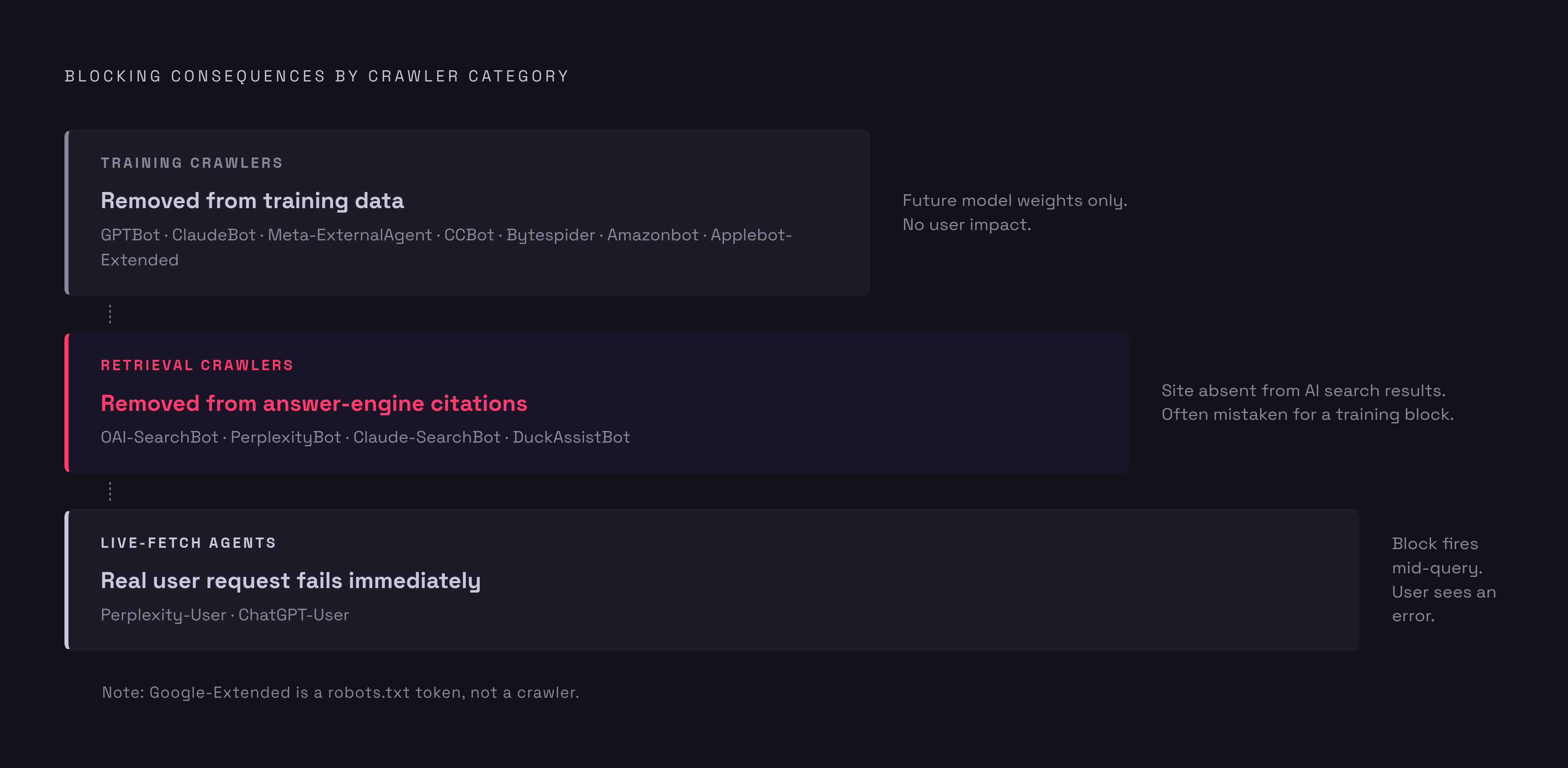
Logs capture every crawler that touches a site, but if you only count requests, you get just partway to a useful decision. Treating all AI crawler traffic as one undifferentiated category hides the choice that actually matters: blocking a training crawler and blocking a retrieval crawler produce entirely different business outcomes, and the two decisions carry very different consequences if reversed later.
Training crawlers include GPTBot, ClaudeBot, Meta-ExternalAgent, CCBot, Bytespider, Amazonbot, and the AI-training opt-out token Applebot-Extended. Most AI-bot HTTP requests come from training, plus crawlers that serve both training and search, and live user-action fetches make up only a small share of total crawler volume.
Search index, or retrieval, crawlers work toward a different goal. OAI-SearchBot, PerplexityBot, Claude-SearchBot, and DuckAssistBot build the index that answer engines draw on when they generate a cited response to a user's question. Blocking one of these removes a site from that engine's citation pool, not merely from its training data, which makes the decision to block far more consequential for visibility than blocking a training crawler would be. If you block GPTBot, that does nothing to remove a site from ChatGPT Search, because that control belongs to OAI-SearchBot alone, and the two settings work independently of each other. Within this category, Perplexity-User and ChatGPT-User fetch a given page only when a live user query triggers that specific retrieval in real time, while PerplexityBot runs as a separate, scheduled background indexing crawler with no fixed revisit cadence, unlike the days-to-weeks rhythm of a training crawler.
Google-Extended is not a crawler with its own user agent; it is a robots.txt token that controls whether content already fetched by Google's main web crawler gets used for Gemini AI training and for grounding in Gemini Apps and Vertex AI. Blocking it does not stop any bot from visiting a site; it tells Google not to use content that its main web crawler has already collected for training purposes. Most published guidance conflates the token with a separate crawler, and that confusion leads directly to misconfigured robots.txt files that fail to do what the site operator intended.
Meta-ExternalAgent generates more HTTP requests than GPTBot in the current observed traffic mix, but it gets far less attention in AI-traffic coverage, and you only see that gap when you look at the logs directly.
User-agent strings as claims, not identities
A user-agent string tells a server what the requester claims to be, not what the requester actually is. Because user-agent strings are trivially spoofable, raw log counts of AI crawler traffic can overstate legitimate activity, and acting on those unverified counts leads to the wrong call on blocking, allowing, or shaping content strategy around a crawler that never really existed as claimed.
Any client can put "GPTBot" or "ClaudeBot" into a request header, and some malicious scrapers and undeclared crawlers do exactly that, presenting themselves with well-known AI bot user-agent strings specifically to bypass access rules or to blend into traffic a site has already chosen to allow. The reliable way to confirm identity is a dual check: a reverse DNS lookup against the requesting IP, cross-referenced with each operator's officially published IP-range files or reverse-DNS suffixes. Client-side analytics has no equivalent check anywhere, because a JavaScript tag never sees the IP-level detail you need to run it, so the log file is the only place you can run this verification step.
The limits of self-declared identity became public in August 2025, when Perplexity was accused of ignoring robots.txt entirely and using stealth crawlers that spoofed Chrome's user-agent to avoid detection. The episode is a reminder that robots.txt functions as a norm that well-behaved crawlers choose to follow, not a rule any server can enforce on its own.
A more durable fix is emerging in the form of Web Bot Auth, an IETF draft that replaces spoofable user-agent strings with cryptographic HTTP message signatures. OpenAI's ChatGPT agent already signs its requests with the standard, and Vercel has adopted it too, so identity verification looks set to move to the protocol level. Distinguishing a training crawler from a retrieval crawler requires more than reading a user-agent string; it requires knowing why the crawler is there and who benefits from a decision to allow or block it. Once visitor intelligence can surface the operator behind a crawler alongside the specific content it accessed, a team can make a block-or-allow call based on actual business impact.
AI crawler consumption versus referral traffic
Once crawler identity has been verified, the logs expose a stark commercial asymmetry: AI crawlers consume site content at enormous scale while returning only a small fraction of that activity as referral traffic. That ratio never appears on any analytics dashboard, because the crawling side of it was never visible to JavaScript tracking.
Cloudflare Radar data shows that crawl-to-referral ratios differ sharply by vendor. Because JavaScript-rendered content stays invisible to both training and retrieval crawlers, any content that loads client-side is never seen by an AI fetcher. A page needs server-side HTML to get crawled, and only a log analysis of HTTP status codes can confirm whether it has that.
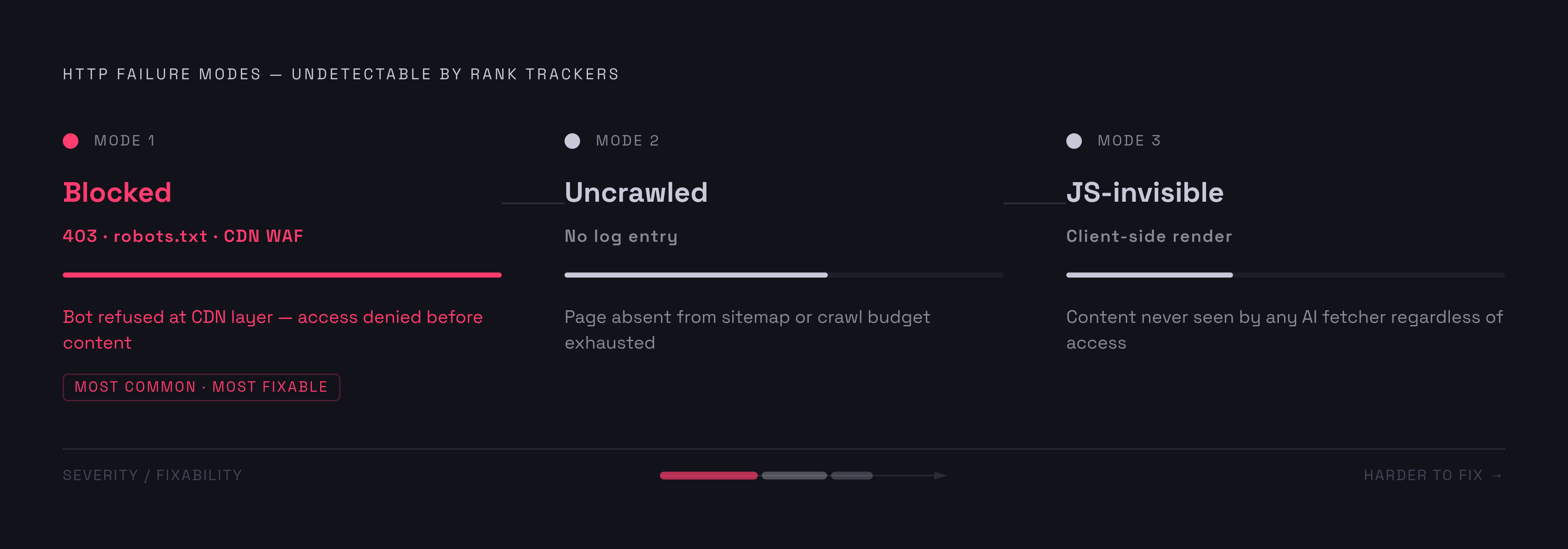
Reading logs this way reveals three distinct failure modes, which no analytics platform or rank tracker can distinguish between. A page can be blocked outright if a bot gets a 403 response or gets excluded by robots.txt or a CDN web application firewall rule, often set quietly at the CDN layer by a security configuration the marketing team never meant to apply to AI traffic, and this is the most common and most fixable cause of AI invisibility. Or a page can go uncrawled entirely, with no log entry from the crawler at all, usually because the page never made it into a sitemap the crawler follows or because crawl budget ran out before the crawler reached it.
The cost of each failure mode plays out on a different timeline depending on the crawler involved. For live-fetch agents like ChatGPT-User or Perplexity-User, a failed retrieval carries an immediate cost, because a real user's query triggered that attempt and it failed in real time, in front of that user. For training crawlers, a missing page just leaves a gap in the training corpus, a gap that waits until the next crawl cycle, weeks away, before it has any chance of being corrected.
A practical six-step process for AI crawler log analysis
A structured log analysis workflow surfaces the specific crawlers, pages, and failure modes that matter most for a given site, and you can run the commands involved in minutes on a standard Apache or Nginx installation.
- Locate the access log. On a standard Nginx installation, this sits at /var/log/nginx/access.log by default; on a cPanel-managed host, raw access logs are available through the Raw Access Logs tool under the Metrics section of the dashboard.
- Surface all known AI crawlers in a single pass, using a grep command that covers the major agents at once:
grep -iE "GPTBot|OAI-SearchBot|ChatGPT-User|ClaudeBot|anthropic-ai|PerplexityBot|Bytespider|Meta-ExternalAgent|DuckAssistBot|Amazonbot" /var/log/nginx/access.log - Identify the most-crawled pages per bot. A grep command filtering for GPTBot specifically, piped through awk and sort, returns the URLs that crawler visits most often; swapping in a different crawler name repeats the same analysis for any other agent.
- Review the results against site priorities. Pages sitting at the top of that list are strong candidates for AI citation optimization, or they may reveal a crawler spending its attention on low-value archive pages instead of the pillar content a site actually wants surfaced.
- Check HTTP status codes per crawler.
- Verify bot identity before drawing conclusions. Cross-reference the requesting IP against each vendor's published IP-range JSON file and run a reverse DNS lookup, and do not act on an unverified user-agent string alone.
Where visitor intelligence fills the gap server logs leave
Server logs answer nearly every question about AI crawler behavior: which bot visited, what it requested, how often, and what status code it received. They answer almost nothing about the human visitors who arrive on a site alongside those crawlers, so you need a different tool to close that gap.
A log line from a human visitor contains only an IP address and a user-agent string. It does not reveal who that person is, what company employs them, or what intent brought them to the page. AI engines crawl a site far more than they ever refer traffic to it, and when a referral does arrive, a human visitor sent over by ChatGPT or Perplexity, the resulting log entry looks identical to any other anonymous session. The referral source may show up in the HTTP referrer field, but the identity of the person behind that visit does not. JavaScript analytics, though blind to crawlers for the architectural reasons already established, does capture human sessions, and when enriched correctly, it can surface the referral channel a human visitor arrived through. The two data sources sit alongside each other as complements, not substitutes.
Visitor identity enrichment addresses the human half of this picture, converting anonymous site visits, including those arriving by way of an AI referral, into identified, actionable leads. Realistic match rates fall well short of full coverage, but they still outperform what form completions alone would ever produce on their own.
Maverick Intelligence addresses both sides of this split: it identifies the AI agents, including ChatGPT, Claude, and thousands of other crawlers, visiting a site and reports what content each one consumes, while separately enriching human visitor sessions with name, company, title, LinkedIn profile, and email. Running crawler visibility and human visitor intelligence as one combined layer, rather than as two separate systems that never talk to each other, is what turns a server log from a record of what happened into a basis for deciding what to do next.